I’ve spent nearly a decade in plant powder formulation R&D. Every day, I deal with the flowability, bulk density, dissolution curves, and flavor masking of various powders.
Lately, clients and consumers keep hitting me with the same question back-to-back: “The beet juice powder and beet root powder you guys make—are they the same thing? Why do they mix up so differently?”
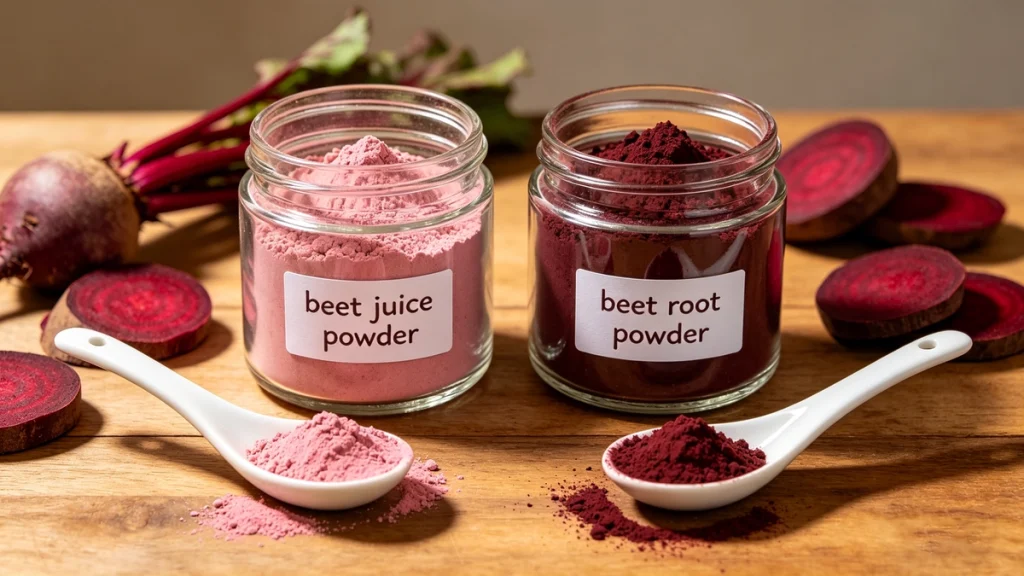
I’m not going to regurgitate the nutrition facts you can find on any random health blog. Instead, I’m going to stand right here at the blending bench and peel back the curtain on these two powders from three angles: physical morphology, processing necessities, and formulation logic.
1. Form Follows Process: One is “Gravel,” the Other is “Hollow Spheres”
Under a microscope, beet root powder and beet juice powder don’t look like they belong to the same family.
Beet Root Powder: Mechanically Milled “Gravel”
The process is brutally simple. Fresh beetroots are sliced, dried, and then thrown straight into a mechanical mill. Whether you use hammer milling or jet milling, the end result is a particle shaped like irregular, jagged shards of rock.
As a formulator, this kind of powder is a headache when it comes to solubility. The particle surface is sharp with a high specific surface area. The moment it hits water, the outer layer swells instantly and forms a gel-like film, trapping the dry powder inside. The result? Clumping and fish eyes. You can stir that cup all day, and you’ll still end up with a puddle of red mud at the bottom. This is dictated by pure physical structure. Even a magician can’t change it.
Beet Juice Powder: Spray-Dried “Hollow Glass Balls”
Beet juice powder follows a fine chemical engineering route. The beet juice is filtered, then atomized through a high-pressure nozzle into tiny droplets that dry almost instantly in a 200°C hot air stream. Achieving this precise hollow sphere morphology isn’t trivial—it demands advanced spray drying OEM capabilities and tight process control throughout the run.
This process creates a very specific microstructure: hollow microspheres.
Think of them as tiny, red ping-pong balls. Because they are spherical, they flow beautifully. Because they are hollow, their density is low, and they disintegrate and disperse instantly upon contact with water. This is the fundamental reason beet juice powder is “cold-water soluble.” It’s not a magic additive; it’s physical morphology beating the pants off mechanical grinding.
Straight Talk from the Formulator: If you open a canister of “all-natural” red powder and it disperses in water instantly like a drop of ink—clear, bright, and sediment-free—it is 100% juice powder, and it was almost certainly made via spray drying. Pure root powder simply cannot do that.
2. The “Non-Negotiable” in the Formula: Why Maltodextrin MUST Be in Juice Powder
A lot of consumers see “Maltodextrin” on the label and immediately assume the manufacturer is cutting corners or scamming them.
As someone who has formulated literally hundreds of tons of beet juice powder, I have to go to bat for this ingredient: In beet juice powder, Maltodextrin is a processing necessity, not a commercial fraud.
Beet juice contains significant amounts of fructose and glucose. What happens to a pure fruit juice droplet when it hits the heat of a spray dryer? It turns into molten sugar syrup. It sticks to the walls of the tower, layer after layer, until the entire batch is ruined and some poor operator has to climb inside with a chisel to scrape it off.
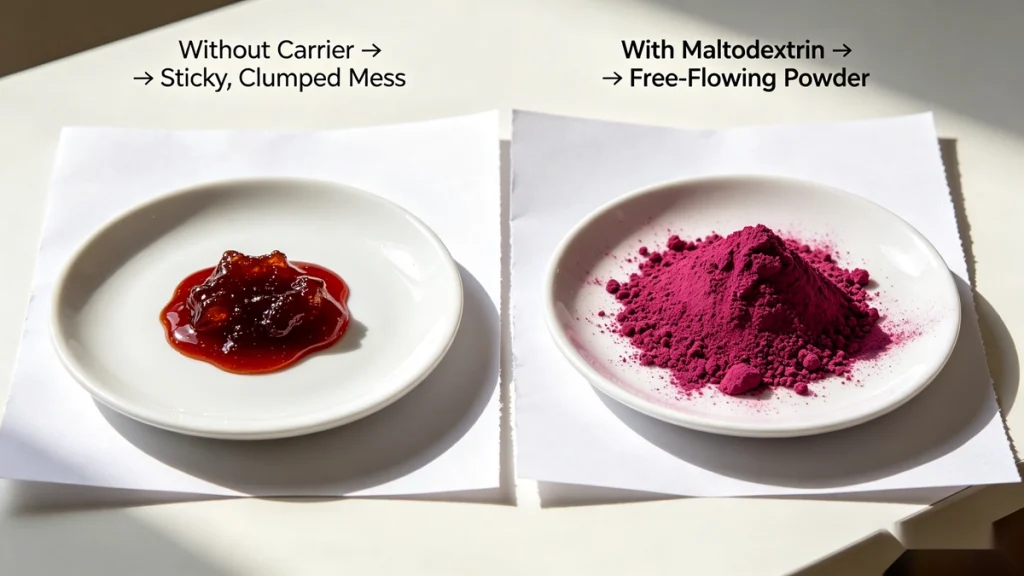
Maltodextrin’s real job here is as a “carrier” and “anti-caking agent.” It has a high glass transition temperature, which essentially “props up” the sugar molecules, allowing the droplet to dry into a free-flowing powder instead of a sticky, gummy mess.
How a Formulator Reads a Supplement Facts Panel:
- You see
Beet Juice Powder, Maltodextrin— That’s proper process engineering. Totally normal. - You see
Beet Root Powderand nothing else — That’s legit too, but it’s going to sink like a stone.
If a product label says Beet Juice Powder but does NOT list Maltodextrin or Gum Arabic as a carrier, I’d raise an eyebrow. Either they used some ultra-premium (read: 3x the cost) freeze-drying tech, or it’s not actually pure juice powder.
3. Why is Juice Powder So Much More Expensive? It’s Not a Markup, It’s Yield Loss
Clients are always trying to negotiate: “Look, root powder is cheap per kilo. Why are you charging me an arm and a leg for juice powder? It’s still beets!”
Every time I hear this, I have to run the numbers for them.
| Comparison Factor | Beet Root Powder | Beet Juice Powder |
|---|---|---|
| Input Material | Whole Beet (All solids retained) | Juice Only (Fiber and pulp discarded) |
| Yield Ratio (Approx.) | 6:1 to 8:1 | 40:1 to 50:1 |
| Excipient Cost | Nearly Zero | Requires 20-30% Carrier Addition |
| Drying Energy | Lower (Tray/Microwave) | High (Spray Drying is energy intensive) |
| Cleanup Downtime | Simple | Labor-intensive (Tower cleaning kills efficiency) |
The Formulator’s Cost Summary: Root powder makes money like a dehydrated vegetable supplier—volume and low margin. Juice powder makes money like a botanical extract manufacturer—high technical barriers and significant processing loss. When brands engage us for custom botanical extraction and toll manufacturing, the cost differential between these two SKUs is one of the first spreadsheets we walk them through. That extra cost you’re paying? You’re buying nitrate concentration and solubility convenience.
4. Real-World Formulation Applications: How I Actually Use These Powders
When a client asks me to develop different product formats, the choice between these two powders is stark and non-negotiable. This is where private label powder manufacturing gets tactical.
1. Instant Drink Mixes / Stick Packs (Where you want a clear, ruby-red solution)
- Use ONLY Beet Juice Powder. Root powder yields a muddy, sediment-heavy mess that looks terrible. Customers will return it thinking it’s spoiled.
- Formulation Headache: Juice powder is incredibly hygroscopic. During packaging, the ambient humidity must be kept strictly below 35% RH in a humidity-controlled packaging environment, or that whole batch of stick packs will turn into red concrete within a week.
2. Tableting / Chewables
- First Choice: Beet Root Powder. The fiber in root powder provides excellent compressibility. It binds well and makes a hard, durable tablet that doesn’t crumble or cap.
- Pitfall to Avoid: Juice powder is high in sugar. It will stick to the die punches like crazy. You’ll end up adding so much Magnesium Stearate to get it to release that the tablet becomes hydrophobic and won’t break down in the stomach. Not worth the hassle.
3. Meal Replacements / Protein Bars
- Blend of Both. Root powder provides the fibrous texture and bulk satiety. Juice powder handles the color correction and delivers the nitrate payload. Research consistently shows that dietary nitrate supplementation improves exercise efficiency, which is why this combination shows up in so many pre-workout and functional food formulations.
The Formulator’s Translation for Shoppers:
- If you plan to mix it with water and drink it, buy the juice powder. Don’t punish your eyes and taste buds.
- If you plan to dump it in yogurt, bake with it, or stir it into oatmeal, buy the root powder. Better value and you get the fiber.
5. The Ultimate BS Detector: Shake, Feel, Taste
I work with powders all day. Here are three tool-free methods to know exactly what’s in that bag.
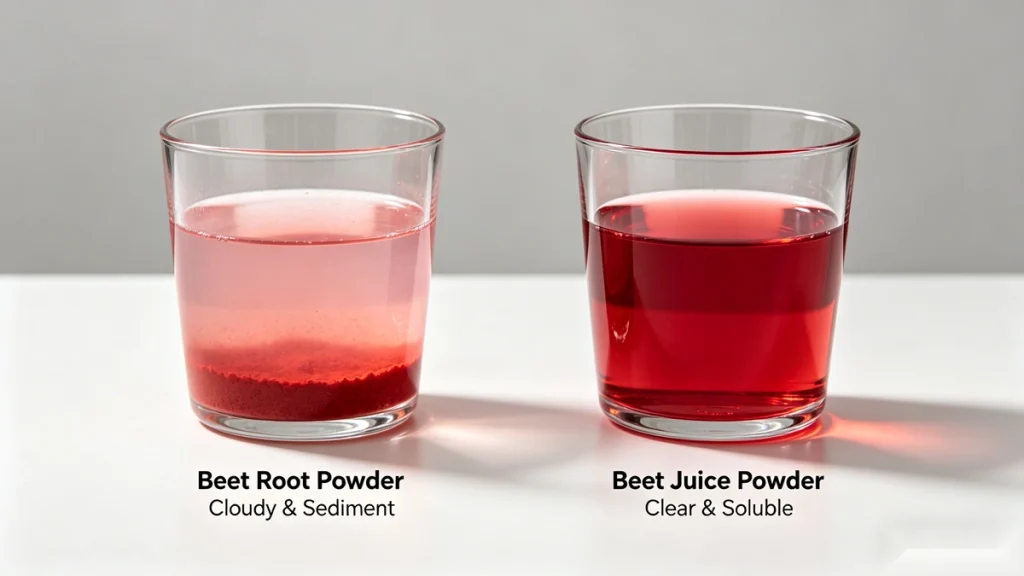
Step 1: The Cold Water Shake (Physical Sedimentation Test)
- Root Powder: Water turns cloudy. Stir and let sit for 5 minutes. A clear line of gritty, mud-like sediment forms at the bottom. The liquid above fades to a pale pinkish-gray.
- Juice Powder: Water becomes a translucent, gem-like ruby red. Let it sit for 30 minutes. Still clear, still bright. (A little foam on top is normal—surface tension).
Step 2: The Finger Rub (Particle Size & Tactile Test)
- Root Powder: Slight gritty feel, like super fine sand or powdered sugar that hasn’t fully dissolved.
- Juice Powder: Extremely smooth, silky feel, almost like talc or high-end flour. Note: If it’s clumped into hard, unbreakable rocks, it has absorbed moisture. That’s a storage issue, not a powder issue.
Step 3: The Tongue Tip (Flavor Purity Test)
- Root Powder: Heavy earthy, “dirt” notes. The finish is astringent and slightly bitter. That’s geosmin—the compound that makes beets taste like a garden. It’s normal.
- Juice Powder: Clean sweetness upfront, bright acidity, almost zero earthy aftertaste. Warning: If it tastes sharply sour or fermented/funky, the raw juice sat too long before drying. That’s a sub-par batch.
Final Thoughts from the Bench
There is no universal “better” between beet root powder and beet juice powder. There is only different destinies in the eyes of a formulator.
One is a dehydrated copy of nature, retaining the weight of the soil. The other is an industrial extraction, presenting the clarity of a gemstone.
If you’re chasing peak nitrate concentration per gram and a pleasant drinking experience, take my advice: go with the juice powder. If you value dietary fiber and unbeatable cost-effectiveness, beet root powder is still the honest, hard-working choice.
Whether you’re formulating the next big pre-workout or just trying to upgrade your morning smoothie, understanding what’s actually in that red powder changes everything. And if you’re a brand looking to bring a beet-based product to market, you can explore our full range of functional powders or talk to us about OEM and ODM manufacturing—we’ve been in the blending room long enough to know what works and what clogs the funnel.
Don’t let the marketing spin confuse you. Look at the physics of the powder, and you’ll know exactly where your money is going.
FAQ
1. Which has more nitrates: beet juice powder or beet root powder?
Beet juice powder. Hands down.
By weight, spray-dried beet juice powder typically delivers 80-120 mg of nitrates per gram. Beet root powder clocks in around 20-40 mg per gram. This is simple math—the juice extraction process concentrates the soluble actives while discarding the fiber bulk. If you’re chasing vasodilation and that pre-workout pump, juice powder gives you more bang for your scoop.
2. Why does beet root powder clump and sink while beet juice powder dissolves clear?
This has nothing to do with quality and everything to do with particle geometry.
Beet root powder is made by mechanical grinding. The particles look like jagged, irregular gravel under a microscope. They sink and form sediment. Beet juice powder is spray-dried into hollow, spherical microspheres. They’re basically tiny red balloons that disperse instantly. It’s physics, not marketing.
3. Is maltodextrin in beet juice powder just a cheap filler?
No. It’s a processing necessity, not a scam.
Pure beet juice contains high levels of fructose and glucose. If you spray-dry 100% juice without a carrier, it turns into sticky, molten sugar that ruins the equipment and yields a brick of hard candy, not a powder. Maltodextrin is the carrier that prevents this. Without it, you can’t make a shelf-stable, free-flowing juice powder at a reasonable cost. If you see a juice powder claiming “no maltodextrin,” be skeptical—it’s likely either freeze-dried (expensive) or it’s just beet root powder with clever labeling.
4. Can I use beet root powder as a pre-workout like beet juice powder?
You can, but you’re leaving performance on the table.
Beet root powder works slower because the nitrate release is trapped within a fibrous matrix. Beet juice powder hits the bloodstream in 60-90 minutes with a sharper peak. If you’re doing a serious training session or race, I’d steer you toward the juice powder. If you’re just looking for daily cardiovascular support and don’t care about timing, the root powder is fine.
5. How should I store beet juice powder?
Treat it like brown sugar on a humid summer day.
Beet juice powder is extremely hygroscopic. Once you open the tub, keep it sealed tight with a desiccant pack. Do not store it in the fridge. The condensation from opening and closing a cold container will turn it into a solid red brick within two weeks. A cool, dark pantry is your best bet.
6. What’s the real difference in cost between the two?
Root powder is a dehydrated vegetable. Juice powder is a botanical extract.
The yield ratio for juice powder is brutal—about 40-50 lbs of raw beets to make 1 lb of powder, compared to about 6-8 lbs for root powder. Add in spray drying energy costs and carrier material, and the price gap is justified. You’re paying for nitrate concentration and dissolution convenience. If you’re just adding it to a smoothie bowl, save the money and buy root powder. If you’re drinking it straight, buy the juice powder. You’ll actually enjoy it.