Most supplement brands don’t lose a halal deal because the factory lacked a certificate. They lose it because an importer, a retailer, or a regulator asked for the gelatin supplier’s halal slaughter documentation — and nobody had it.
That’s the difference between a factory that says it’s halal and one that actually runs halal-compliant production. If you’re searching for a halal supplement manufacturer, what you really need isn’t a logo on a website. You need a partner who can walk you through ingredient sourcing, capsule shell verification, cross-contact controls, and the documentation package before a single sample is made.
This guide covers what to verify, what to ask for, and where most halal supplement projects hit avoidable problems.
What a Halal Supplement Manufacturer Actually Controls
Halal supplement manufacturing goes well beyond “no pork, no alcohol.” Those are the starting line, not the finish. A legitimate operation manages six layers of control:
- Ingredient origin — Every active, excipient, flow agent, and encapsulation material needs a documented halal status. One excipient with an ambiguous animal source compromises the entire batch.
- Processing aids — Solvents, release agents, and anti-foaming compounds that never appear on the label can still break halal compliance if they’re ethanol-based or animal-derived.
- Capsule shell sourcing — This is where most compliance gaps show up. A factory-level halal certificate doesn’t automatically cover the capsule supplier’s gelatin. You need the shell supplier’s documentation separately.
- Cross-contact control — Shared equipment running non-halal products requires validated cleaning protocols. If a line produces porcine gelatin softgels on Monday and claims to run halal bovine softgels on Tuesday, the cleaning validation needs to be documented — not assumed.
- Label and artwork governance — Halal logo placement and claims on packaging must match what the certification body actually approved. Unapproved logo usage creates liability.
- Batch-level documentation — Every production run needs traceable records: supplier halal certificates, COAs, and manufacturing logs, retained for audit.
None of this is theoretical. These layers get tested every time a shipment reaches a customs desk or a retailer’s compliance team opens the file.
Why Private Label Buyers Search for Halal Manufacturing
After working through hundreds of halal supplement inquiries, three buyer profiles show up consistently:
A brand wants to launch halal gummies or capsules for Muslim consumers. This buyer usually has a concept and a target market but hasn’t mapped the formula against halal risk. The first real conversation almost always turns to gelatin, glycerin, and flavor systems.
A distributor needs halal documentation for Southeast Asia or the Middle East. The product itself may already exist. The challenge is paper-based: the importer requires a halal certificate, ingredient-level declarations, and export documents, and the current manufacturer either can’t provide them or doesn’t understand what’s being asked for.
An existing formula needs to be converted into a halal-compliant version. This is the detail-heavy scenario. Magnesium stearate sources get swapped, gelatin becomes pectin or HPMC, ethanol-based flavor carriers get replaced, and every supplier change triggers a new documentation trail. One ingredient substitution can cascade into five new supplier documents to verify.
In all three scenarios, the buyer’s core need is the same: a manufacturer who can explain how halal compliance is maintained throughout production, not just point to a certificate on the wall.
Supplement Formats and Their Halal Risks
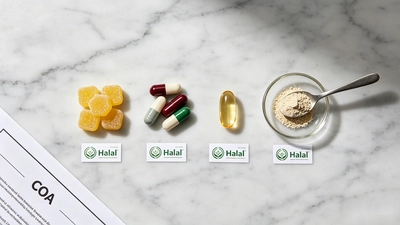
The dosage form determines where the halal risk concentrates. During formula review, here’s what gets checked for each format:
| Supplement Format | Main Halal Risk | What to Verify Before Production |
|---|---|---|
| Gummies | Gelatin source, glazing oil, flavors, colors | Pectin base preferred; halal flavor documentation; no animal-derived coating or carmine (E120); confirm glazing agent is plant-based |
| Capsules (hard) | Gelatin shell vs. HPMC shell, capsule colorants | Shell supplier halal certificate; bovine gelatin requires halal slaughter documentation; HPMC generally lower risk but still verify supplier docs |
| Softgels | Gelatin, glycerin, fill oil source | Gelatin origin and slaughter method; glycerin must be plant-based or halal-certified synthetic; fish oil or other fill oil specification and COA |
| Powders | Protein source, enzymes, probiotic culture media, flavors | Ingredient origin documentation; carrier and flow agent halal declarations; allergen statement; halal certificate for any enzyme or probiotic material |
| Liquid Drops | Ethanol, glycerin, botanical extraction solvent | Solvent declaration for every extract; preservative system review; carrier must be halal-compliant |
| Tablets | Coating, magnesium stearate, colorants, flavors | Magnesium stearate source (plant vs. animal); coating material halal status; excipient documentation for binders and disintegrants |
Gummies and softgels tend to generate the most back-and-forth during halal reviews. Gelatin is the single highest-risk ingredient in the supplement supply chain — it can be porcine (haram), bovine from non-halal slaughter, or bovine with proper halal documentation. If a manufacturer can’t trace gelatin all the way back to a halal-certified slaughter source, everything downstream is questionable.
For a closer look at how gummy production handles these constraints, see how gummy supplement manufacturing supports halal and clean-label formulations. Capsule shell sourcing is covered in more detail on our capsule supplement manufacturing page, and the ingredient verification process for powders is outlined under powder supplement manufacturing .
The Pre-Production Document Checklist
If there’s one section to bookmark, it’s this one. The documents you request before production starts determine whether your halal claim holds up under scrutiny.
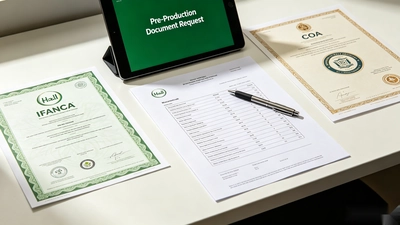
Ask for these before committing to a production run:
- Halal certificate copy — the full document, not just a logo. Check the issuing body, company name, factory address, and validity date.
- Certificate scope — does the certificate explicitly cover your dosage form? A halal certificate for tablets doesn’t automatically extend to softgels. This is one of the most commonly overlooked gaps.
- Ingredient-level halal declarations — for every active and every excipient. A factory-level certificate alone is insufficient.
- Certificate of Analysis (COA) — batch-level verification of potency, purity, and microbial safety. A complete COA isn’t just a formality; if you’re unsure what to look for, here is a breakdown of supplement COA documentation that explains the key sections.
- Formula sheet — full ingredient breakdown with supplier names and part numbers.
- Specification sheet — physical, chemical, and microbiological parameters for the finished product.
- Raw material origin documents — country of origin and supplier traceability for high-risk ingredients.
- Allergen statement — halal-conscious consumers often require allergen transparency as well.
- GMO statement — increasingly expected in halal-oriented markets.
- Certificate of Free Sale (CFS) — required for export clearance in many countries.
- Certificate of Origin — needed for customs and duty calculations.
- Batch production records — available on request for larger orders.
- Packaging artwork approval form — written confirmation that halal logo placement and claims match the certification scope.
- Label claim review — verification that any “halal” claim on the label is fully substantiated.
A manufacturer’s underlying quality system determines how consistently these documents are available at the batch level. Certifications like GMP, FSSC 22000, HACCP, and BRCGS aren’t just wall decorations — they create the operational discipline that makes halal documentation reliable rather than something you have to chase. You can review how these systems interlock on our supplement manufacturer certifications page.
How to Verify a Halal Certificate Before Choosing a Factory
A halal certificate that looks legitimate at first glance might not survive five minutes of real scrutiny. Here’s what to check:
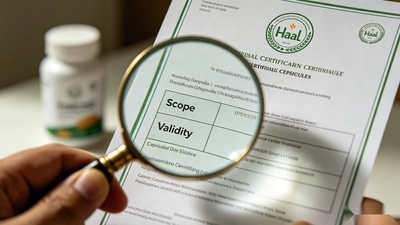
1. Issuing body. Is it a recognized halal certification authority? In North America, IFANCA and AHF carry the most weight with major retailers. Different bodies matter for different markets.
2. Company name and factory address. The name on the certificate must match the entity that will actually manufacture your supplements. A trading company’s certificate means nothing if a different factory is doing the production.
3. Validity dates. Certificates expire. Confirm the document is current and note the renewal date.
4. Product category and scope. The certificate should explicitly list supplements, nutraceuticals, or health products on its scope. Food certificates don’t automatically translate to supplements.
5. Dosage form coverage. Confirm the certificate covers your specific format — gummies, capsules, softgels, powders, or whatever you’re ordering. Scope gaps here are common.
6. Ingredient-level documentation availability. A facility certificate is step one. The real verification happens at the raw material level. Ask the manufacturer directly: can you provide halal declarations for every ingredient in my formula?
Regional Requirements: BPJPH, JAKIM, and Beyond
If your brand is targeting specific markets, the certification landscape becomes more layered.
BPJPH (Indonesia): For brands entering Indonesia, BPJPH compliance is the central requirement. Under Law No. 33/2014, supplements fall under mandatory halal certification, with the compliance deadline set for October 17, 2026. Products must satisfy both BPOM safety regulations and BPJPH halal certification requirements in parallel. Brands should confirm early whether their manufacturer’s certification is recognized by BPJPH and understand the import registration pathway for their product category. A deeper walkthrough is available on our BPJPH halal certification for supplements page. The official BPJPH halal certification framework provides the current regulatory baseline, and the International Trade Administration offers additional context on Indonesia’s halal product assurance requirements for supplements , including mandatory compliance timelines.
JAKIM (Malaysia): JAKIM recognition is widely referenced in the Malaysian market. While not always mandatory for imports, JAKIM-recognized certification can significantly streamline the importer’s registration and retailer acceptance.
Middle East (GCC): Requirements vary by country and local authority. Some GCC markets accept certificates from recognized foreign bodies; others require country-specific certification. Always confirm with the local importer before finalizing a certification strategy.
One certificate does not cover all markets. If your brand plans to distribute across Indonesia, Malaysia, and the Middle East, factor in potential multi-certification requirements early in the planning process.
Inside a Halal Formula Review
A halal supplement project shouldn’t start with sample production. It should start with a formula review that catches compliance issues while they’re still cheap to fix.
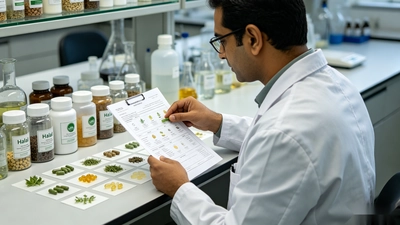
Here’s how our quality and R&D teams handle it:
Step 1 — Formula screening. Every ingredient that carries halal risk gets flagged: gelatin, glycerin, flavor carriers, ethanol-based extracts, animal-derived enzymes, and any excipient with an ambiguous source.
Step 2 — Dosage form recommendation. Based on the formula profile and target market, we recommend the most appropriate format — gummies, capsules, softgels, powders, drops, or tablets — with halal risk factored into that recommendation, not treated as an afterthought.
Step 3 — Supplier document verification. For every high-risk ingredient, we confirm that the supplier can provide a halal declaration, COA, and specification sheet. If a supplier can’t produce the necessary documents, we source a compliant alternative before the formula is locked.
Step 4 — Sample development. R&D produces samples using verified halal-compliant ingredients. Base, flavor, color, and texture are adjusted within halal constraints. No corners cut on documentation just to speed up a sample shipment.
Step 5 — Batch documentation package. After production, the buyer receives the COA, specification sheet, halal certificate, export documents, and any additional paperwork required by the destination market.
This workflow exists for one reason: it’s far more expensive to retrofit halal compliance after production than to build it in from the first formula review.
Red Flags When Sourcing Halal Supplements
When evaluating a manufacturer’s halal claims, certain signals should stop you in your tracks:
- The factory shows a halal logo but can’t produce the actual certificate.
- The certificate is in a trading company’s name, not the factory’s.
- The certificate address doesn’t match the production site.
- The scope doesn’t cover supplements or your specific dosage form.
- Gelatin is described as “bovine” with no slaughter documentation. Bovine alone is not enough — halal slaughter verification is what matters.
- Flavor or coating suppliers can’t provide halal documentation. Flavors frequently use ethanol carriers; coatings may contain shellac or insect-derived ingredients.
- The factory claims “natural ingredients are automatically halal” without document review. Natural doesn’t mean halal. Ethanol is natural. Porcine-derived materials are natural. Documentation is what counts.
- The factory places a halal logo on packaging without formal approval. Logo usage must be backed by a valid certificate with matching scope.
- The factory can’t explain cross-contact controls on shared lines. If non-halal products run on the same equipment, validated cleaning protocols are non-negotiable.
- The formula changes after certification review without re-approval. Any ingredient substitution post-certification can invalidate the halal status.
Each of these has caused real problems for real brands. They’re avoidable if you know what to look for early.
Halal Supplement Manufacturing Capabilities
When developing halal supplements, the manufacturing partner needs to cover the formats your brand requires while maintaining documentation discipline across all of them. Our halal-compatible production includes:
- Gummies — pectin-based formulations with halal flavor and color systems
- Capsules — HPMC (plant-based) and halal-certified bovine gelatin options
- Softgels — halal-certified gelatin with plant-based glycerin and verified fill oils
- Powders — protein blends, greens, and functional powders with documented ingredient origins
- Tablets — halal-compliant coatings, binders, and excipients
- Liquid drops — alcohol-free extraction solvents and halal carrier systems
Beyond formats, we support custom formula development, private label packaging, and flavor or texture adjustment within halal parameters. Every project includes the full documentation package: COA, specification sheet, halal certificate, Certificate of Free Sale, Certificate of Origin, and any market-specific documents required. Standard production lead time runs 25–30 working days, with urgent order support available for qualified projects.
Is a Halal Manufacturer Right for Your Brand?
Not every supplement brand needs halal certification. But if any of the following applies, engaging a manufacturer with established halal capabilities early will save you time and compliance risk:
- You’re targeting Indonesia, Malaysia, GCC countries, or Muslim consumer segments in any market.
- You’re launching private label halal gummies, capsules, or softgels.
- Your distributor requires halal documentation for import clearance.
- You’re converting an existing formula into a halal-compliant version.
- You’re selling on marketplaces where halal positioning differentiates your brand.
- You want to avoid the ambiguity of “probably halal” ingredients on your label.
If you’re developing halal gummies, capsules, powders, softgels, or liquid supplements, we can review your formula, dosage form, packaging plan, and document requirements before sampling begins. That review surfaces any compliance gaps while there’s still time to address them — without cost or timeline surprises.
Frequently Asked Questions
What is a halal supplement manufacturer?
A halal supplement manufacturer is a contract manufacturer that produces dietary supplements — gummies, capsules, softgels, powders, tablets, and liquids — using halal-compliant ingredients, processes, and documentation. This means verifying every raw material source, preventing cross-contamination with non-halal substances, and providing auditable records including halal certificates, ingredient declarations, and batch-level COAs. A factory-level certificate is the starting point, not the full story.
What documents should buyers request before production?
The essentials: halal certificate with scope details, ingredient-level halal declarations, batch COA, formula sheet, specification sheet, raw material origin documents, allergen statement, GMO statement (if relevant), Certificate of Free Sale, and Certificate of Origin. For larger orders, batch production records should also be available.
Is BPJPH required for supplements sold in Indonesia?
Supplements are subject to Indonesia’s mandatory halal certification framework, with a compliance deadline of October 2026. Brands should verify early whether their manufacturer’s certification is BPJPH-recognized and understand the import registration pathway. Detailed guidance is available on our BPJPH certification page and through official BPJPH resources.
What is Ketetapan Halal and how does it relate to supplement manufacturing?
Ketetapan Halal refers to the halal determination or decree issued within Indonesia’s certification process. For supplement manufacturing, it relates to how a product’s halal status is formally established through BPJPH’s ingredient review, audit, and final determination. We cover this in more detail on our KETETAPAN HALAL certification page.
How can a brand quickly verify a halal certificate?
Check five things: the issuing body’s recognition, the company name and factory address match, the validity date is current, the scope covers supplements and your dosage form, and the manufacturer can produce ingredient-level halal declarations upon request. A certificate that fails any of these checks needs further investigation before you commit.