1. Introduction: Why Choosing the Right Creatine Manufacturer Determines Your Success
In the global sports nutrition industry, creatine remains one of the highest-volume raw materials—yet also one of the most inconsistent in terms of quality, purity, and supplier transparency. For brands, wholesalers, and private-label companies, the single most important step before launching or scaling a creatine product is choosing the right Creatine Manufacturer.
But the challenge is real: many suppliers present themselves as “factories” while operating only as trading companies with no production facilities, no quality systems, and no real control over the raw materials they sell. As a result, buyers frequently face issues such as unstable purity levels, unsafe impurity profiles, missing certifications, inconsistent lead times, or product recalls.
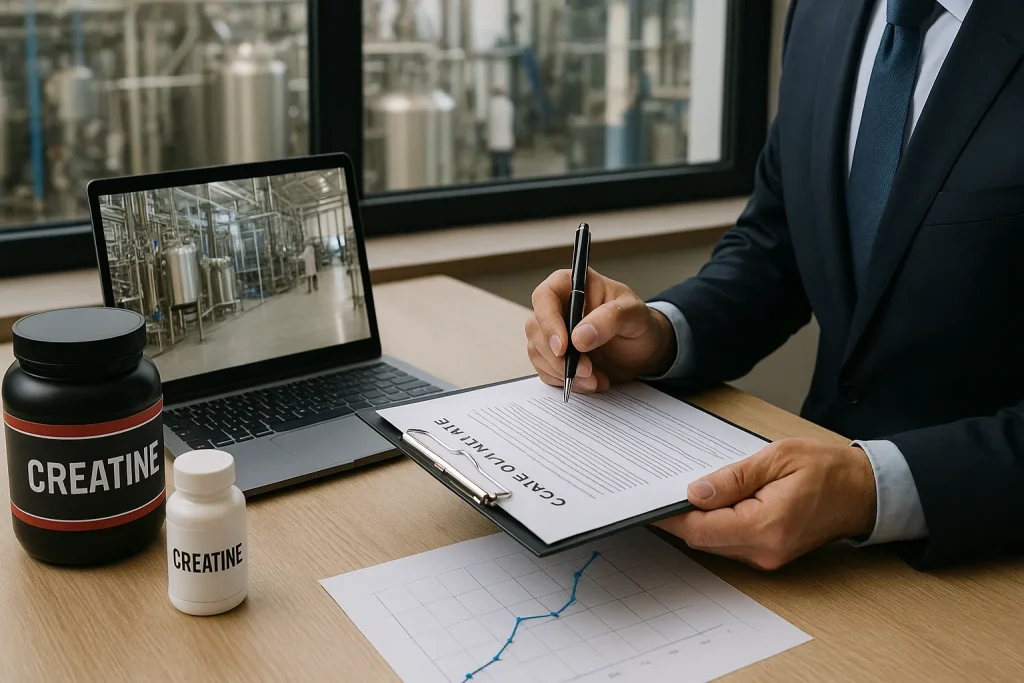
To help brands avoid these risks, this guide breaks down the five essential factors every buyer must evaluate—presented in a practical Q&A format so you can use each section as an internal checklist when screening suppliers.
2. Q&A: The Five Critical Factors to Identify a Reliable Creatine Manufacturer
Q1. What certifications must a real creatine manufacturer provide?
A reliable creatine manufacturer should never hesitate to show proof of compliance. Industry-grade certifications demonstrate that the company operates a legitimate production site and follows recognized global standards. More importantly, certifications help brands avoid regulatory issues when exporting finished dietary supplements to the U.S., EU, Southeast Asia, and the Middle East.
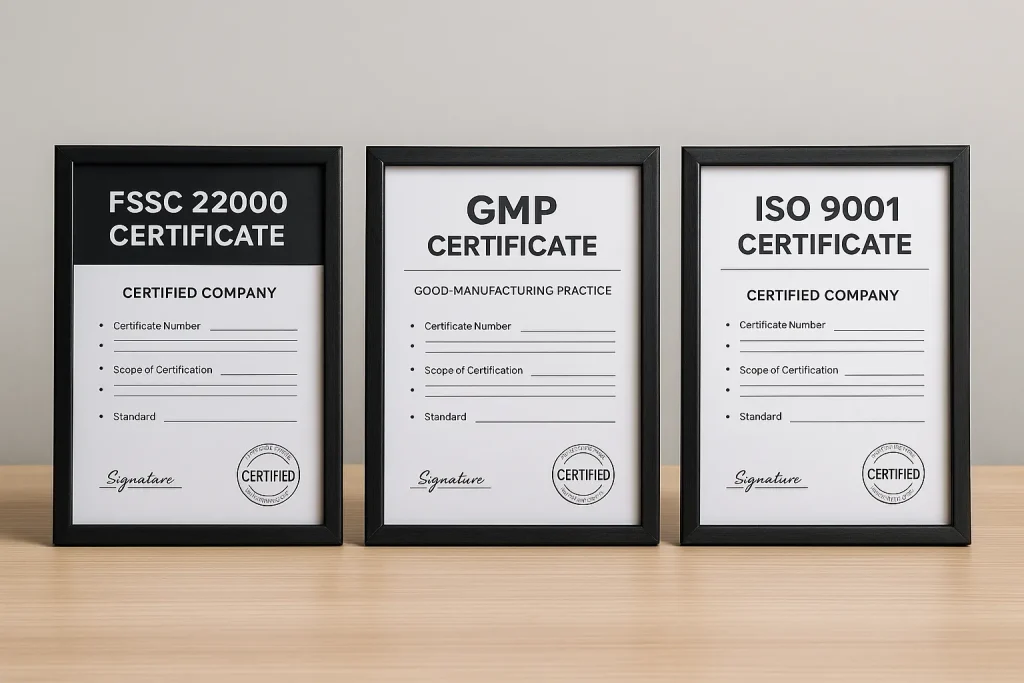
Key Certifications to Request and Why They Matter
1. FSSC 22000
One of the strictest global food safety frameworks.
It confirms that the entire production environment—from raw material handling to packaging—meets internationally aligned food safety controls.
2. GMP (Good Manufacturing Practice)
Ensures standardized production rules, controlled sanitation procedures, and quality consistency.
Essential for any brand launching finished creatine products.
3. ISO 9001 Quality Management
Demonstrates continuous improvement and strict documentation systems.
Manufacturers with ISO 9001 rarely produce unstable batches.
4. HACCP
Verifies that the manufacturer has risk-control protocols in place for contamination, impurities, and critical control points.
5. Halal & Kosher Certifications
Required for major markets such as the Middle East and Israel.
Even for Western markets, these certifications help reinforce purity and cross-contamination control.
How to Spot Fake or Misleading Certifications
- The certificate lists an office address instead of a factory site.
- The certificate is expired or missing a validity date.
- Certification body is unknown or non-accredited.
- Supplier refuses to send a PDF copy with registration numbers.
A real creatine manufacturer will always share official documents proactively.
Q2. How can you verify whether the supplier actually operates a real manufacturing facility?
This is one of the most important questions every buyer must ask. The fastest way to avoid problems is to confirm whether the “supplier” is a true Creatine Manufacturer—or just a trading company reselling creatine sourced from other factories.
What to Request From Real Manufacturers
1. Factory Walkthrough Videos
Modern facilities always provide high-resolution videos showing:
- Reaction kettles
- Filtration systems
- Drying units
- Packaging lines
- On-site laboratories
Traders typically cannot provide this.
2. Production Line Photos
Look for images showing workers in PPE, industrial reactors, and QC labs.
Avoid suppliers who send “white background stock images.”
3. Government Business License
Verify whether the license clearly states “manufacturing” scope, not “trading.”
4. Google Maps Verification
Factories should be located in industrial zones, not office buildings.
This is one of the quickest ways to spot a fake “factory.”
5. An Open Invitation to Visit
Authentic manufacturers always welcome on-site audits.
Trading companies will delay or avoid visits.
Red Flags That Indicate a Trader
- “We cannot show you the production area due to confidentiality.”
- Documents with inconsistent addresses.
- No batch-specific CoA for creatine monohydrate or HCl.
- Only offer extremely low MOQ—indicating they don’t manage production.
If a supplier tries to hide their facility, they likely don’t have one.
Q3. Why are R&D capabilities and QC testing essential when selecting a creatine manufacturer?
Creatine production is a chemically intensive process that requires controlled synthesis, impurity monitoring, and strict drying conditions. Without scientific oversight, creatine can develop harmful contaminants such as:
- Creatinine
- DHT (Dihydro-1,3,5-triazine)
- Cyanamide
- Heavy metals
These impurities directly affect safety and legality in global markets.
A Qualified Creatine Manufacturer Must Have:
1. Fully Equipped Laboratory
Look for equipment such as:
- HPLC
- UV spectrophotometer
- Moisture analyzer
- ICP-MS for heavy metal testing
- Microbial incubators
- pH meters
Without this equipment, the manufacturer cannot guarantee purity.
2. Batch-Specific QC Documentation
Every batch must include a complete Certificate of Analysis (CoA) showing:
- Purity (typically ≥ 99.5%)
- Creatinine levels
- DHT (should be ND)
- Heavy metals
- Microbial values
- Loss on drying
3. Technical Specialists
A real manufacturer has in-house chemists and QC engineers—not just salespeople.
4. Third-Party Testing When Requested
Reputable suppliers can provide SGS, Intertek, or Eurofins test results when required.
Questions to Ask the Supplier
- “What impurities do you test for in creatine monohydrate?”
- “How do you ensure creatine stability during production?”
- “Can you share an anonymized CoA of your last three batches?”
- “Do you test raw materials and finished products in-house?”
Any hesitation is a warning sign.
Q4. What should you expect in terms of MOQ and OEM/ODM services from a real creatine manufacturer?
MOQ (Minimum Order Quantity) and customization capability are strong indicators of whether a supplier manages physical production or simply purchases from multiple factories.
Authentic Creatine Manufacturers Will Offer:
1. Reasonable MOQ
Typical MOQ ranges include:
- 25 kg bag (standard raw material MOQ)
- 500–1000 kg bulk orders
- 3,000–10,000 bottles for private label packaging
Low MOQ is not always bad—but it often indicates a reseller.
2. OEM (Private Label) Services
- Customized bottles and jars
- Labels with brand artwork
- Packaging size options: 250 g, 500 g, 1 kg
- Athlete-targeted, vegan, clean-label branding
3. ODM Formulation Services
Advanced factories can help you develop:
- Creatine monohydrate blends
- Creatine with electrolytes
- Pre-workout combinations
- Creatine tablets or capsules
4. Transparent Lead Time
Established manufacturers follow stable production cycles and can clearly state:
- Production time
- Packaging time
- Lab testing duration
- Shipping schedules
Trading companies frequently change delivery times or go silent after receiving deposits.
Q5. How do communication quality and transparency reveal a supplier’s reliability?
Communication is often the biggest indicator of whether a supplier can support long-term business.
Reliable Creatine Manufacturers Will:
- Respond clearly and professionally
- Provide regulatory documents immediately (CoA, MSDS, TDS)
- Explain production timelines without vague language
- Provide competitive but stable pricing
- Offer solutions before problems arise
- Share product testing results willingly
Unreliable Suppliers Will:
- Delay sending documents
- Send incomplete CoAs
- Claim test results are “not available yet”
- Avoid answering questions directly
- Change prices frequently
- Provide conflicting information
In B2B partnerships, good communication is part of quality control.
3. Final Checklist: How to Evaluate a Creatine Manufacturer (Print-Friendly)
Certification Check
✓ FSSC 22000
✓ GMP
✓ ISO 9001
✓ HACCP
✓ Halal / Kosher
Factory Verification
✓ Real production photos
✓ Walkthrough videos
✓ Google Maps location
✓ Business license showing manufacturing scope
✓ On-site audit available
Quality Control
✓ HPLC, ICP-MS, and lab equipment
✓ Full CoA with purity + impurity profiles
✓ Third-party test results available
✓ Strong R&D team
OEM/ODM Capability
✓ Clear MOQ
✓ Packaging customization
✓ Multi-format creatine (powder, capsules, blends)
Professionalism
✓ Fast communication
✓ Transparent pricing
✓ Complete documents
✓ Predictable lead time
Conclusion: A Reliable Creatine Manufacturer Is a Long-Term Competitive Advantage
Choosing the right creatine manufacturer is not only about securing raw material—it is about building a reliable, compliant, scalable supply chain. With the rising global demand for sports nutrition products, your manufacturer becomes part of your brand identity. Their quality is your quality. Their transparency is your transparency.
By applying the five factors in this guide, B2B buyers can avoid common supplier risks and build more stable partnerships with real creatine manufacturers. Brands that are also comparing factories for pre-workout, hydration, protein, or other performance products can use our overview of sports supplement manufacturers to see how production formats, MOQ structures, testing requirements, and project scale differ from one supplier to another.
FAQ
How do I verify if a creatine supplier is a real Creatine Manufacturer?
A genuine Creatine Manufacturer can provide factory photos, production videos, certifications, and batch-specific CoAs. Traders often avoid showing real equipment or production facilities.
What certifications should a reliable Creatine Manufacturer have?
Look for FSSC 22000, GMP, ISO 9001, and HACCP. These confirm controlled production standards, traceability, and compliance with global food safety regulations.
What quality tests should a creatine manufacturer perform?
A professional manufacturer must run tests for purity, creatinine, DHT, heavy metals, moisture content, and microbial safety using equipment such as HPLC and ICP-MS.
Why do MOQ and OEM capabilities matter when choosing a Creatine Manufacturer?
Clear MOQ policies and professional OEM/ODM services indicate real production capacity. Manufacturers with consistent packaging, labeling, and formula support are more reliable partners.
What are the biggest red flags when evaluating a creatine supplier?
No certifications, stock photos, missing CoAs, inconsistent pricing, slow communication, and refusal to provide factory proof are all signs the supplier is not a real Creatine Manufacturer.