If you are developing high-dose gummies, the real constraint is not marketing claims.
It is physics.
Understanding the maximum active load pectin gummies can reliably stabilize is one of the most common failure points in private label projects—especially for creatine, caffeine, and other dense actives.
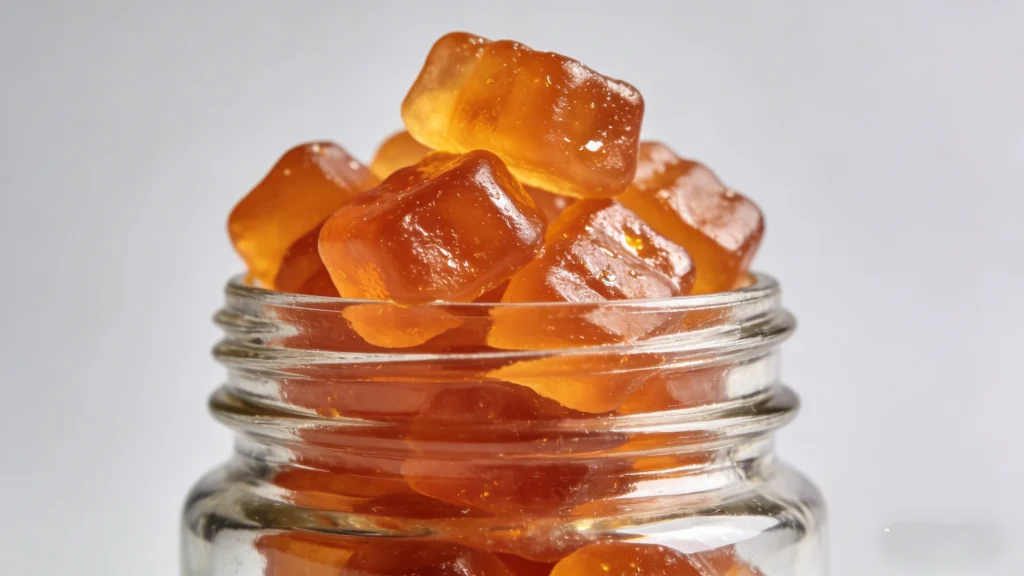
This article breaks down where pectin systems reach their limits, why many formulations collapse during scale-up, and what buyers should realistically expect before approving production.
Why “Maximum Active Load” Is a Manufacturing Question, Not a Label Question
Many buyers approach active dosage from a label-first mindset:
- “Can we fit X mg per gummy?”
- “Can we reduce serving size?”
- “Can we match capsule dosages?”
In pectin gummies, this approach often leads to instability.
This is why buyers evaluating a GMP certified gummy manufacturer often assess formulation feasibility before approving label claims.

Active load is constrained by:
- Solids content limits
- Water activity thresholds
- Gel network strength
- Thermal exposure during depositing
A high active pectin gummy manufacturer evaluates feasibility before numbers appear on a label.
The Physical Limits of Pectin Gummy Systems
Unlike gelatin, pectin forms a gel network through acid and sugar interactions.
This creates inherent constraints.
Key limiting factors include:
1. Total Solids Saturation
Pectin gummies require a balanced solids matrix.
As active load increases:
- Syrup viscosity rises sharply
- Depositing accuracy drops
- Air entrapment increases
At a certain point, the system cannot maintain uniform dispersion.
2. Water Activity and Stability
High active loading often displaces functional sugars.
This affects:
- Water binding capacity
- Shelf-life stability
- Microbial resistance
Reducing sugars too aggressively to “make room” for actives often backfires.
3. Particle Suspension and Sedimentation
Dense actives such as creatine tend to settle.
Without proper particle control:
- Top-to-bottom dosage variance increases
- Gummies fail content uniformity tests
- COA results become inconsistent
This is why micronization and dispersion strategy matter as much as total dosage.
Learn more about creatine micronization for gummies and how particle size affects suspension stability.
Practical Active Load Ranges Buyers Should Expect
There is no universal maximum, but reliable ranges exist when stability and manufacturability are prioritized.
In pectin systems:
- Low-density botanical extracts allow higher percentage loading
- Crystalline actives reach limits faster
- Stimulants amplify flavor and stability challenges
Buyers should evaluate feasibility per active category, not per product concept.
Attempting to force capsule-level dosing into pectin gummies often results in:
- Texture collapse
- Phase separation
- Failed stability testing
Why Pectin Gummies Fail During Scale-Up (Even If Samples Worked)
A common buyer frustration is:
“The sample worked. Production didn’t.”
This happens because:
- Bench samples tolerate higher solids
- Pilot runs expose shear and heat limits
- Full-scale depositing magnifies viscosity problems
High active pectin gummies that survive scale-up are designed with process margins, not just lab success.
The Role of Process Selection in Active Load Stability
Manufacturing equipment matters.
In high active formulations:
- Dosage accuracy becomes sensitive to flow consistency
- Cleanability impacts cross-contamination risk
- Temperature control affects gel setting
This is where process choices—such as starchless depositing systems—become relevant for buyers evaluating consistency.
COA and Stability Testing Implications at High Active Levels
As active load increases, testing scrutiny increases.
Buyers should expect:
- Narrower potency tolerances
- More frequent batch verification
- Finished product COAs, not just raw material COAs
This ties directly back to third-party COA verification practices discussed earlier.
What Buyers Should Ask Before Approving a High-Active Formula
A practical feasibility checklist includes:
- Target mg per gummy vs per serving
- Active density and particle size
- Suspension strategy during depositing
- Stability testing protocol
- COA scope at finished-product level
If a manufacturer avoids these questions, risk increases downstream.
How Jiabei Health Approaches High Active Pectin Gummies
Jiabei Health supports private label buyers developing high active pectin gummy formulations through:
- Feasibility-first formulation review
- Active load optimization rather than maximization
- Micronization and dispersion control strategies
- Process selection aligned with dosage consistency
- Stability and COA planning integrated early
Our approach prioritizes reliable commercialization, not just theoretical dosage targets.
Brands that want a broader view of our pectin formulation, depositing, and QC workflow can also review our gummy supplement manufacturing capabilities.
Where Buyers Typically Go Next
Once active load feasibility is confirmed, buyers usually focus on:
- Taste and bitterness control
- Encapsulation strategies
- Consumer experience at higher dosages
These challenges are addressed in the next technical discussion:
Bitterness Masking for Caffeine Gummies
FAQ
What is the maximum active load pectin gummies can support?
The maximum active load depends on ingredient density, particle size, and formulation balance. Practical limits are defined by stability and dosage consistency rather than label targets.
Why do high active pectin gummies fail during scale-up?
Scale-up introduces higher shear, heat exposure, and flow constraints that can destabilize formulations that appeared stable in lab samples.
Is pectin suitable for high-dose creatine or caffeine gummies?
Pectin can support high active formulations when particle control, dispersion, and process margins are properly engineered.
Do high active gummies require additional COA testing?
Yes. Higher active loads typically require tighter potency verification and finished-product COAs to ensure dosage uniformity.