We regularly receive RFQs that say little more than “bulk pre-workout.”
That can mean 300 kg of finished powder for local filling. It can mean 2,000 finished tubs with labels and scoops. Sometimes it means the buyer has a rough ingredient list and still needs someone to turn it into a product.
Those jobs look similar in an email. They are not similar on the production floor.
A useful quote usually starts with five things: the formula or product concept, serving size, quantity, packaging, and destination market. Without those, a price per kilogram is mostly guesswork.
First, Define What “Bulk” Means for Your Project
For some buyers, bulk means a finished pre-workout blend supplied in larger food-grade bags or drums. They already have a filler or contract packer in their own market.
That setup can work very well.
The manufacturer blends the finished formula. The buyer takes care of retail filling, labels, final packaging, and local distribution.
For other buyers, “bulk” simply means they want to order a commercial quantity. What they actually need is a retail-ready product—1,000 tubs, 5,000 pouches, or another finished format.
Then the project includes much more than powder.
There is filling, scoops, seals, labels, coding, cartons, and packaging setup.
And then there is the third type of inquiry:
6 g citrulline
beta-alanine
caffeine
taurine
watermelon
That is a starting brief, not a production formula.
The exact amounts, serving weight, ingredient forms, sweetener system, flavor, packaging and market requirements still have to be worked out. At that stage, the project is closer to OEM and ODM supplement manufacturing than a simple bulk purchase.
Start With the Serving, Not the Ingredient List
One of the easiest ways to make a pre-workout project unnecessarily expensive is to keep adding ingredients before deciding how large one serving should be.
Take two 30-serving products:
| Product A | Product B | |
|---|---|---|
| Serving size | 8 g | 18 g |
| Net weight | 240 g | 540 g |
| Likely jar size | Smaller | Larger |
| Freight weight | Lower | Higher |
| Flavor work | Easier | Usually harder |
That 10 g difference per serving becomes 300 g per tub.
At 5,000 units, Product B contains 1,500 kg more powder.
That is not a small formulation change. It affects ingredient purchasing, batch size, jar size, freight, scoop size and often the flavor system.
This is why we prefer to discuss the serving early.
A brand may initially say, “We want 6 g citrulline, 3.2 g beta-alanine and 2.5 g betaine.”
Fine.
Those three ingredients already total 11.7 g.
There may still be caffeine, taurine, electrolytes, flavor, acids and sweeteners to add. The final serving can grow quickly.
For U.S. products, serving size also feeds into the Supplement Facts panel. FDA guidance covers serving size, servings per container and declared dietary ingredient amounts, so it is worth fixing the basic serving structure before the artwork is locked. See the FDA guidance on Supplement Facts labeling.
High-Dose Formulas Come With Trade-Offs
There is nothing wrong with a high-load pre-workout.
The problem starts when a brief asks for everything at once:
high doses, small scoop, low cost, natural sweeteners, mild taste, premium ingredients and a low MOQ.
Those goals do not always cooperate.
A higher active load often means a larger scoop and container. It gives the flavor system less room to work. It adds freight weight. If several specialty ingredients are involved, sourcing gets more complicated as well.
We sometimes see formulas where the label has grown faster than the product concept.
An ingredient was added because a competitor uses it. Another was added because it looks good on the Supplement Facts panel. Then another branded raw material goes in.
By the time the formula reaches manufacturing, the product is harder to flavor, harder to source and more expensive—but the positioning is not necessarily clearer.
A shorter formula is not automatically better. A longer one is not automatically better either.
The useful question is whether each ingredient has a reason to be there.
Flavor Is Usually Where the Real Development Starts
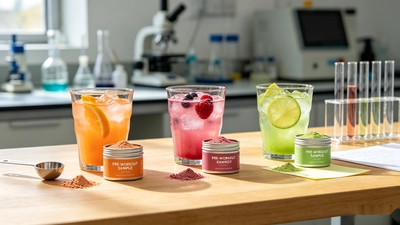
Blending powder is not normally the difficult part.
Making a high-load pre-workout taste like something a customer wants to drink every day can be.
Raw materials bring their own taste. Some are bitter. Some are acidic. Others have mineral, earthy or lingering notes.
Now add a brief like:
“We want a clean lemon-lime, not too sweet, no sucralose.”
That is a real formulation job.
A flavor that works well in one pre-workout can fall apart when the active load changes.
Increase an electrolyte. Change the caffeine source. Add an extract. Increase the serving weight.
The front label may still say lemon-lime, but the base underneath it is different.
Natural sweeteners need to be decided early
A request for stevia or monk fruit is not a simple ingredient swap.
Sweeteners behave differently. Their onset, intensity and aftertaste are different, and they mask bitterness differently.
If “naturally sweetened” matters to the brand, say so before the first sample.
It is much easier to build the flavor around that requirement than to approve a sucralose-based flavor and then try to convert it at the end.
Be specific when you review samples
We get much better results from feedback like:
less sweet, slightly more acidic, reduce the lingering bitterness
than:
can you make it taste better?
The first sample does not need to be perfect. It needs to give the brand and formulator something concrete to adjust.
In practice, a focused second round is often more useful than chasing many small sample variations without a clear target.
Powder Behavior Matters After the Sample Is Approved
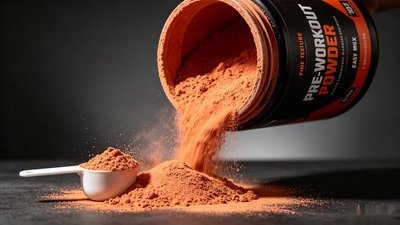
Taste gets most of the attention during development.
Production has other concerns.
A formula also has to blend, move through equipment, fill consistently and remain acceptable after the customer opens the jar.
Bulk density can affect packaging more than many buyers expect. Two formulas with the same net weight can occupy noticeably different volumes.
Particle size matters too. A blend made from materials with very different densities may behave differently during mixing and filling than a relatively uniform powder.
Then there is moisture.
Many pre-workout ingredients are hygroscopic. Under the wrong conditions, powder can pick up moisture and begin to clump.
Packaging barrier, warehouse conditions, desiccant selection and the formula itself all play a role.
This is part of actual powder supplement manufacturing. A formula cannot be judged only by how a 100 g bench sample looks the day it is made.
Bulk Powder or Finished Tubs?
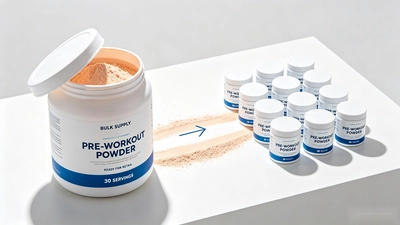
If you already have a reliable filler in your market, bulk powder can be a very sensible way to buy.
You are paying the manufacturer to produce the blend, not to complete the entire retail pack.
For a distributor or established brand, that may reduce packaging freight and give more flexibility locally.
But bulk is not automatically cheaper once the whole project is counted.
A brand still needs:
- retail packaging;
- filling;
- labor;
- local quality procedures;
- warehousing;
- coordination between suppliers.
For a new brand with no local packer, those extra handoffs can become more expensive than expected.
Finished tubs cost more from the manufacturer because more work is included. But one supplier handling powder, filling and packaging may still be the simpler commercial decision.
We have seen both models make sense.
It depends on the buyer’s supply chain, not on the word “bulk.”
Stick packs should be decided early
Stick packs are useful for trial products, gyms, travel formats and single-serving concepts.
They are not just smaller pouches.
The filling format, film, seals, print setup and unit cost are different enough that they should be discussed before the formula and pack size are finalized.
Why Price per Kilogram Tells You So Little
A buyer may ask:
What is your bulk pre-workout price per kg?
It is understandable. A kilogram price is easy to compare.
But it can be misleading.
One kilogram of a basic formula using widely available ingredients and one kilogram of a high-load formula using specialty raw materials are both one kilogram.
The cost structure is not remotely the same.
A useful quotation needs the formula, serving size, quantity, packaging and target market.
Even a rough brief helps.
For example:
30 servings
around 14 g per serving
moderate caffeine
lemon-lime
1,500 tubs
U.S. market
That is enough to start asking useful questions.
“Best pre-workout, best price” is not.
Work Backward From the Retail Price
This part of product development is often left until too late.
Suppose the planned retail price is $39.99.
That $39.99 still has to absorb manufacturing, packaging, freight, fulfillment, platform fees, distributor margin, marketing and discounting.
The formula does not get the whole retail price.
If the brand already knows its acceptable landed cost, formulation becomes easier.
Maybe 6 g of a hero ingredient matters more than custom printed packaging on the first run.
Maybe a branded raw material is central to the product story and should be protected.
Maybe the launch needs a simpler flavor or a stock jar to stay inside the target.
That is a healthier discussion than approving the dream formula first and discovering later that the economics do not work.
A product can be technically good and still be commercially wrong.
MOQ Often Comes From Somewhere You Did Not Expect
There is rarely one universal MOQ that applies to every pre-workout project.
Sometimes the powder is easy to make and the packaging creates the minimum.
A 500-tub request may be perfectly manageable from a blending standpoint, but the custom pouch supplier may want several thousand printed pieces.
In another project, one branded ingredient may only be used at a low level in the formula, but its supplier still sells it in a much larger minimum pack.
That excess inventory has to be accounted for somewhere.
Commercial equipment creates its own practical minimums too. Running a very small batch on a production line built for larger lots can make setup and cleaning disproportionately expensive.
This is why a low MOQ and a fully customized formula can pull in opposite directions.
They are both reasonable requests. They simply introduce different costs.
If first-order volume is the priority, do not customize everything at once.
Protect the parts of the product that matter most.
Do You Really Need a Custom Formula?
For many first launches, a stock or semi-custom formula is enough.
Full custom starts to make more sense when the formula itself is part of the brand’s differentiation.
| Stock Formula | Custom Formula | |
|---|---|---|
| Development | Faster | More involved |
| Ingredient control | Limited | High |
| Sampling | Usually simpler | More revisions possible |
| MOQ pressure | Often lower | Depends on sourcing |
| Best fit | Market testing | Differentiated product |
A startup entering pre-workout for the first time may learn more from getting a solid product into the market than spending months perfecting a completely unique formula.
An established sports-nutrition brand may need the opposite.
If the formula, dosage philosophy or ingredient story is central to the brand, custom development is justified.
If the differentiation is mainly packaging, audience or positioning, a proven base formula may be perfectly adequate.
COA and Finished-Product Testing
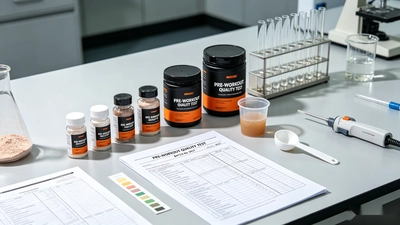
Buyers sometimes assume that a finished-product COA will show an individual assay for every ingredient listed on a complex pre-workout label.
That is not always how the testing plan is structured.
Before ordering, ask what is controlled at raw-material level, what finished-product specifications have been established, and what will actually appear on the COA.
That conversation is more useful than asking only:
“Do you provide a COA?”
Depending on the formula and specification, finished-product testing may cover microbiological parameters, heavy metals where applicable, selected actives and other agreed requirements.
A finished-product COA should be read as a batch-specific quality document, not as a marketing brochure.
For products intended for the U.S., dietary supplement manufacturing falls under 21 CFR Part 111. FDA’s dietary supplement CGMP guidance covers manufacturing, packaging, labeling, holding, specifications and production controls.
For stimulant-containing products, blend control deserves particular attention.
A long COA is not the goal.
A relevant specification is.
A Good Sample Is Not a Production-Ready Formula
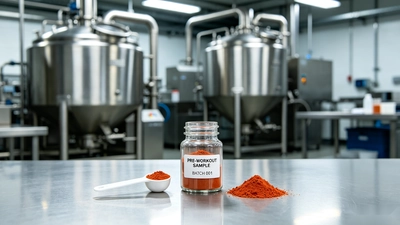
One of the easiest mistakes to make is assuming a successful bench sample can simply be multiplied into a commercial batch.
It cannot.
A 100 g sample and a 300 kg blend behave differently.
At scale, the manufacturing team has to think about staging, ingredient addition order, mixing time, density differences, hopper feeding, fill behavior and batch uniformity.
That does not mean scale-up is unpredictable.
It means the approved sample needs to become a clear production specification.
“The berry sample tastes good” is useful.
It is not enough.
The approved version should be tied to a specific formula, serving size, flavor version, appearance and packaging configuration.
Once production starts, those details should stop moving.
Three Expensive Mistakes We See Repeatedly
Finalizing artwork before the formula is stable
The serving changes.
Then the Supplement Facts panel changes.
Then net weight changes.
Sometimes the jar changes too.
Now the artwork has to be rebuilt.
A mockup is fine early. Final print files are not.
Buying packaging before confirming the powder
A jar may look perfect on a rendering and turn out to be wrong for the final formula.
Net weight is only part of the story. Bulk density changes how much space the powder actually occupies.
Confirm the powder and fill volume first.
Specifying several specialty ingredients and then asking for the lowest possible MOQ
This is a common combination.
Each specialty raw material may bring its own supplier minimum and lead time. If the launch volume is small, decide which ingredients really carry the product concept.
Adding six small-dose specialty ingredients does not make the sourcing problem small.
What to Send if You Want a Useful Quote
You do not need a polished technical file.
If you already have a formula, send the ingredient amounts per serving, serving size, servings per container, expected quantity, packaging, flavor and destination market.
If you do not have a final formula, send the commercial brief instead.
Something like this is enough:
Product: Pre-workout powder
Positioning: Moderate-stim, pump-focused
Serving: About 14 g
Servings: 30
Flavor: Lemon-lime
Quantity: 1,500 tubs
Market: United States
Formula: Custom development
Retail target: Under $40
From there, the manufacturer can tell you what still needs to be defined.
That is a much better starting point than asking for a catalog price.
From Sample to Production
The process itself is not complicated:
Brief → Formula Review → Sample → Revision → Approval → Scale-Up → Filling → Testing/Release → Shipment
The important part is what happens between those steps.
A good formula review should catch an unrealistic serving size or sourcing problem before sampling.
A useful sample review should focus on specific sensory feedback.
And once the formula moves into production, the approved version should be frozen.
Late changes to the serving size, active level, flavor or packaging can affect several other parts of the project at once.
Most avoidable delays happen because one of those decisions was still moving.
When Bulk Supply Makes Sense
Bulk supply is usually a good fit when the buyer already has local filling capability, a trusted contract packer, or a reason to separate manufacturing from retail packaging.
Retail-ready production is often easier for a smaller brand that wants fewer suppliers to manage.
Neither model is automatically better.
If a local packer already fills thousands of tubs every month, importing finished retail units may be unnecessary.
If a new brand has no packaging supply chain at all, importing bulk powder may create more work than it removes.
Compare the complete route to market, not just the factory invoice.
Five Questions Worth Asking Before You Order
What is not included in the quote?
Testing, labels, scoops, cartons, samples and freight are common areas of misunderstanding.
What is actually setting the MOQ?
If it is packaging rather than powder, another pack format may solve the problem.
What finished-product testing is included?
Ask what is tested and what documentation you will receive.
What changes between the approved sample and the production batch?
A manufacturer should be able to explain the scale-up clearly.
Who owns the final label and market compliance review?
Sort this out before anything is printed.
A Better Starting Point for Bulk Pre Workout
If you want a useful quote for a bulk pre workout supplement, send the formula or concept, serving size, quantity, packaging format and target market.
That is usually enough to identify where the real constraint sits.
Sometimes it is cost.
Sometimes it is flavor.
Sometimes the powder is easy and the pouch is the problem.
Jiabei Health works with brands and distributors on custom powder formulations, bulk powder production and retail-ready private-label projects. A clear brief lets us assess the project before unnecessary development work starts.
Send Us Your Pre-Workout Brief
Frequently Asked Questions
Can I buy pre workout powder in bulk without retail packaging?
Yes. If you already have a local filler or contract packer, the finished blend can be supplied in bulk rather than retail tubs.
Is bulk pre workout cheaper than finished tubs?
Not always. Bulk supply removes some filling and packaging costs from the manufacturer’s quote, but you still need to handle those steps elsewhere. Compare the total landed and packed cost.
Why is my pre workout MOQ higher than expected?
The minimum may come from a specialty ingredient, custom packaging, or production setup rather than the powder itself.
Can I use my own pre workout formula?
Yes, provided the ingredients can be sourced and the formula is suitable for the intended manufacturing process and market.
Do I need a custom pre workout formula?
Not necessarily. A stock or semi-custom formula can be a better fit for a smaller first launch. Custom development makes more sense when the formula itself is part of the brand’s differentiation.
What should I send for a pre workout quote?
Send the formula or product concept, serving size, serving count, order quantity, flavor, packaging preference and target market. If you know the target landed cost or retail price, include that too.