Put two calcium magnesium supplement bottles side by side and they can look almost identical. Turn them around, though, and the formulas may have very little in common.
One uses calcium carbonate and magnesium oxide. Another uses calcium citrate and magnesium glycinate. A third adds vitamin D3, zinc, or K2. Serving size might be one tablet on one product and four capsules on another.
That is why comparing these supplements by the large milligram number on the front label rarely tells the whole story.
A more useful comparison starts with four things: elemental calcium and magnesium, mineral forms, serving size, and the rest of the formula.
| What to Check | Why It Matters |
|---|---|
| Elemental calcium | Shows how much actual calcium the serving provides |
| Elemental magnesium | Shows how much actual magnesium the serving provides |
| Mineral source | Carbonate, citrate, oxide, glycinate and other forms behave differently in a formula |
| Serving size | A daily serving may mean one tablet or several capsules |
| Added nutrients | D3, zinc, K2 and boron change the purpose and complexity of the formula |
| Dosage form | Tablets, capsules, gummies and powders have very different loading limits |
Once you know where to look, comparing calcium magnesium supplements becomes much easier.
Why Are Calcium and Magnesium Combined in Supplements?
Calcium and magnesium are both essential minerals. Calcium is best known for its role in bones and teeth, but it is also involved in muscle contraction and nerve signaling. Magnesium contributes to normal muscle and nerve function and participates in many enzyme-driven processes in the body.
The NIH calcium fact sheet and NIH magnesium fact sheet provide detailed reviews of their physiological roles, dietary sources, recommended intakes, supplement forms, and safety considerations.
Putting the two minerals in one product is therefore a logical category for brands targeting bone health, general mineral support, or convenient daily supplementation.
But that does not mean every calcium-magnesium product should use the same ratio or the same mineral sources.
This is where formulas start to separate from one another.
What Should You Compare First on the Supplement Facts Label?

The front of a bottle is designed to be read quickly. The Supplement Facts panel is where the useful comparison begins.
Start With Elemental Calcium
A common mistake is to treat the weight of a calcium compound as if it were the amount of calcium itself.
They are not the same thing.
Calcium carbonate, for example, is approximately 40% calcium by weight, while calcium citrate contains about 21%. That difference has a very practical consequence: substantially more calcium citrate raw material is required to deliver the same elemental calcium target.
So a formula using citrate may need:
- more tablet mass,
- larger tablets,
- additional capsules,
- or a lower calcium target per serving.
This is one reason ingredient form cannot be separated from dosage-form design.
Do the Same With Magnesium
The same principle applies to magnesium.
A magnesium compound contains magnesium plus the material it is bound to. A product formulated with magnesium citrate, oxide, glycinate, or another source should ultimately be compared based on the elemental magnesium declared per serving, not simply the raw-material weight.
NIH notes that the Supplement Facts panel declares the amount of elemental magnesium rather than the weight of the entire magnesium-containing compound.
For a shopper, this prevents misleading comparisons.
For a formulator, it affects almost everything: raw-material quantity, capsule count, tablet dimensions, cost, and manufacturing feasibility.
Then Check the Serving Size
This is easy to miss.
Suppose two products both provide the mineral amounts you are looking for. One requires two tablets a day. The other requires six capsules.
Nutritionally, the numbers on the panel may appear comparable. From the consumer’s point of view, they are quite different products.
The FDA requires dietary supplements sold in the U.S. to declare dietary ingredients and their amounts within the Supplement Facts panel. Its dietary supplement labeling guidance is a useful reference when interpreting how supplement ingredients and serving information are presented.
Which Forms of Calcium and Magnesium Are Used in Supplements?

There is no single ingredient called “calcium magnesium.” A finished formula is built from specific mineral sources, and those choices matter.
Calcium Carbonate vs. Calcium Citrate
These are two of the most familiar calcium forms used in dietary supplements.
Calcium carbonate has a relatively high elemental calcium percentage. From a manufacturing standpoint, that can be useful when a formula needs to deliver a meaningful amount of calcium without making the tablet or capsule serving unnecessarily large.
Calcium citrate provides less elemental calcium by raw-material weight. More material is therefore needed to reach the same elemental target. It also has different use and absorption characteristics from carbonate. NIH identifies carbonate and citrate as the two most common forms of calcium in supplements.
Neither fact means one should automatically replace the other.
The real formulation question is:
What calcium source makes sense for the intended dose, dosage form, target consumer, and product positioning?
That question becomes especially important in tablet supplement manufacturing, where adding hundreds of milligrams of mineral material can quickly affect tablet weight, diameter, thickness, hardness, and the number of tablets required per serving.
Other calcium sources—including phosphate, lactate and gluconate forms—are also used, but carbonate and citrate are more useful starting points when comparing mainstream supplement labels.
Magnesium Oxide, Citrate, and Glycinate
Magnesium labels tend to be even more varied.
Magnesium oxide offers high magnesium density by weight, which can make it useful when elemental loading and product size are important design constraints.
Magnesium citrate is another widely used form. NIH notes that magnesium forms that dissolve well in liquid, including citrate and chloride, tend to have better bioavailability than less soluble forms such as oxide.
Magnesium glycinate or bisglycinate has become common in products positioned around premium magnesium formulations. It is frequently selected where brands want a chelated magnesium story, although it typically requires more raw-material mass to reach a given elemental magnesium target than a high-density source such as oxide.
That last point matters.
It is tempting to reduce magnesium selection to a ranking:
glycinate = good
oxide = bad
Real product development is not that simple.
If a brand wants a high elemental magnesium target in a compact tablet at a mainstream price, its formulation constraints will be different from those of a premium capsule product using a lower elemental dose.
Bioavailability matters, but so do elemental loading, serving size, ingredient cost, manufacturing behavior, and the intended customer.
What Is the Best Calcium-to-Magnesium Ratio?
The 2:1 calcium-to-magnesium ratio appears frequently on supplement labels, which can make it look like an established rule.
It isn’t a universal formula.
Commercial products may use 2:1, 1:1, or other proportions depending on their nutritional targets and positioning.
A bone-focused formula, for example, may be calcium-led. A product built primarily around magnesium may contain a much lower calcium amount. Others combine calcium and magnesium with several supporting nutrients rather than making the mineral ratio the main selling point.
| Formula Style | Typical Product Direction |
|---|---|
| Higher calcium relative to magnesium | Calcium-led or bone-support formula |
| 2:1 Ca:Mg | Common commercial mineral positioning |
| 1:1 Ca:Mg | More balanced mineral positioning |
| Magnesium-led formula | Lower calcium relative to magnesium |
| Ca + Mg + D3/K2/Zinc | Broader multi-nutrient formula |
So, rather than asking only:
“Is 2:1 the best ratio?”
A more useful question is:
“What is this formula designed to deliver, and does the amount per serving make sense for me?”
Diet already contributes calcium and magnesium, and individual requirements vary. A ratio printed on a bottle should not be treated as a universal personal intake recommendation.
Why Do Some Calcium Magnesium Supplements Add Vitamin D3, Zinc, K2, or Boron?
Once calcium and magnesium are established, formulas can become surprisingly crowded.
Sometimes the additions make sense. Sometimes they are there largely because consumers recognize the ingredients.
Vitamin D3
Vitamin D is one of the most logical companion nutrients in calcium-focused formulations because it plays a role in calcium absorption and bone mineralization. NIH’s calcium guidance specifically discusses the relationship between vitamin D status and calcium absorption.
That is why calcium + magnesium + D3 is such a familiar supplement combination.
For product developers, however, adding D3 changes more than the ingredient list. Its potency, input level, premix strategy, testing method, and stability all have to be considered.
Zinc
Zinc often appears in multi-mineral products intended to provide broader nutritional support.
The useful question is not whether zinc is a “good ingredient.” It is whether its inclusion has a clear reason within that specific formula.
Adding more minerals may make a label look stronger, but every additional active affects space, cost, specifications, testing, and—in some formats—taste.
Vitamin K2 and Boron
K2 and boron are more common in formulas positioned as expanded bone-support products rather than simple calcium-magnesium supplements.
Again, more ingredients do not automatically mean a better formula.
A clean calcium-magnesium-D3 product with sensible doses may be a more coherent design than a long ingredient panel filled with token amounts of ten different nutrients.
Tablets, Capsules, Gummies, or Powder?

Mineral formulas expose the practical differences between dosage forms very quickly.
Calcium and magnesium are not ingredients typically added at a few micrograms per serving. The amount of mineral raw material can be substantial, so physical space becomes part of formula design.
| Format | Main Advantage | Practical Constraint |
|---|---|---|
| Tablet | High mineral loading | Tablets can become large |
| Capsule | Flexible ingredient selection | High-dose formulas may require several capsules |
| Gummy | Consumer-friendly format | Limited active loading; taste and texture matter |
| Powder | More room for high-dose ingredients | Flavor, dispersion and sedimentation must be managed |
Tablets
Tablets are often a practical choice for mineral-heavy formulas because compression allows a relatively large amount of material to fit into each unit.
But there is a limit.
Increase calcium, magnesium, zinc, excipients and other nutrients far enough and the tablet becomes physically larger. At some point the decision is no longer purely nutritional. The team has to decide whether to increase tablet size, increase tablets per serving, or adjust the formula.
That tradeoff is normal in mineral product development.
Capsules
Capsules provide useful flexibility, particularly when a brand wants a blend of different mineral sources or additional botanical ingredients.
The constraint is volume.
A capsule only holds so much powder. A high calcium target made with a lower-density source can turn what looked like a simple one-capsule concept into several capsules per serving.
That is why capsule supplement manufacturing usually starts with the elemental target and actual bulk density of the formula—not with the assumption that everything will fit into a preferred capsule size.
Gummies
Calcium magnesium gummies sound straightforward until the mineral load starts going up.
Gummies already need enough room for the gelling system, sweetening system, flavors, acids, water management, and other structural components. Add a large quantity of mineral salts and the formula can change in texture, taste, processing behavior, and appearance.
Some magnesium sources can also bring noticeable mineral or bitter notes that need to be managed rather than hidden behind more flavor.
For that reason, gummy supplement manufacturing for mineral products often involves a harder tradeoff between active dose and serving size than a comparable tablet formula.
A gummy can be a very good format. It just should not be expected to behave like a compressed mineral tablet.
Powder
Powders solve part of the space problem.
A scoop or sachet can accommodate far more material than a single capsule or gummy, which makes powders useful for higher-dose mineral concepts.
Then a different set of problems appears:
- Does the powder disperse well?
- Does it settle quickly?
- How mineral-heavy does it taste?
- Can the flavor system mask it without becoming excessively sweet?
- Does the product remain consistent throughout shelf life?
Each dosage form moves the constraint rather than eliminating it.
How to Compare Two Calcium Magnesium Supplements
If you have two bottles in front of you, you do not need to decode every ingredient on the label.
Start here.
1. Compare Elemental Calcium
Look at the amount declared as calcium per serving.
Then check which calcium source supplies it.
A larger number printed elsewhere on the package may refer to an ingredient blend or compound weight rather than elemental calcium.
2. Compare Elemental Magnesium
Do exactly the same thing.
“Magnesium glycinate 1,000 mg” and “magnesium 200 mg” are not interchangeable statements.
Find the elemental magnesium amount on the Supplement Facts panel.
3. Check the Mineral Forms
Look for the source in parentheses or elsewhere on the label:
- calcium carbonate
- calcium citrate
- magnesium oxide
- magnesium citrate
- magnesium glycinate
- or a blend
The form tells you more about how the product was designed than the product name alone.
4. Look at How Many Units Make One Serving
A bottle containing 120 capsules does not necessarily provide 120 servings.
If the serving size is four capsules, it provides 30 servings.
This seems obvious once you notice it, but it changes price comparisons dramatically.
5. Ask Whether the Added Ingredients Have a Job
D3 in a calcium formula is easy to understand.
If a product also includes zinc, K2, boron, phosphorus, trace minerals, herbs, and several vitamins, look at whether those ingredients are present in meaningful amounts and whether the product still has a clear purpose.
A long label is not automatically a better label.
6. Look at How Quality Is Verified
A polished Supplement Facts panel cannot tell you whether the raw materials were correctly identified or whether the finished batch met its specifications.
For supplement brands, useful quality controls include raw-material qualification, traceability, in-process controls, and finished-product testing. Our supplement manufacturing quality standards outline how these controls fit into production.
Batch documentation matters too. A batch-specific COA is more meaningful than treating “COA available” as a generic marketing statement with no connection to the actual lot being supplied.
What Should You Know Before Taking a Calcium Magnesium Supplement?
A label comparison can tell you what is in the bottle. It cannot determine how much calcium or magnesium a particular person needs.
Total intake matters because food, fortified foods, medications, and other supplements may already contribute these minerals.
The form can also affect how a supplement is used. NIH notes, for example, that calcium carbonate absorption is more dependent on stomach acid and is generally taken with food, while calcium citrate is less dependent on stomach acid.
Calcium and magnesium supplements may also interact with certain medications. NIH identifies interactions involving calcium or magnesium and several types of medicines, so people taking prescription medication should check with a healthcare professional rather than assuming a mineral supplement is automatically harmless.
More is not automatically better.
The right decision depends on diet, age, health status, medications, and the reason for using the supplement in the first place.
This article is intended for general product and formulation information, not individual medical advice.
What Changes When a Brand Develops Its Own Calcium Magnesium Formula?
For a private label brand, the first useful question usually isn’t:
“What bottle should we use?”
It is:
“How much elemental calcium and magnesium do we actually want per serving?”
Once those targets are defined, the rest of the project becomes much clearer.
A typical development sequence looks something like this:
- Set the elemental calcium and magnesium targets.
- Select calcium and magnesium sources.
- Decide whether D3, zinc, K2, boron, or other nutrients belong in the concept.
- Calculate how much raw material is needed to deliver those elemental amounts.
- Check whether the formula physically fits the intended tablet, capsule, gummy, or powder format.
- Review manufacturing behavior, specifications, testing requirements, cost, and serving size.
This is also why two products with the same name can be completely different manufacturing projects.
Two “Calcium Magnesium Supplements,” Two Very Different Formulas
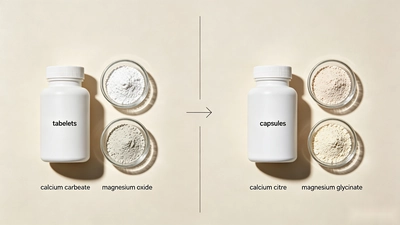
Imagine these two concepts:
| Formula A | Formula B | |
|---|---|---|
| Calcium source | Calcium carbonate | Calcium citrate |
| Magnesium source | Magnesium oxide | Magnesium glycinate |
| Added nutrients | Vitamin D3 | Vitamin D3 + K2 |
| Format | Tablet | Capsule |
| Raw-material volume | Relatively compact | Higher |
| Likely unit count | Lower | Potentially higher |
| Positioning | Mainstream mineral formula | Premium mineral formula |
Both could legitimately sit on a shelf under the words calcium magnesium supplement.
They are not the same product.
Formula B may require much more raw material to reach similar elemental mineral targets. That can increase capsule count and raw-material cost. Formula A may achieve higher elemental loading in a more compact format, but it serves a different formulation and market strategy.
Neither is automatically superior.
The better formula is the one that matches the brand’s intended customer, target dose, dosage form, price position, and quality specification.
For brands working through those decisions, our OEM and ODM supplement manufacturing service covers formulation development, dosage-form selection, production, testing, and packaging rather than starting with a fixed off-the-shelf formula.
Frequently Asked Questions
Can You Take Calcium and Magnesium Together?
Calcium and magnesium are commonly included in the same dietary supplement, and commercial products frequently provide both in one serving. Individual requirements still vary, so the fact that they can be formulated together does not mean everyone needs the same amounts.
People taking medications or managing a medical condition should check potential interactions with a healthcare professional.
What Is a Good Calcium-to-Magnesium Ratio?
There is no single calcium-to-magnesium ratio that is appropriate for every product or every person.
A 2:1 ratio is common in commercial formulas, but 1:1 and other ratios also exist. Diet, intended positioning, elemental targets, serving size, and the purpose of the formula all influence the final ratio.
Is Calcium Citrate Better Than Calcium Carbonate?
Not in every situation.
Calcium carbonate contains more elemental calcium by weight, which can help keep tablets or servings smaller. Calcium citrate contains less elemental calcium by weight and has different absorption and usage characteristics.
Rather than treating one as universally better, compare the form together with elemental calcium, serving size, and your individual needs.
Is Magnesium Glycinate Better Than Magnesium Oxide in a Calcium Magnesium Supplement?
They solve different formulation problems.
Magnesium oxide offers high elemental magnesium density. Glycinate is commonly used in products positioned around chelated magnesium, but more raw material may be required to reach the same elemental target.
A formula should therefore be evaluated as a whole rather than ranked solely by the magnesium source printed on the front label.
Should a Calcium Magnesium Supplement Include Vitamin D?
It does not have to, but vitamin D is a logical and common companion nutrient because vitamin D plays an important role in calcium absorption and bone health.
Whether it belongs in a particular product depends on the product concept, target consumer, dose, and how the brand intends the supplement to be used.
The Bottom Line
The words calcium magnesium supplement tell you the category. They do not tell you whether two products are equivalent.
To make a useful comparison, look past the front-label milligrams and check:
elemental calcium → elemental magnesium → mineral forms → serving size → supporting nutrients → dosage form → quality verification
Those details explain why one calcium-magnesium product may be a compact tablet while another requires several capsules, why two formulas using the same minerals can sit at very different price points, and why a longer ingredient list is not necessarily a better one.
For brands developing a calcium magnesium product, the same logic applies in reverse: start with the elemental targets and intended consumer, then build the ingredient forms and dosage form around them.
A good formula should make sense on the Supplement Facts panel and on the production floor.