Many supplement projects move quickly in the early stage because the first conversations usually focus on formula direction, packaging style, MOQ, lead time, and target price. At that point, everything can feel straightforward. But once the discussion moves closer to import planning, document review, or market entry preparation, buyers often realize that product details alone are not enough.
This is where document coordination becomes part of the real work. Among the files that may come up during that stage, the certificate of free sale is one of the documents importers, distributors, and registration partners often ask about. It is not required for every supplement project, and it is not always discussed at the very beginning, but in some markets it becomes an important part of the documentation package.
A certificate of free sale is a supporting trade document used to indicate that a product can be legally sold in its country of origin or export.
For many buyers, the main issue is not simply understanding the name of the document. The more practical questions are what it actually proves, when it may be needed, how it differs from a COA or certificate of origin, and whether the requirement should be confirmed before packaging and production move too far ahead. In real export work, those are the questions that matter most.
What Is a Certificate of Free Sale for Supplements?
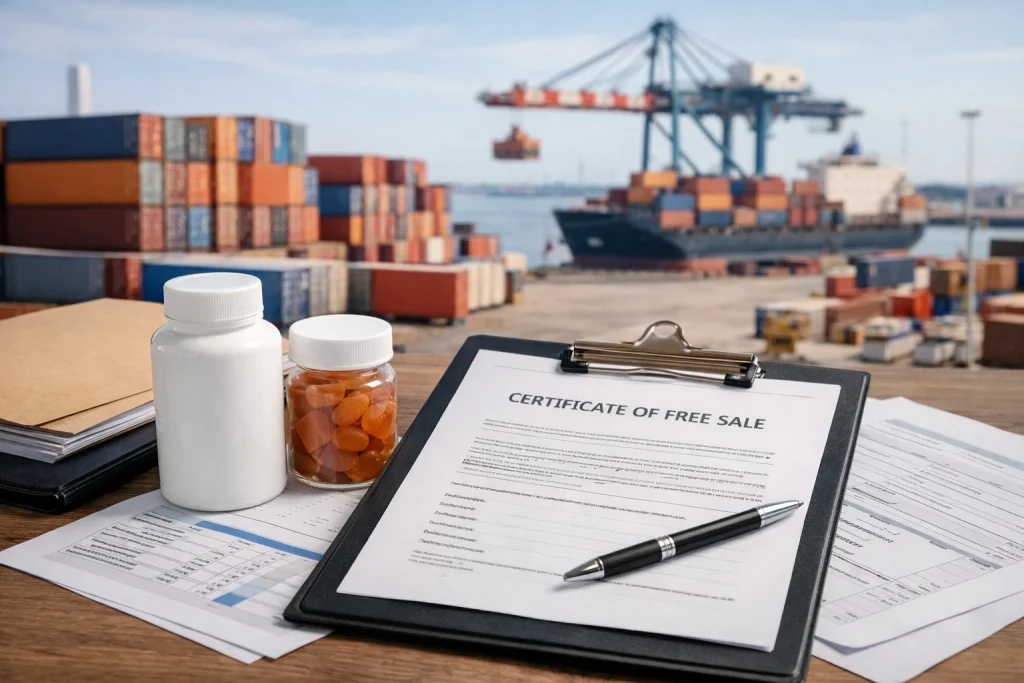
A certificate of free sale is generally used to show that a product, or the relevant product category, can be legally sold in the country of origin or export, a concept that is commonly referenced in international trade and import documentation practices. In supplement trade, buyers may encounter this document when preparing for import registration, customs communication, distributor review, or other documentation checks required by the destination market.
In simple terms, the certificate is often treated as a supporting trade document. It helps demonstrate that the product is not being made only for export under unclear status, but is part of a product category that is allowed to be sold in its originating market under normal commercial conditions. That is one reason why importers may ask about it before shipment, especially when they are preparing their own registration files or working with local authorities and partners.
It is important to note that a certificate of free sale is a supporting document, not a direct product approval for the destination market.
At the same time, buyers should understand what a certificate of free sale does not mean. It is not the same as a certificate of analysis. It is not a certificate of origin. It is not a direct substitute for local regulatory approval in the importing country. It also does not remove the need for the buyer to confirm local compliance requirements. In practice, it is one piece of the documentation process, not the entire process itself.
That distinction is important because many delays in supplement projects do not happen because a document is impossible to prepare. They happen because the parties involved assume one document will answer every compliance question, and later discover that different files serve different purposes.
Why Supplement Importers Ask for a Certificate of Free Sale
Importers usually ask about a certificate of free sale for practical reasons, not because they want paperwork for its own sake. In many cases, the request appears when the importer is building a more complete file set for a product that is moving toward registration, import review, or formal distributor approval.
One common reason is import registration planning. Some markets, channels, or registration consultants may ask the buyer to provide supporting documents that show the product category is legally sold in the country of origin or export. When that happens, the certificate of free sale becomes part of a broader documentation package rather than a stand-alone requirement.
Another reason is channel review. Distributors, pharmacy channels, local wholesalers, and certain retail partners may want more than a label and product photo before they move forward. They may ask for technical files, batch-related files, or trade-supporting documents that make the product easier to assess internally. In that context, the certificate of free sale may help support commercial confidence, especially for buyers working with a new manufacturer or launching into a new market.
Importers may also ask for this document to reduce uncertainty before shipment. Real projects often become more complex once labels are finalized, cartons are printed, and booking schedules are already being arranged. If a buyer only begins checking document expectations at that late stage, even a small paperwork gap can create unnecessary back-and-forth. Confirming whether a certificate of free sale may be needed earlier in the process often makes the project easier to manage.
In short, buyers usually ask for a certificate of free sale to support import documentation, reduce compliance uncertainty, and prepare a more complete file set before shipment or registration review. It is less about theory and more about reducing avoidable friction.
Is a Certificate of Free Sale Required for Every Supplement Order?
No, a certificate of free sale is not required for every supplement order. Whether it is needed usually depends on the destination market, product type, sales channel, and the importer’s documentation process.That is one of the most important points for buyers to understand. Some orders move forward without it, while others may require it as part of market-entry preparation, importer review, or destination-country document handling.
The difference usually depends on the market, the product category, the intended sales channel, and the import process being followed by the buyer, as documentation requirements can vary significantly across countries and regulatory frameworks.A distributor selling through one channel in one country may not ask for the same documentation as a registration partner working in another. Even within the same broad product category, documentation needs can vary depending on how the product will be declared, reviewed, or sold.
In some markets, buyers may raise this question earlier in the project because supporting documents play a bigger role in import preparation. Indonesia is one example where document expectations may need to be discussed sooner, especially when the project involves local registration review, importer coordination, or distributor-side compliance checks. Even then, the exact requirement can still vary depending on the product type, import pathway, and local process.
This is why experienced buyers often confirm documentation expectations early instead of assuming the same file set will work everywhere. A supplement manufacturer may be able to support a range of project documents, but the buyer still needs clarity on what the destination side expects. The earlier that discussion happens, the more room there is to organize packaging details, product information, and supporting files in a coordinated way.
In real projects, one of the most common mistakes is to discuss formula and price first, then leave documentation until later. That can work for very simple orders, but it becomes risky when the product is entering a market with more formal review steps. A file requirement that appears late in the process can affect timing, communication, and sometimes even packaging decisions. It is usually better to know early than to fix the issue under deadline pressure.
In Which Markets Is a Certificate of Free Sale More Commonly Discussed?
A certificate of free sale is not discussed in exactly the same way in every market. In some countries, buyers may not bring it up until later in the project, while in others it may come up much earlier as part of import preparation or local document review. This is often the case in markets where supporting trade documents are reviewed more closely before product entry or distribution.
Indonesia is one example where buyers may pay closer attention to documentation earlier in the process. When a project involves registration planning, importer coordination, or distributor-side review, questions about a certificate of free sale may appear sooner than expected. That is one reason it is often better to confirm document expectations before packaging and shipment planning move too far ahead.
Indonesia is one example of a market where buyers may ask about a certificate of free sale earlier in the project.
At the same time, buyers should avoid assuming that one country example automatically applies to every project. Documentation needs can still vary based on the supplement format, product positioning, import pathway, and the local process followed by the importer or registration party.
Who May Issue a Certificate of Free Sale?
One of the questions that often follows is not just whether a certificate of free sale is needed, but who is able to issue it.
In practice, there is no single universal issuing body that applies to every situation. The acceptable issuing route can vary depending on the product category, the destination market, and what the importing side or local authority recognizes as valid supporting documentation.
In many cases, buyers may encounter certificates issued by chambers of commerce, trade associations, or other recognized organizations involved in export documentation. In other cases, the accepted document path may depend on how the importer, registration consultant, or local partner structures the documentation package for that specific market.
For that reason, the most practical approach is not to assume that one issuing source will work for every project. Instead, buyers should first confirm what type of certificate or issuing body is accepted on the destination side. Once that is clear, the documentation process becomes much easier to align.
What Is the Difference Between a Certificate of Free Sale, COA, and Certificate of Origin?
These three documents are often mentioned together, but they do not serve the same function. Buyers sometimes group them under the general idea of “export paperwork,” yet each one supports a different part of the transaction.
| Document | What it usually shows | Common use in supplement trade |
|---|---|---|
| Certificate of Free Sale | Shows that the product or product category can be legally sold in the country of origin or export | Import documentation, registration review, distributor requests |
| COA | Shows product specifications or test results for a batch or finished product | Quality review, batch verification, buyer technical review |
| Certificate of Origin | Shows where the goods are produced or exported from | Customs, tariff, trade documentation |
A certificate of free sale is mainly connected to market status and documentation support. A Certificate of Analysis (COA) is much more about product specifications, testing, and batch-level quality information.If you have already reviewed a detailed discussion of testing and technical documents, it makes sense here to also understand how a Certificate of Analysis fits into the broader supplement documentation process. A certificate of origin, by contrast, is typically related to trade and customs matters, especially when origin needs to be formally stated.
Confusion happens when buyers expect one document to replace another. For example, a COA may help confirm product specifications, but it does not answer the same question as a certificate of free sale. Likewise, a certificate of origin may be important for customs handling, but it does not serve the same purpose as a market-status document. Understanding these differences early can save time, especially when preparing a documentation checklist for a new project.
When Should Buyers Confirm Certificate of Free Sale Requirements?
The best time to confirm certificate of free sale requirements is earlier than many buyers expect. In most cases, buyers should confirm the requirement before packaging is finalized, before the bulk order is released, and well before shipment planning begins.
One useful point to confirm the requirement is before the product direction is fully locked. If the buyer is still comparing product versions, formulas, packaging formats, or market routes, this is the stage where document expectations can still be aligned without causing unnecessary changes later. Once a project becomes more fixed, flexibility naturally decreases.
It is also wise to confirm document needs before packaging information is finalized. In some cases, documentation and packaging discussions are treated as separate topics, but they are often connected in real export work. Product naming, label presentation, intended use description, and importer information may all influence how the project is reviewed by the destination side. That does not mean a certificate of free sale controls the label, but it does mean documentation planning should not be isolated from packaging planning.
Another important stage is before bulk order confirmation. By that point, the buyer usually has a clearer understanding of target market requirements, importer expectations, and launch timing. If a certificate of free sale may be needed, confirming it before the order is fully released is much easier than discovering the issue while the project is already moving toward shipment.
Finally, buyers should avoid leaving this discussion until shipment planning begins. Once booking schedules, delivery deadlines, and customs coordination are already in motion, even a relatively manageable documentation question can feel much bigger than it actually is. Most document problems are easier to solve when there is still time to organize them properly.
How Is a Certificate of Free Sale Usually Obtained?
While the exact process can vary depending on the market and documentation route, most projects follow a similar practical sequence.
First, the buyer should confirm whether a certificate of free sale is actually required for the destination market. This step is important because not every project needs it, and assumptions at this stage can lead to unnecessary work later.
Second, it is important to clarify what type of certificate or issuing route is accepted. Different markets or partners may recognize different documentation paths, so aligning this early avoids confusion.
Third, the basic product and company information should be prepared. This may include product details, intended use, company information, and other supporting materials that help position the product within normal commercial conditions.
Fourth, packaging and product presentation should be aligned if needed. In some projects, label details, product naming, or intended use descriptions may need to be consistent with how the product is represented in supporting documents.
Finally, the timing should be coordinated before bulk production and shipment planning move forward. Confirming documentation early helps ensure that the project progresses without last-minute adjustments.
Does a Certificate of Free Sale Involve Additional Cost or Lead Time?
In most cases, a certificate of free sale may involve some additional cost and processing time, but the exact details can vary depending on the issuing route, supporting documentation, and market requirements.
From a practical perspective, the cost itself is usually not the most critical factor. What matters more is whether the requirement has been identified early enough in the project timeline. When the need for a certificate is confirmed in advance, the process can often be coordinated smoothly alongside other documentation work.
On the other hand, if the requirement appears late—after packaging is finalized or shipment planning has already begun—even a relatively manageable document step can create unnecessary pressure. This is why experienced buyers tend to focus less on the fee itself and more on early confirmation and proper timing.
How a Supplement Manufacturer Can Support Document Preparation
A capable supplement manufacturer should do more than quote price and lead time. In export projects, document coordination is often part of what separates a smooth order from a stressful one. That does not mean the manufacturer replaces the importer’s local compliance review, but it does mean the manufacturer can play an important supporting role in preparing a more complete and usable documentation package.
One part of that support is early communication. When buyers raise documentation questions at the start of the project, the manufacturer can help review what information is already available, what basic product files may be prepared, and what other materials might need to be aligned based on the destination market and product type. This is often where delays can be prevented before they appear.
Manufacturers can also support document preparation by organizing product-related information more clearly. That may include specification sheets, label files, batch-related documents, origin-related files, and quality-supporting records depending on the project. When these materials are prepared with the buyer’s actual use case in mind, communication becomes much easier.
For projects involving a certificate of free sale, the most practical approach is to discuss the requirement together with the product details and destination-market context. Not every buyer will need the same file set, and not every market treats document review in the same way. Still, when a buyer identifies the requirement early, the manufacturer can usually cooperate more effectively in preparing supporting information and helping the project move forward with fewer surprises.
This is also where an experienced OEM and private label supplement manufacturer can add value beyond production itself. Buyers are not only looking for a factory that can make the product. They are often looking for a partner that understands how production, packaging, documentation, and shipment preparation fit together in one workflow.
We understand that some buyers may need a certificate of free sale during the import process, and our team can cooperate in preparing supporting information based on project needs and destination market requirements. In many cases, the key is not only whether a document is requested, but whether the requirement is discussed early enough for the project team to prepare properly.
What Buyers Should Prepare Before Asking About a Certificate of Free Sale
When buyers ask about a certificate of free sale, the conversation becomes much more efficient if they already have a few key details ready. The more complete the project background is, the easier it is to understand what support may be needed and how the document question fits into the overall export process.
The first essential detail is the destination country. This detail matters because it directly affects how the documentation process will be handled on the destination side. A request that is normal in one country may not appear in another, and the way documents are reviewed may also differ.
The second detail is the product type. A clear description of the supplement format and intended use helps avoid confusion from the beginning. Capsules, gummies, powders, softgels, and liquids may all follow different commercial and documentation paths depending on the importing side.
Formula information is also helpful, even if only at a practical level. The buyer does not always need to provide a complete technical file in the first conversation, but it is useful to clarify the core ingredients, positioning, and whether the formula is standard, custom, or still under development. This gives the project team a better foundation for discussing which documents may be relevant.
Packaging format and label version should also be considered. If the buyer already has draft artwork, target language requirements, or importer details prepared, those materials can help align documentation planning with the actual finished product.
Finally, buyers should state whether other supporting compliance documents may be requested together. In many projects, the question is not only about the certificate of free sale itself. The buyer may also need a COA, certificate of origin, specification sheet, invoice-related support, or other files as part of the same package. Looking at the requirement in context makes the process much more manageable.
Common Mistakes Buyers Make When Discussing Certificate of Free Sale Requirements
One common mistake is assuming that every market asks for the same document set. Buyers sometimes hear that another importer used a certificate of free sale successfully and assume the same document will always be enough. In reality, market expectations vary, and documentation needs should be checked against the specific destination and import route.
Another mistake is treating a COA as the same thing. This confusion is very common in supplement sourcing because both documents may appear in the same project file set. But a COA is primarily used to show product specifications or test results, while a certificate of free sale is related to the product’s market-status support in the country of origin or export. Mixing them up can slow down the conversation and create unnecessary misunderstanding.
Some buyers also wait too long to raise documentation questions, which can create unnecessary pressure once the project is already moving toward shipment.They may focus first on sample approval, price negotiation, or packaging design and assume the paperwork can be sorted out at the end. That approach can create pressure later, especially if shipment timing is already tight. Document questions are usually easier to handle when they are part of the project discussion from the start.
A final mistake is expecting one document to solve all compliance concerns. A certificate of free sale may be useful, but it is not a universal answer to every import, registration, customs, or local-market requirement. Serious buyers usually get better results when they treat documentation as a structured package rather than a single-file shortcut.
Final Thoughts
A certificate of free sale is not the first topic most supplement buyers raise when starting a project, but it can become an important one as soon as the order moves closer to registration, customs review, distributor approval, or shipment preparation. That is why it deserves attention earlier rather than later.
For supplement importers, the real issue is rarely just the document name. The more important question is whether the requirement has been confirmed in time, understood in the right context, and supported by the right combination of related files. A smoother process usually starts with clearer communication before production and packaging move too far ahead.
Not every supplement order needs a certificate of free sale. But when it is required, early coordination makes the process significantly easier to manage.In export work, document preparation is often not about adding complexity. It is about reducing avoidable delays.
Frequently Asked Questions
What is a certificate of free sale for supplements?
A certificate of free sale for supplements is generally used to show that the product, or relevant product category, can be legally sold in the country of origin or export. It is often discussed as part of import documentation, registration preparation, or distributor review.
Is a certificate of free sale the same as a COA?
No. A certificate of free sale and a COA serve different purposes. A COA is mainly used to show product specifications or test results, while a certificate of free sale is typically used to support documentation related to market status in the country of origin or export.
Do all supplement importers need a certificate of free sale?
No. Not every supplement importer needs it. Requirements vary depending on the destination market, the product category, the import process, and the buyer’s sales channel or registration path.
When should buyers confirm free sale certificate requirements?
Buyers should ideally confirm the requirement early in the project, before packaging is finalized, before the bulk order is confirmed, and well before shipment planning begins. Early confirmation usually makes documentation easier to organize.
Can a supplement manufacturer help prepare supporting documents?
Yes, in many cases a supplement manufacturer can help coordinate supporting product information and related files. The exact support depends on the project, the destination market, and the document package required by the buyer or importer.
Is Indonesia a market where buyers may ask about a certificate of free sale?
Yes, Indonesia is one of the markets where buyers may discuss a certificate of free sale earlier in the project, especially when documentation is connected to registration planning, importer review, or distributor-side requirements. However, the exact need should still be confirmed based on the product type and local process.
Who can issue a certificate of free sale?
The issuing body for a certificate of free sale can vary depending on the product type, destination market, and accepted documentation route. In practice, buyers may encounter certificates issued by chambers of commerce, trade-related organizations, or other recognized bodies. The most important step is to confirm what type of document is accepted by the importer or local authority in the destination market.