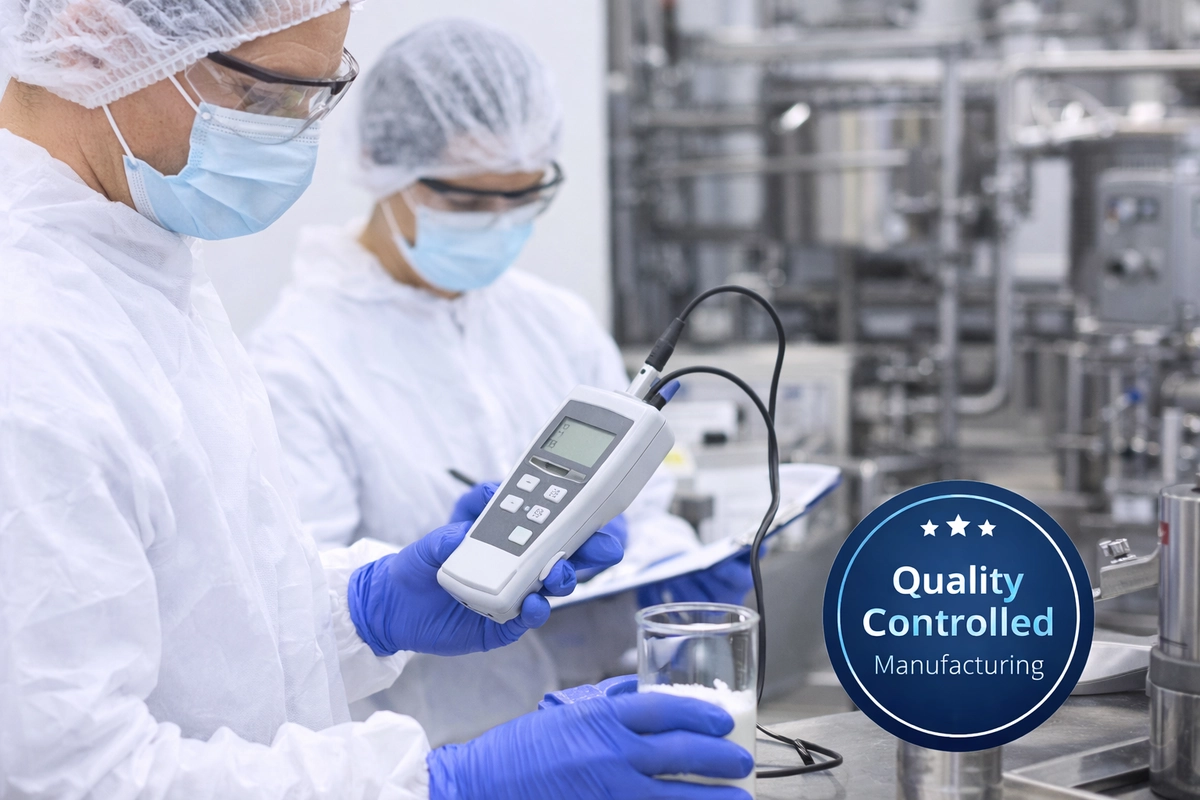
HACCP certification for dietary supplement manufacturers has become a key standard for global supplement production. In the nutraceutical and dietary supplement industry, food safety is the foundation of trust. Whether you are developing a private label supplement line or sourcing from an OEM factory, ensuring that every capsule, gummy, and powder is produced under controlled and verified safety standards is non-negotiable. That is where HACCP certification—Hazard Analysis and Critical Control Points—plays a vital role.
This article explains what HACCP certification means for dietary supplement manufacturers, how it supports global compliance, and why Jiabei Health has adopted HACCP principles at every stage of its OEM production system.

What Is HACCP Certification?
HACCP (Hazard Analysis and Critical Control Points) is an internationally recognized management system designed to ensure the safety of food and supplement products. It was developed by NASA and the U.S. Department of Agriculture to prevent contamination in space food programs—later becoming the global foundation for food safety management.
Unlike routine quality checks, HACCP focuses on prevention. It requires manufacturers to identify potential biological, chemical, or physical hazards at every stage of production and establish control points to eliminate or reduce risks before they occur.
Today, HACCP certification is recognized by regulatory agencies such as:
- The U.S. FDA (Food and Drug Administration)
- The European Food Safety Authority (EFSA)
- The Codex Alimentarius Commission (WHO/FAO)
In supplement manufacturing, it represents more than a certificate—it is a systematic guarantee that the factory operates under preventive and verifiable safety control.
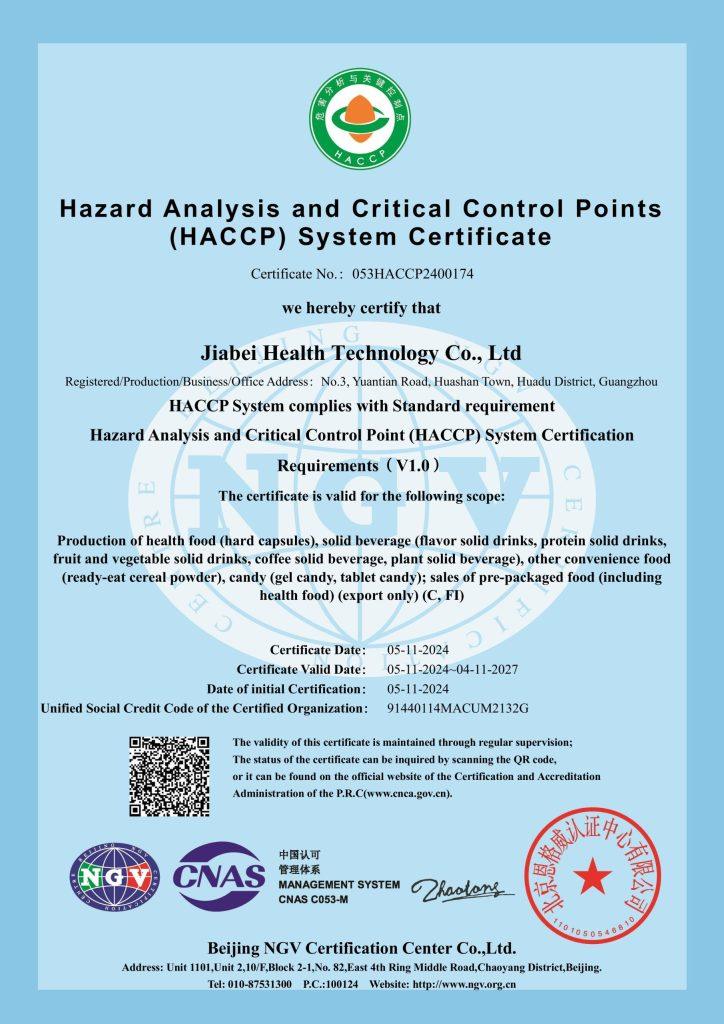
The Seven Principles of HACCP
A true HACCP-certified manufacturer follows a structured framework built on seven core principles:
- Conduct a Hazard Analysis – Identify all possible hazards in raw materials, equipment, storage, and transportation.
- Determine Critical Control Points (CCPs) – Define where hazards can be prevented or controlled (for example, mixing, heating, or packaging).
- Establish Critical Limits – Set measurable thresholds such as temperature, pH, or time limits that ensure safety.
- Establish Monitoring Procedures – Use instruments and checklists to continually record CCP conditions.
- Establish Corrective Actions – Define steps to take when limits are not met, including product isolation and retesting.
- Establish Verification Procedures – Schedule audits, testing, and third-party reviews to verify system effectiveness.
- Establish Record-Keeping and Documentation – Maintain detailed records to trace product safety from raw material to shipment.
For dietary supplement OEM buyers, these steps mean traceability and accountability—key elements when evaluating a potential factory partner.
HACCP vs. GMP vs. FSSC 22000: Understanding the Difference
Many buyers confuse HACCP with GMP or FSSC 22000. In reality, they are complementary layers of one safety system:
| Certification | Core Focus | Typical Application |
|---|---|---|
| HACCP | Hazard prevention and control | Base requirement for all food and supplement plants |
| GMP (Good Manufacturing Practice) | Production and documentation standards | Legal compliance for FDA registration |
| FSSC 22000 | Integrated food safety management system based on ISO 22000 and HACCP | Global certification recognized by GFSI |
In short:
- HACCP = Safety control foundation
- GMP = Process discipline and manufacturing hygiene
- FSSC 22000 = Full safety management certification
Jiabei Health integrates all three to maintain the highest international compliance level.
How Jiabei Health Implements HACCP Certification for Dietary Supplement Manufacturers
As an OEM and private label supplement manufacturer, Jiabei Health applies HACCP methodology throughout the production chain, from ingredient sourcing to global export logistics.
1. Raw Material Selection
Each supplier is required to provide a complete Certificate of Analysis (COA) and testing reports for heavy metals, microbiology, and pesticides. Only materials meeting HACCP and GMP criteria are approved.
2. Controlled Production Environment
Temperature, humidity, and cross-contamination risks are continuously monitored. Dedicated production zones are established for sensitive materials such as probiotics and herbal extracts.
3. In-Process Control
Every batch undergoes critical control inspections: weight uniformity, pH balance, moisture content, and microbial levels.
4. Final Product Verification
Finished supplements—capsules, gummies, drops, and powders—are tested again before packaging. HACCP audit teams verify all documentation before release.
5. Packaging and Labeling
Labels are checked for compliance with destination-country regulations (FDA, EFSA, ASEAN, etc.). All packaging lines are sanitized according to HACCP protocols.
6. Traceable Documentation
Every product is linked to a batch record showing its complete safety history. This ensures that buyers can trace every raw material and test result at any time.
Why HACCP Certification Matters to OEM Buyers
1. Compliance Confidence
When your OEM partner is HACCP-certified, it demonstrates readiness for global export. Many regions—including the EU, the United States, and Southeast Asia—consider HACCP compliance a prerequisite for import registration.
2. Brand Reputation and Consumer Trust
For private label supplement brands, safety certification is not just a formality—it is a marketing advantage. Consumers increasingly prefer brands that can show documented safety assurance.
3. Regulatory Efficiency
With HACCP documentation, OEM buyers can prepare product dossiers faster for FDA listing, EU notification, or Halal verification.
4. Risk Reduction
The preventive approach minimizes production downtime, product recalls, and reputational damage caused by contamination or labeling errors.
5. Global Market Access
Many distributors and retail chains (especially in Europe and the Middle East) require suppliers to provide HACCP certificates before listing a new supplement SKU.
Verification: How to Check a Factory’s HACCP Certificate
For importers and brand owners, verifying a supplier’s HACCP status is simple yet essential:
- Request the Certificate Copy – Ensure it’s issued by an accredited certification body such as SGS, Intertek, or TÜV.
- Check Expiration and Scope – Confirm the certificate covers dietary supplement manufacturing, not only general food.
- Cross-Check with Auditor’s Website – Most certification bodies allow online verification using a certificate number.
- Evaluate Integration – Ask if HACCP is combined with other systems like GMP or FSSC 22000.
- Inspect Records During Audit – A true HACCP system will have written hazard analysis and CCP monitoring logs available for review.
Jiabei Health welcomes client audits and provides full traceability reports to international buyers.
HACCP in the Context of Jiabei Health’s Global Compliance Framework
At Jiabei Health, HACCP certification is part of a larger compliance framework that also includes:
- GMP (Good Manufacturing Practice)
- FSSC 22000 Food Safety Certification
- BRCGS Global Standard for Food Safety
- BPJPH and Ketetapan Halal Certifications
- Kosher Certification
- FDA Registration and Free Sale Certificates
This integrated system ensures every OEM or ODM project meets both regulatory requirements and brand expectations.
From Safety to Strategy: The OEM Advantage
Beyond compliance, HACCP certification also strengthens your business positioning. When presenting your private label product to distributors, you can confidently state that it was manufactured in a HACCP-certified facility—backed by documented food safety assurance.
Jiabei Health supports B2B clients with:
- Full COA and HACCP audit reports
- Product registration documentation (FDA, CFS, COO)
- Global DDP logistics and customs assistance
- Flexible packaging and label customization
- OEM/ODM formulation development
Safety is not just a system—it is a promise embedded in every production step.
Case Insight: How HACCP Supports Multi-Market Export
For instance, one of Jiabei Health’s European clients required a plant-based capsule supplement certified under both FSSC 22000 and HACCP. The HACCP system allowed precise hazard mapping for each herbal extract, meeting both EU and Middle Eastern import standards without additional testing delays.
By combining HACCP documentation with Halal and GMP credentials, the client successfully registered their product line in five countries within six months. This illustrates how HACCP functions as a gateway to international scalability.
Building a Safer Supplement Future
As global supplement demand expands, regulations are becoming stricter and more harmonized. OEM factories that maintain HACCP systems are not just following rules—they are future-proofing their operations.
For brand owners, choosing a HACCP-certified manufacturer means:
- Consistent product safety
- Smooth regulatory acceptance
- Fewer market recalls
- Stronger consumer trust
For Jiabei Health, HACCP certification reflects a long-term commitment to quality, compliance, and partnership transparency.
HACCP certification focuses on identifying and controlling food safety risks throughout the production process, but it represents only one element of a comprehensive compliance system. To understand how HACCP works alongside other certifications, see our supplement manufacturer certifications overview.
Frequently Asked Questions (FAQ)
Q1: Is HACCP certification mandatory for dietary supplement factories?
While not legally mandatory in every country, HACCP certification is considered the global standard for food safety. Many regulatory bodies and distributors now require it for supplements entering international markets.
Q2: How often does HACCP certification need to be renewed?
Typically every three years, though internal audits and surveillance visits occur annually to verify system performance.
Q3: What types of supplements are covered under Jiabei Health’s HACCP system?
All dosage forms—gummies, capsules, tablets, powders, and liquid drops—are covered by HACCP documentation and safety control procedures.
Q4: Can a supplement brand use the factory’s HACCP certificate in its marketing materials?
Yes, OEM buyers can reference the certification when describing their product manufacturing process, as long as the statement is accurate and not misleading.
Q5: How does HACCP relate to Halal or Kosher certification?
HACCP focuses on safety, while Halal and Kosher focus on religious compliance. A combination of both ensures the supplement is safe, lawful, and culturally acceptable across different markets.
Conclusion
HACCP certification is more than a regulatory requirement—it is the backbone of global supplement safety.
For OEM and private label buyers, partnering with a HACCP-certified manufacturer like Jiabei Health means working with a team that values preventive control, traceable documentation, and international compliance.
From ingredient selection to finished product shipping, HACCP principles guide Jiabei Health’s daily operations—ensuring that every product leaving the factory is not only effective, but safe, compliant, and trusted worldwide.