A buyer asks for 500 bottles of capsules. The formula is not complicated, and the bottle is a standard size. At first glance, it looks like a straightforward low-MOQ project.
Then the buyer adds a second bottle count, English and Arabic labels, and individual cartons for each version.
It is still one capsule formula, but it is no longer one simple order.
This is where conversations about MOQ often go wrong. A number such as 500 bottles may describe the finished quantity for one product version. It does not automatically cover several labels, custom packaging, specialty ingredients, or multiple SKUs.
A reliable low MOQ supplement manufacturer should be able to explain that difference before taking a deposit.
For selected formulas using standard bottle packaging, Jiabei Health can support projects starting from approximately 500 bottles. That starting point is most realistic when the order is built around one formula, one finished SKU, and one label version. Custom formulas, printed pouches, multiple flavors, and market-specific packaging need to be reviewed separately.
The objective is not simply to make the first order smaller. It is to create a product that can be manufactured again without changing the formula, replacing the packaging, or starting development from the beginning.
Start With the Right Type of Project
Not every brand needs a fully custom formula.
In fact, asking for more customization than the product needs is one of the fastest ways to turn a manageable first order into an expensive development project.
There are three common starting routes.
| Manufacturing route | Usually works best for | What to watch |
|---|---|---|
| Stock private label | Faster launches and market testing | Less formula differentiation |
| Semi-custom | Brands that need a clear but practical difference | Even small changes can affect MOQ |
| Fully custom | Proprietary concepts and specific technical requirements | More sourcing, sampling, and batch constraints |
Stock private label
A stock formula has already been developed and prepared for commercial production. The buyer adds its own branding and chooses from the packaging options available for that product.
This is often the most sensible route for a brand entering a new category. There is less technical uncertainty, the sampling process is shorter, and the manufacturer already understands how the formula behaves on the production line.
That does not mean the finished product has to look generic. A well-designed label, a suitable bottle, the right count, and clear positioning can still create a credible retail product.
The compromise is formula exclusivity. Another brand may be able to purchase a similar base formula.
For a first launch, that may be acceptable. The brand can test demand, pricing, and repeat purchase before investing in a more differentiated version.
Semi-custom manufacturing
Semi-custom is often the practical middle ground.
The project starts with an established formula or production platform, but selected details are changed. This might mean adjusting the active dosage, replacing a sweetener, changing the capsule shell, modifying a flavor, or adding one supporting ingredient.
This approach sounds simple, but the effect of a change depends on the product.
Adding a botanical extract to a capsule may create a raw-material minimum. Adding it to a gummy may also change the taste, color, moisture, and drying behavior. The ingredient is the same; the production impact is not.
We have also seen projects where a buyer changes the serving size after the formula is approved. The formula itself still works, but the larger daily serving no longer fits the chosen bottle count. That means a different bottle, a new label layout, and sometimes a new shipping calculation.
Semi-custom projects can work at a practical starting quantity. They still need to be quoted as the revised product, not as the stock formula that existed before the changes.
Fully custom manufacturing
A fully custom project begins with the brand’s own product brief.
There may be a specific active profile, a proprietary ingredient combination, an unusual dosage, or requirements for a particular market. This gives the buyer more control, but it also creates more decisions before production can begin.
Ingredient availability is usually the first question. A formula may use only a few grams of a specialty ingredient per batch, while the raw-material supplier requires a much larger purchase. Someone has to buy, pay for, and store the remaining material.
The product also has to work as a dosage form. A formula that looks reasonable in a spreadsheet may be too bulky for the requested capsule size, too bitter for a gummy, or difficult to flavor in a drink powder.
None of this means a custom product cannot be made in a smaller run. It means the MOQ cannot be confirmed from the product name alone.
Jiabei Health supports private label, OEM, and ODM services for brands that need different levels of formula and packaging control.
Build One Product Before Building a Range
Small orders become difficult when too many versions are introduced at once.
A buyer may think of the project as one formula. Production and packing teams see each finished version separately.
One capsule blend packed into a 60-count bottle with an English label is one SKU. Add a 120-count bottle and an Arabic label, and the same blend can quickly become four finished SKUs.
That affects bottle inventory, label printing, line setup, reconciliation, packing records, and remaining materials.
For the first order, one commercial version is usually enough:
- One formula
- One flavor
- One bottle count
- One package type
- One label version
- One target market
This is not a rule that every brand must follow. It is a practical starting point.
A focused first SKU gives the buyer cleaner sales data. It becomes easier to see whether customers accept the price, whether the serving format works, and whether the product earns repeat orders.
Launching four versions with a small quantity of each often produces the opposite result. The budget is spread across more labels and packaging, while none of the SKUs has enough inventory to generate reliable feedback.
Customize what customers will notice
Some custom decisions are central to the product. Others can wait.
The formula, dosage, dietary requirements, capsule shell, sweetener system, and market-required label information may all be essential. These choices affect what the customer buys and whether the product is suitable for the intended market.
A custom bottle color or embossed cap is different. It may improve presentation, but it can also create a packaging order far larger than the first production run.
The same is true for custom cartons, several launch flavors, and new gummy molds.
We often suggest separating the product decision from the decoration decision.
Build the formula and serving format the brand actually needs. Use packaging that can be purchased and repeated at the first-order volume. More elaborate packaging can be introduced once demand supports it.
A strong formula in a standard bottle is not a weak launch. A product that cannot be restocked because the packaging supplier requires 10,000 pieces is a weak supply plan.
Approve a product that can be reproduced
Sample approval should be more specific than “the taste is good” or “the capsules look fine.”
The approved version needs a clear production reference. Depending on the format, that may include the formula revision, raw-material grade, piece weight, capsule size, flavor reference, bottle, cap, count, and artwork version.
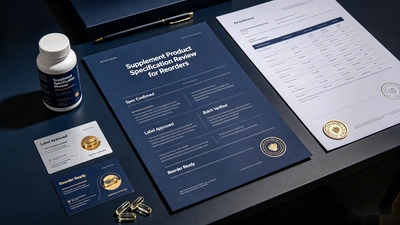
This matters because ingredient names alone do not always define the product.
Two extracts may carry the same common name but have different concentrations or carriers. Two flavors described as “berry” may perform very differently in a mineral-heavy powder. A bottle with the same nominal capacity may come from a different mold and fit the label differently.
The first commercial batch should establish the version that future batches are expected to follow.
Without that reference, “make it the same as last time” leaves too much open to interpretation.
Discuss the second order before the first one ships
Brands often ask about production lead time but forget to ask about the complete reorder timeline.
Production is only one part of it. Raw materials may need to be purchased. Labels may need to be reprinted. Printed packaging may come from another supplier. Export preparation and freight also take time.
A product using common ingredients and stock bottles can usually be replenished more easily than one using a branded extract and custom packaging.
The manufacturer should explain which materials are likely to drive the next lead time and whether unused ingredients or labels will be retained.
That conversation belongs in the first order—not when the brand has only two weeks of inventory left.
Factory example: We have reviewed projects described as “500 bottles of one capsule formula” that turned into two counts and two languages. Technically, the blend was simple. Packing was not. The practical choices were to launch one version first, increase the total packaging quantity, or accept unused labels for later orders. Quoting the project as a simple 500-bottle job would have been misleading.
Why 500 Bottles May Not Mean a 500-Bottle Project
The finished bottle count is only the visible part of the order.
Behind it are three separate calculations: how much product the equipment can run, how much material must be purchased, and how much packaging each supplier is willing to produce.
The production batch may be larger
A blender cannot always run efficiently with exactly the amount needed for 500 bottles. A gummy line needs a workable cooking batch. Tablet compression requires setup material and in-process checks. Softgel equipment has its own batch conditions.
The manufacturer may therefore make more bulk product than the amount packed for the initial order.
That is not automatically a problem, but it should be discussed. The extra bulk may be packed separately, retained where the product allows it, or included in the cost calculation.
A quote that only shows finished bottles can hide this part of the project.
One ingredient can change the MOQ
Common raw materials are usually easier to plan around a small order. Specialty ingredients are different.
Branded ingredients, standardized botanical extracts, probiotic strains, custom flavors, and low-usage functional materials may come with supplier minimums that are much larger than one production batch requires.
The remaining material still has to be managed.
Sometimes it can be stored for a reorder. Sometimes the buyer must cover the full purchase. In other cases, the formula can use a suitable alternative that is available in a more practical quantity.
There is no single answer. The important point is that the ingredient minimum is identified before the formula and price are approved.
Packaging is often the real minimum
Standard bottles and labels are usually the easiest route for a smaller order.
Printed pouches, custom-colored bottles, blister cards, folding cartons, and stick-pack film are less flexible. Their suppliers may work with minimums that have nothing to do with the supplement factory’s filling quantity.
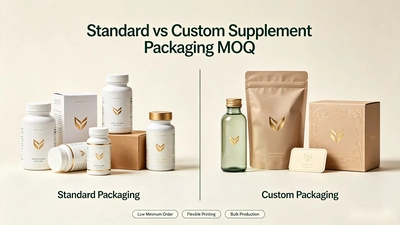
Two labels can also create two packaging jobs, even when the product inside the bottle is identical.
That is why a low production MOQ does not always produce a low complete-project MOQ.
Our guide to how supplement MOQ is determined explains these production, ingredient, and packaging factors in more detail.
Which Formats Are Easier to Start Small?
There is no dosage form that always has the lowest MOQ.
Capsules are often described as the easiest option, but that is only true when the formula fits a standard capsule and the buyer uses ordinary bottle packaging. Put those capsules into custom blister cards, and packaging may become the largest constraint in the project.
The same principle applies across formats.
| Format | A smaller run is more practical when… | What commonly changes the calculation |
|---|---|---|
| Capsules | The ingredients, shell, and bottle are standard | High fill weight, specialty ingredients, or blister packs |
| Tablets | Existing tooling and a simple finish are used | Custom shape, coating, or compression setup |
| Gummies | The base, flavor, and shape are already established | New actives, flavor work, drying, or custom molds |
| Powders | The blend uses standard jars or pouches | Flavor development and printed film |
| Liquids | The formula is validated and stock bottles are available | Stability, viscosity, and filling components |
| Softgels | The oil blend and shell specifications are established | Encapsulation batch and technical setup |
An established gummy formula may work for a trial order. A new active system, new flavor, new shape, and custom carton are not four small changes. Together, they turn the project into a new product-development job.
Powders show the same pattern. A formula packed in a stock jar may be fairly straightforward. The same blend in individually printed stick packs can have a very different packaging minimum.
The dosage form matters. The number of nonstandard decisions usually matters more.
What to Look for in a Low MOQ Manufacturer
A manufacturer does not need a forty-page brief to discuss a first order. It does need more than “I want sleep gummies” or “What is your capsule MOQ?”
A serious quotation should refer to the exact product being discussed: formula, dosage, flavor, count, packaging, label version, and destination market.
When comparing suppliers, send the same brief to each one. Otherwise, a lower price may simply mean that one factory excluded packaging, used a different formula, or quoted a different testing scope.
There are three questions worth asking early.
What exactly does the MOQ apply to?
Ask whether the number is per formula, flavor, bottle count, label, or finished SKU.
Do not assume the quantity can be split freely.
A factory may be able to manufacture one blend and fill it into two bottle counts, but the labels, cartons, and packing setup still need to be handled separately.
Which part of the project creates the highest minimum?
Sometimes it is production. Sometimes it is a raw material. Very often, it is packaging.
A useful manufacturer will tell you which part is driving the number. That gives the buyer a choice.
If the custom carton is the problem, the first order may use a bottle and label only. If one ingredient has a difficult purchase minimum, the formula may be adjusted. If multiple labels create too many SKUs, one market can launch first.
A low MOQ is most useful when the manufacturer can show how to make the project simpler—not when it only repeats a small number.
Will the same product be available next time?
Ask what will be retained after the first batch.
The manufacturer should be able to identify the formula version, relevant material specifications, packaging details, and approved artwork. It should also explain how a larger reorder would affect production.
The lowest MOQ is not a good deal if the formula must be changed at the second order because the original raw material is unavailable or the packaging cannot be purchased again.
For a broader review of samples, packaging, testing, and commercial terms, see our supplement manufacturer quote checks.
How Jiabei Health Reviews a Low MOQ Project
At Jiabei Health, we do not confirm an MOQ from “capsules,” “gummies,” or “powder” alone.
We first look at the actual product.
That includes the formula, workable production batch, requested finished quantity, packaging components, and number of SKUs. The target market matters as well, especially when the order includes different languages or market-specific label versions.
Selected formulas in standard bottle packaging may begin from approximately 500 bottles. The cleanest setup is usually one formula, one finished SKU, and one label version.
When the project includes custom ingredients, several flavors, printed pouches, custom cartons, or multiple markets, we separate those requirements before confirming the final quantity.
This matters because buyers need to know where the real minimum comes from.
If the formula works but the carton quantity does not, the packaging can be simplified. If the order creates too many SKUs, the launch can be narrowed. If a specialty ingredient drives the cost, the buyer can decide whether to purchase the remaining material or revise the formula.
The aim is not to force every product into the smallest possible order. It is to find a starting quantity that the factory can produce correctly and the brand can reorder without rebuilding the project.
Jiabei Health manufactures gummies, capsules, tablets, powders, liquids, and softgels for international private label, OEM, and ODM customers. Details of our GMP, FSSC 22000, BRCGS, HACCP, and Halal systems are available on our supplement manufacturing certifications page.
Frequently Asked Questions
What is a realistic low MOQ for supplement manufacturing?
There is no single industry number. Selected formulas using standard bottle packaging may start at around 500 bottles, while custom gummies, softgels, specialty ingredients, printed pouches, and multiple SKUs may require more. The finished product—not only the dosage form—determines the practical MOQ.
Can a custom formula be made at a low MOQ?
Sometimes. A custom formula is easier to produce in a smaller run when it uses available ingredients and an established manufacturing process. Specialty raw materials, high active loads, complex flavors, or unusual packaging can raise the minimum. The complete formula needs to be reviewed before the quantity is confirmed.
Is MOQ calculated per formula or per SKU?
Both can matter. One production batch may be shared, but different flavors, counts, labels, languages, or packaging formats create separate finished SKUs. Those versions may require different packaging quantities and production setups.
What should I send to get an accurate MOQ?
Send the dosage form, formula or ingredient concept, serving size, count per container, flavor, target quantity, packaging preference, destination market, and number of label versions. With those details, the manufacturer can review the actual project rather than provide a general website number.
A Small Order Should Still Be a Real Product
The best first order is not always the one with the lowest bottle count.
It is the one the factory can make consistently, the brand can sell confidently, and both sides can reproduce when inventory runs low.
Keep the first SKU focused. Spend the customization budget on the formula and product features that matter. Use packaging that is available at the starting volume. Confirm the product specification before production, and discuss the reorder before the first batch ships.
The right low MOQ supplement manufacturer will not hide behind one advertised number. It will show which part of the project drives the MOQ and help the buyer choose a workable route.
Send Jiabei Health your formula direction, dosage form, target quantity, market, and packaging requirements to request a project-specific MOQ.