
Dietary Supplement Manufacturer Certifications & Quality Standards
Jiabei Health operates under internationally recognized food safety and quality management systems.
Our supplement manufacturing facility is certified under GMP, FSSC 22000, HACCP, BRCGS, and Halal standards,
ensuring global compliance for dietary supplement brands, distributors, and private label partners.




Supplement Manufacturing Certifications We Operate Under
Our facility operates under audited supplement manufacturing and food safety systems, supporting consistent production and global compliance requirements.
-scaled-r8mpomkhyzg9ohd9jl9k5p7n4vy5ors4gnmf3lyg9s.jpg "JiaBei Health GMP Certified Manufacturing Facility | Quality Assurance")
GMP Certified Manufacturing
We follow GMP procedures across supplement manufacturing, including production control, quality management, and batch documentation to ensure consistent product standards.
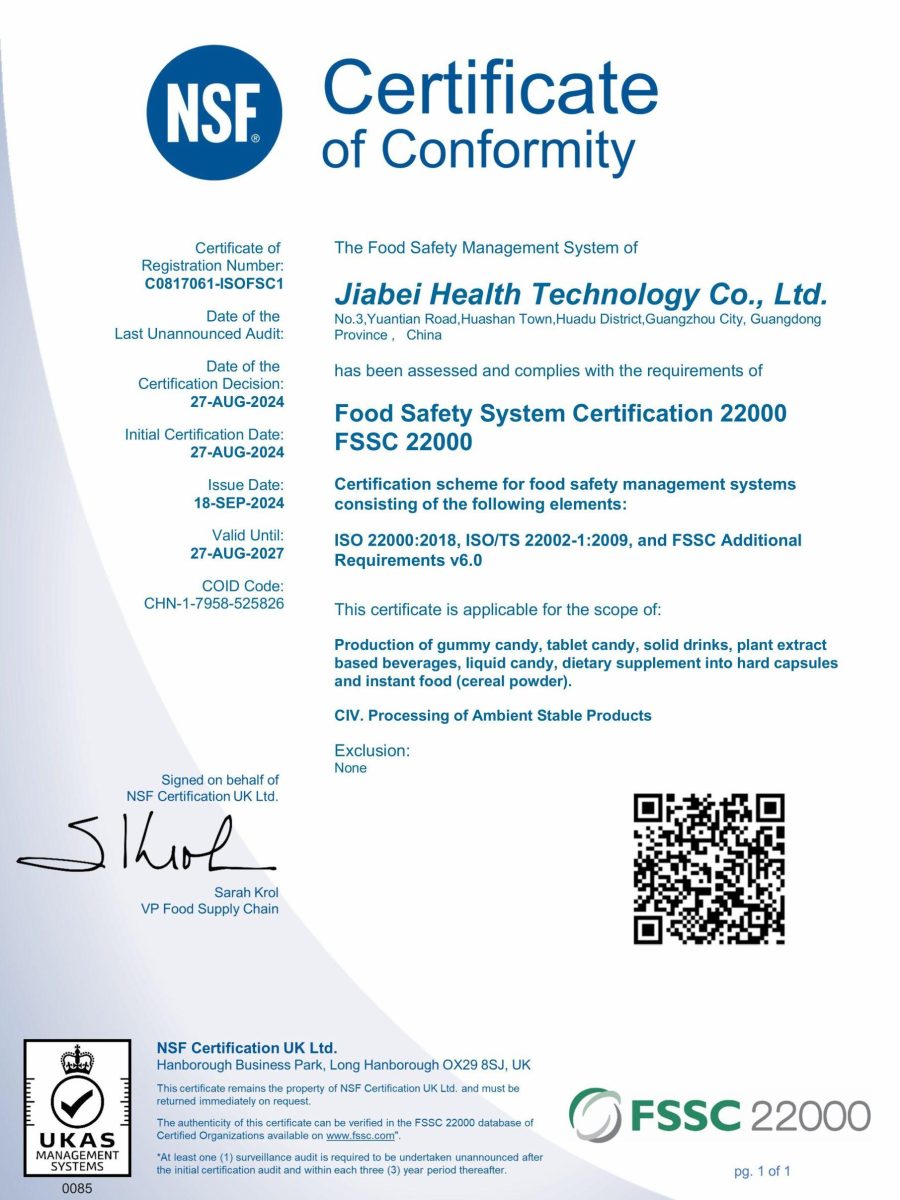
FSSC 22000 Food Safety System
Our supplement manufacturing facility operates under a structured food safety system, ensuring controlled processes and continuous compliance monitoring.
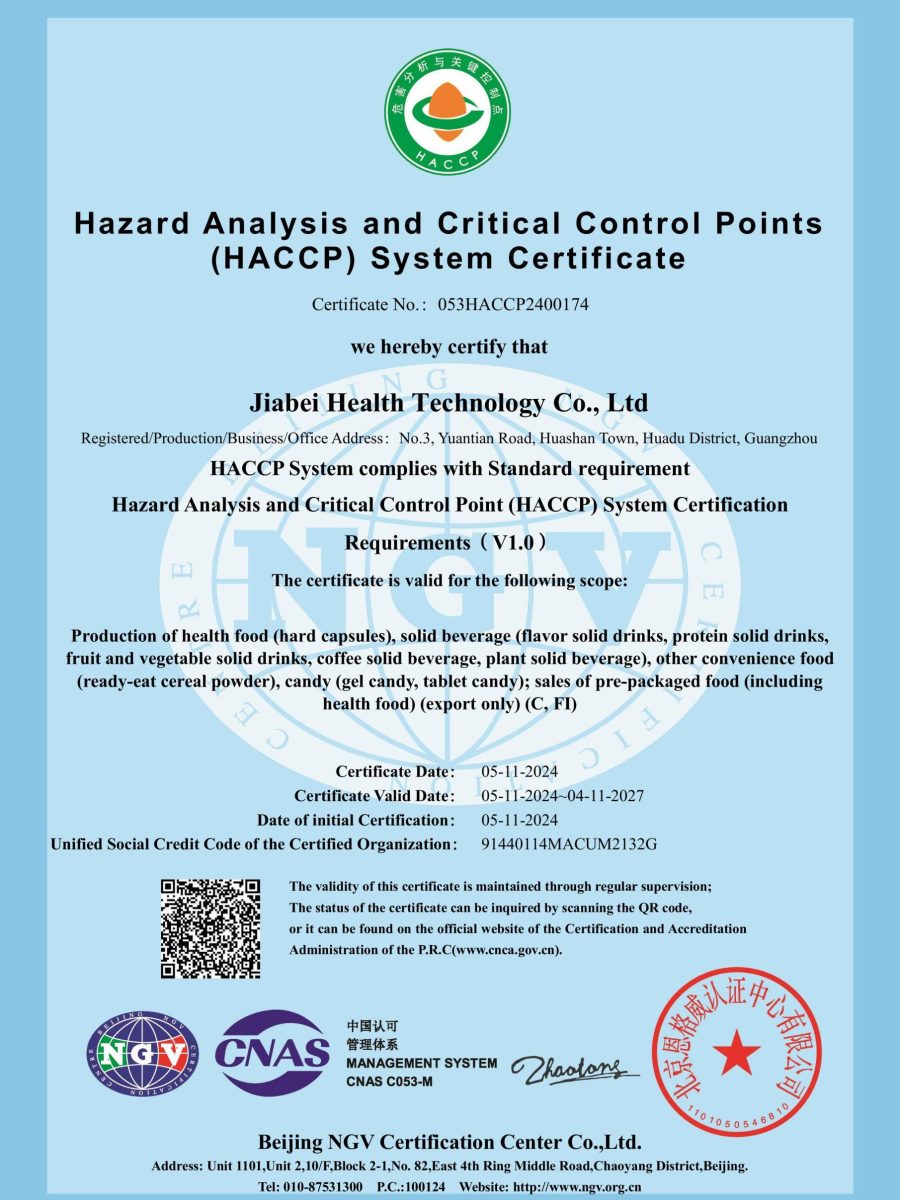
HACCP Risk Control System
We apply HACCP principles in supplement production to identify and control risks from raw materials to finished products.
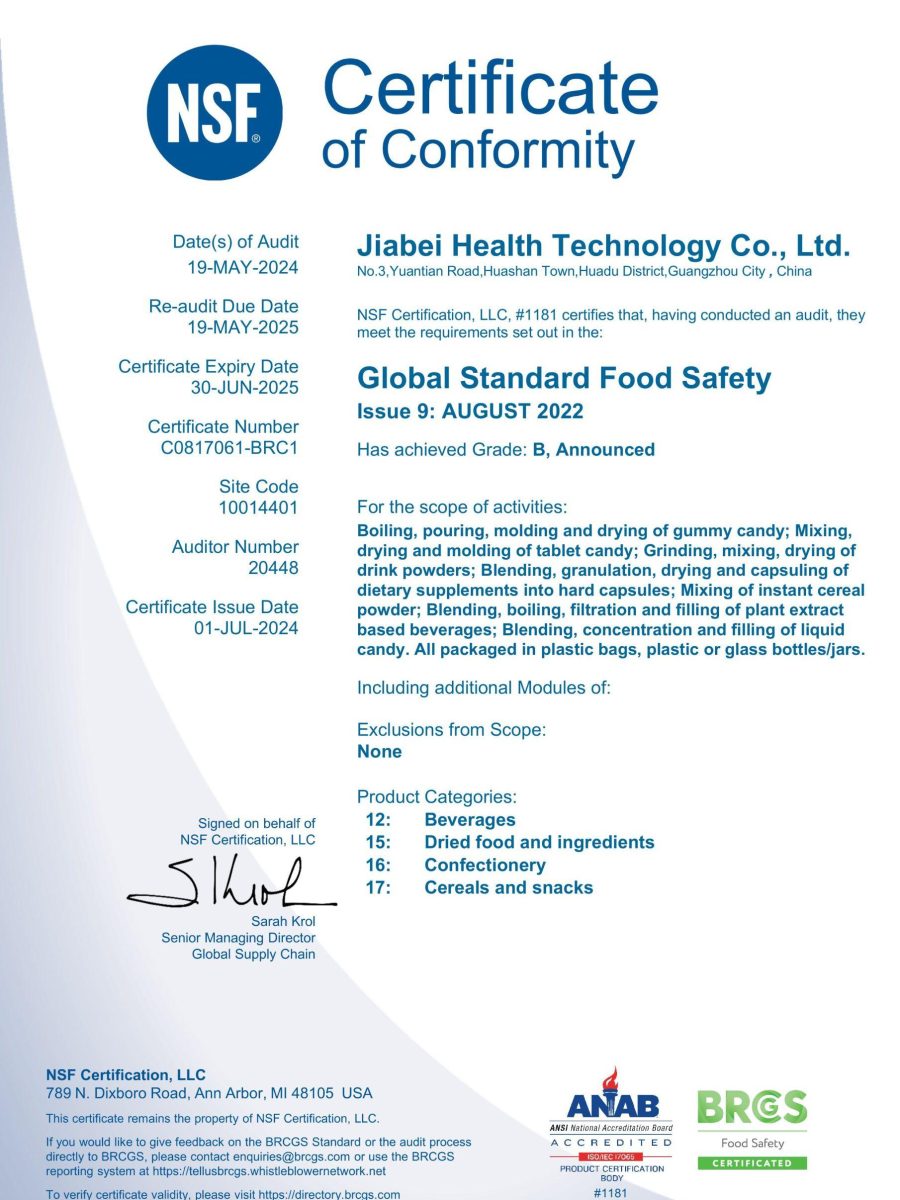
BRCGS Quality Standard
We maintain BRCGS-aligned manufacturing systems to support compliance requirements for supplement brands and distributors.
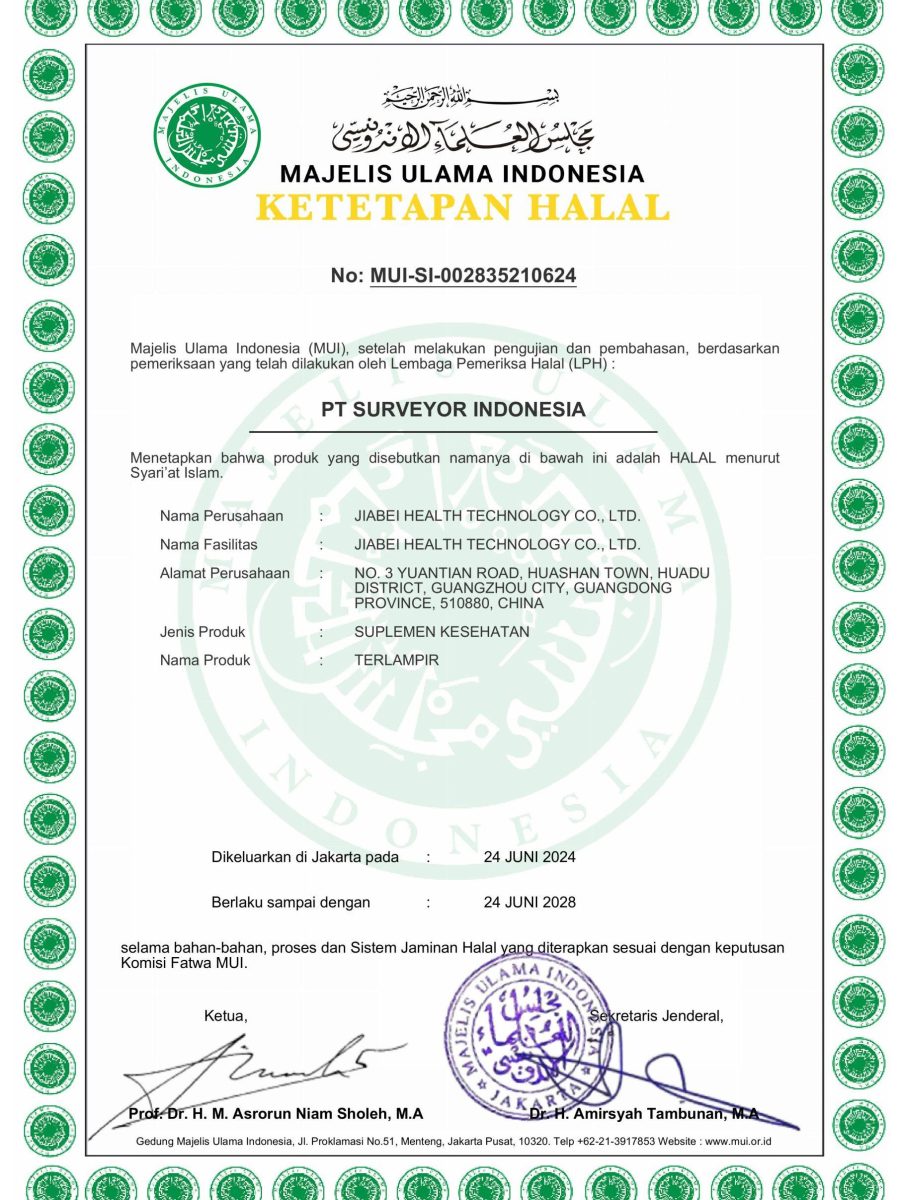
Halal Certified Production
Our supplement manufacturing process meets halal requirements, supporting product development for Southeast Asia and global halal markets.

FDA Registered Facility
Our supplement manufacturing facility is registered with the FDA, supporting compliance and documentation for U.S. market distribution.
Which Certifications Matter for Different Markets?
Our supplement manufacturing system supports different compliance requirements across global markets.
United States
- FDA registration for facility compliance
- GMP-based supplement manufacturing systems
- Batch-level COA and documentation
- Labeling aligned with U.S. supplement standards
European Union
- Strong focus on food safety systems
- Ingredient traceability in supplement production and documentation
- Regulatory compliance for labeling and claims
- Consistent production and quality records
Southeast Asia
- Halal certification for key markets
- Import documentation and compliance support
- Flexible supplement formulation and labeling
- Growing demand for functional supplements
Middle East & Halal
- Halal-certified production systems
- Clean-label supplement ingredients
- Market-specific documentation support
- Alignment with regional regulatory expectations
What Defines Supplement Manufacturing Quality Beyond Certifications
Certifications are just the baseline.
True manufacturing reliability comes from traceability, process control, and consistent execution.

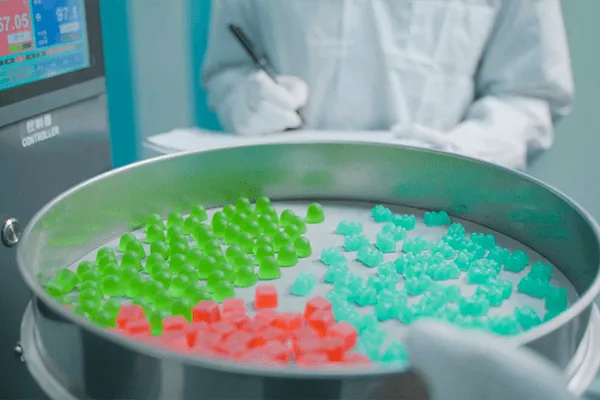
- Batch-Level COA Support
We provide Certificate of Analysis (COA) for each batch, supporting product verification and regulatory requirements.
- Raw Material Traceability
All raw materials are tracked and documented, ensuring transparency from sourcing to finished products.
- In-Process Quality Control
Quality checks are applied throughout production to maintain consistency and reduce risk.
- Finished Product Testing
Finished products are tested before release to ensure compliance with specifications and safety standards.
- Export Documentation Support
We support required documentation such as free sale certificates, certificates of origin, and shipping compliance files.
Supplement Manufacturer Certifications Explained
Choosing a certified supplement manufacturer is not just about displaying logos. Each certification reflects a different part of dietary supplement manufacturing, from GMP control and food safety systems to halal compliance, retailer audits, and U.S. market documentation.
GMP Certified Supplement Manufacturer
GMP is one of the most important standards in dietary supplement manufacturing. It shows that the factory follows documented production procedures, batch records, traceability systems, and controlled quality practices across daily operations.
- Supports batch consistency, traceability, and production control
- Often expected by importers, brand owners, and compliance teams
BRCGS Certified Supplement Manufacturing
BRCGS is widely recognized in supplier qualification for retail, distribution, and international food-related channels. It helps buyers evaluate whether a supplement factory is prepared for stricter audit standards, supplier reviews, and documented quality management.
- Valuable for retailer, distributor, and importer assessment
- Strengthens confidence during factory audits and vendor reviews
FSSC 22000 Supplement Manufacturer
FSSC 22000 focuses on food safety system management. For supplement manufacturing, it signals that the facility works with structured risk control, monitoring procedures, and preventive systems that are often important for international buyers and cross-border supply programs.
- Supports global food safety expectations and buyer confidence
- Useful for international supplier qualification and audit readiness
Halal Certified Supplement Manufacturer
Halal certification is especially important for brands targeting Muslim markets in Southeast Asia, the Middle East, and other halal-sensitive regions. It covers more than ingredients alone, because buyers also care about sourcing, handling, process compliance, and market entry requirements.
- Supports halal-compliant ingredient selection and production control
- Important for export access in halal-focused markets
HACCP in Dietary Supplement Manufacturing
HACCP helps identify, evaluate, and control critical risks throughout the manufacturing process. In a supplement factory, this matters for raw material handling, processing, packaging, and release, especially when buyers want clearer preventive control rather than reactive correction.
- Helps reduce production risk through preventive process control
- Supports safer, more stable, and more reviewable operations
FDA Registered Supplement Manufacturer
For brands entering the U.S. market, FDA registration is a familiar checkpoint during supplier review. It helps support documentation readiness and regulatory transparency, but it should be understood correctly, because FDA registration is not the same as product approval.
- Relevant for U.S. market documentation and supplier screening
- Important to distinguish FDA registration from FDA approval
Supplement Manufacturing Certifications FAQ
Common questions buyers ask when evaluating certified supplement manufacturers, including GMP, HACCP, FSSC 22000, and global compliance requirements.
What certifications should a supplement manufacturer have?
Most buyers start with GMP certification, since it directly reflects how supplements are produced and controlled. In practice, many also look for HACCP or FSSC 22000 to assess food safety systems.
The exact requirements depend on your target market, product type, and distribution channel.
Is GMP certification enough for supplement manufacturing?
GMP is essential, but it is rarely enough on its own. Many distributors and retailers expect additional certifications that cover food safety and risk management.
A combination of GMP, HACCP, and FSSC 22000 is often considered a more complete standard when evaluating manufacturers.
What is the difference between GMP, HACCP, and FSSC 22000?
These certifications focus on different parts of the process. GMP is about consistent production and documentation. HACCP focuses on identifying and controlling risks.
FSSC 22000 builds on food safety systems and is often required in more structured international supply chains.
Does FDA registration mean the supplement is approved?
No. FDA registration applies to the manufacturing facility, not the product itself. It means the facility is registered with the FDA, but it does not indicate product approval.
This is an important distinction for brands entering the U.S. market.
Why is Halal certification important for supplements?
Halal certification is essential when targeting markets in Southeast Asia or the Middle East. It ensures that ingredients and production processes meet halal requirements.
For many distributors in these regions, it is a basic requirement rather than an optional certification.
How do certifications affect supplement import and export?
Certifications often play a role in supplier approval and market entry. Some buyers require specific certifications before placing orders, and certain markets may request documentation during import review.
Working with a certified supplement manufacturer can help reduce compliance risks and make the process smoother.