Why certifications matter in supplement manufacturing
Supplement manufacturer certifications play a critical role in determining whether a factory can consistently meet quality, safety, and global market access requirements. They are risk-control tools. In supplement manufacturing, certifications define whether a factory can operate consistently, document correctly, and support market access over time.
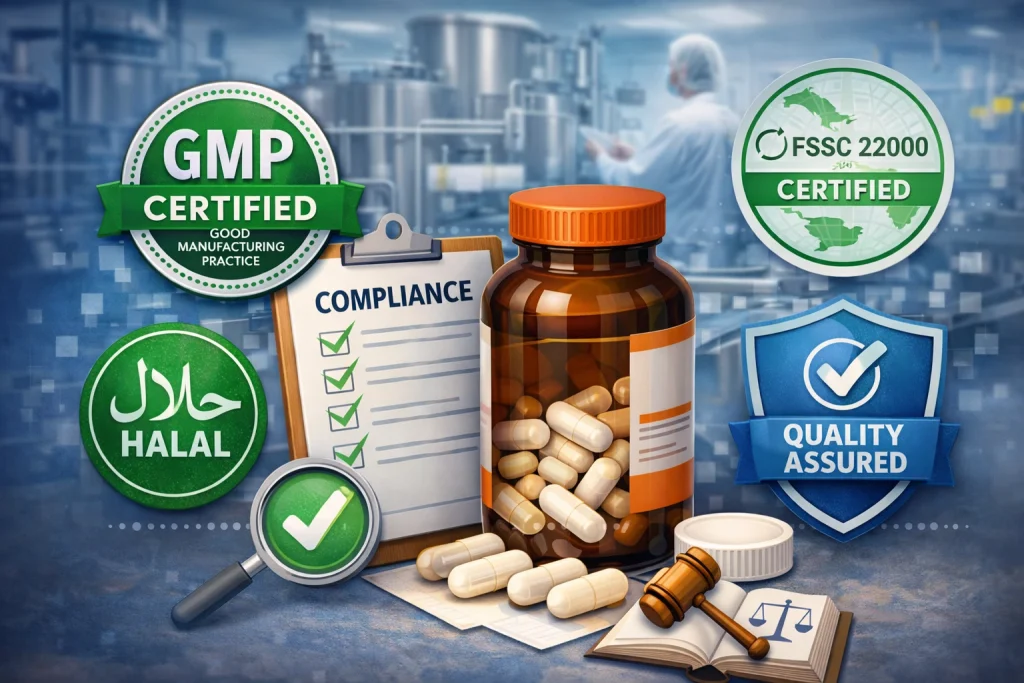
However, certifications are often misunderstood. Holding multiple certificates does not automatically guarantee operational alignment, just as lacking a specific certificate does not always indicate weak capability. Understanding how different certifications function together is essential when evaluating a long-term manufacturing partner.
How different certifications serve different purposes
No single certification covers all aspects of supplement manufacturing. Each framework addresses a specific dimension of production, quality, or market access. The real value lies in how these certifications complement one another within an integrated compliance system.
GMP: the foundation of manufacturing discipline
Good Manufacturing Practice (GMP) forms the baseline for supplement production. It governs production environment control, personnel training, sanitation, documentation practices, and deviation handling.
GMP does not define product excellence; it defines manufacturing discipline. Without it, consistency cannot be maintained at scale.
HACCP: proactive food safety risk management
HACCP focuses on identifying and controlling potential food safety hazards before they occur. Rather than relying solely on end-product testing, HACCP establishes preventive controls throughout the production process.
For supplement brands, HACCP demonstrates that safety risks are managed systematically rather than reactively.
FSSC 22000: advanced food safety management systems
FSSC 22000 builds upon ISO 22000 and prerequisite programs to create a comprehensive food safety management framework. It is widely recognized by international buyers and regulatory bodies.
Factories certified to FSSC 22000 typically operate with higher documentation depth, audit readiness, and process integration across departments.
BRCGS: global retailer and distributor confidence
BRCGS certification is particularly valued by large distributors and retail-focused brands. It emphasizes supplier accountability, traceability, and continuous improvement within the supply chain.
For buyers supplying multiple markets, BRCGS often serves as a strong indicator of a factory’s readiness to support large-scale distribution.
Halal certifications: market access beyond food safety
Halal certification extends beyond ingredient approval. It covers raw material sourcing, production segregation, sanitation procedures, and traceability to ensure compliance with Halal principles.
For brands targeting Muslim-majority markets, Halal certification is not optional—it is a prerequisite for entry.
BPJPH Halal: mandatory compliance for the Indonesian market
BPJPH Halal is Indonesia’s official Halal regulatory framework. Unlike voluntary Halal schemes, BPJPH compliance is legally required for products entering the Indonesian market.
Understanding the distinction between general Halal certification and BPJPH Halal approval is critical for brands planning regional expansion.
KETETAPAN HALAL: formal Halal determination documentation
KETETAPAN HALAL represents the formal Halal determination issued under recognized Halal governance structures. It supports transparency and regulatory alignment within Halal-certified production systems.
This documentation often serves as an important supplement to broader Halal certification frameworks.
Kosher certification: niche trust with global relevance
Kosher certification verifies compliance with Jewish dietary laws. While market demand is more specialized, Kosher certification can enhance trust among certain distributors and consumer segments.
For manufacturers, Kosher compliance requires strict ingredient verification and process control.
FDA registration: market entry, not quality certification
FDA registration is frequently misunderstood. It is a facility registration requirement for the U.S. market, not a quality certification.
While essential for U.S. market access, FDA registration does not replace GMP or food safety certifications. It functions as a regulatory entry point rather than a quality benchmark.
COA and trade documentation: operational proof at the batch level
A Certificate of Analysis (COA) provides batch-specific verification of product specifications. Unlike certifications, COAs operate at the production batch level and directly support quality verification and customs clearance.
Trade documents such as Free Sale Certificates further support international distribution by confirming legal marketability.
How certifications work together in practice
Experienced buyers do not evaluate certifications in isolation. They assess how manufacturing discipline, food safety management, religious compliance, and documentation systems function together.
A robust compliance framework enables stable production, smoother audits, and predictable market access—especially during supplier transitions or volume expansion.
Explore individual certification requirements in detail
For buyers requiring deeper insight into specific certifications, detailed explanations are available below:
- GMP supplement manufacturing
- HACCP certification for supplements
- FSSC 22000 certified supplement manufacturer
- BRCGS certification for supplement manufacturing
- Halal certified supplement manufacturer
- BPJPH Halal certification for supplements
- KETETAPAN HALAL compliance
- Kosher certified supplement manufacturing
- FDA registered supplement manufacturer
- certificate of analysis for supplements