You send the same vitamin product idea to three manufacturers.
One quote comes back low.
One is much higher.
One factory will not even give a final number until you answer more questions.
Most buyers see this and think one factory is expensive, one is competitive, and one is wasting time.
In real manufacturing, that is usually not what is happening.
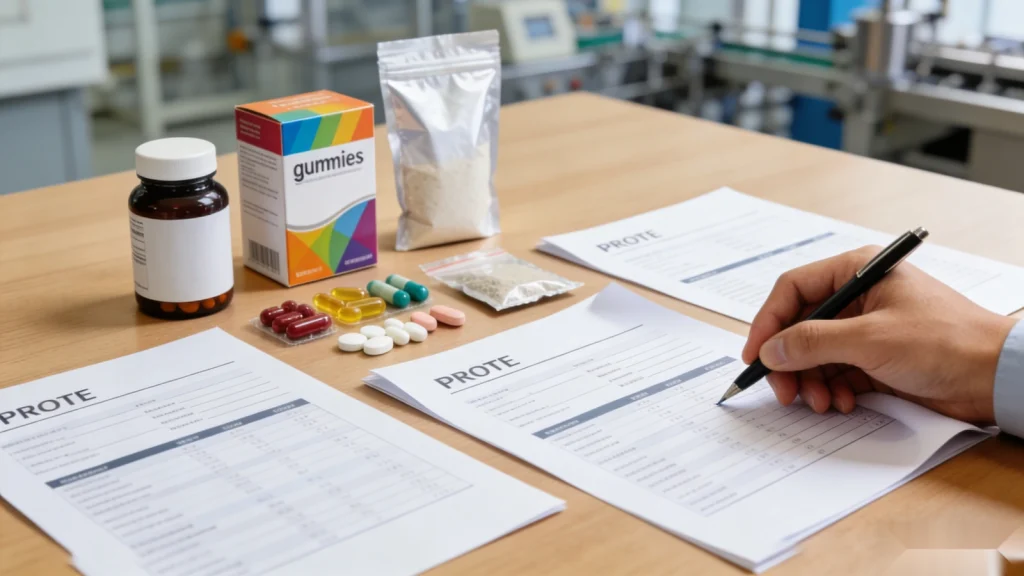
A vitamin manufacturing quote is not based on the product name alone. In most cases, it quickly turns into a broader OEM and ODM manufacturing discussion once dosage form, packaging, customization level, and launch goals are defined. At that stage, buyers are often sharing more than a basic product idea, which is also why some projects begin to raise confidentiality questions early on. It is a price for a production path.
That is why two quotes can look far apart even when the product idea sounds similar.
The buyer sees one product.
The factory sees one full manufacturing project.
What Really Changes a Vitamin Manufacturing Quote
| Factor | What buyers often think | What manufacturers are actually evaluating | Why the quote changes |
|---|---|---|---|
| Dosage form | Just the product format | Equipment, process route, labor, yield, and packaging flow | Different formats create different cost structures |
| Formula feasibility | Ingredient cost | Whether the formula can actually work in the chosen format | Difficult formulas add development work and production risk |
| Factory capacity | Delivery speed | Current line availability, schedule pressure, and production value | Busy lines and difficult scheduling can raise cost |
| Packaging | Bottle, label, box | Material sourcing, packaging speed, labor, and complexity | Packaging can reshape the entire quote |
| Mold requirement | A one-time fee | Whether an existing mold can be reused or a custom shape is needed | Custom shapes can move a project into a different pricing category |
| Order quantity | Unit price only | Whether the order can absorb setup, sourcing minimums, and labor | Low volume can make the full project structure less efficient |
1. Dosage Form Changes the Entire Production Route
A gummy product and a capsule product may both sit under the vitamin category, but they rarely follow the same production route, and the same becomes even more obvious in custom powder supplement projects.
That is the first thing many buyers underestimate.
Dosage form is not just about how the product looks on the shelf. It decides which machines are used, how many process steps are involved, how much labor is needed, what the typical yield looks like, and what kind of packaging path follows after production.
A gummy project has to deal with cooking, depositing, drying, demolding, and appearance control.
A capsule project depends more on powder behavior, filling efficiency, and capsule size compatibility.
A tablet project brings compression, hardness, and surface consistency into the discussion.
A powder project has its own demands around blending, flavor handling, filling, and packaging fit.
This is why dosage form usually sets the starting point of the quote. It is not a detail. It is the base structure.
2. Formula Feasibility Can Raise Cost Even Before Production Starts
This is where buyers and factories often think in completely different ways.
A buyer may look at a formula and focus on the ingredients listed. A manufacturer looks at the same formula and asks a harder question: can this formula actually work in the target dosage form without creating major problems?
That question matters because not every formula is easy to execute.
Some ingredient ratios make the color darker than expected.
Some combinations create bitterness, sourness, mineral harshness, or an herbal aftertaste.
Some formulas affect texture, flowability, filling performance, or forming consistency.
Some look clean on paper but become difficult when they move into a real manufacturing environment.
That is where development cost begins to rise.
A manufacturer may need to adjust the flavor system, add sweeteners, improve balance, or use extra support ingredients to make the product acceptable. In other cases, the original formula direction may need to be simplified because the target result is not practical in that dosage form.
So formula cost is not only about raw material price. It is also about whether the formula can be made well, tasted well, and produced consistently.
Common Formula Issues That Can Affect a Quote
| Formula issue | What usually happens next |
|---|---|
| Strong bitterness or herbal aftertaste | Flavor masking or sweetener support may be needed |
| Dark or unstable color | Appearance correction may be needed |
| High acidity or imbalance | The taste system may need to be rebuilt |
| Poor ingredient ratio | Flowability, texture, forming, or filling may suffer |
| Weak manufacturability | More development time and more production risk |
| Wrong fit for the dosage form | The format or the formula may need to change |
From a factory’s point of view, a formula is not just a recipe. It is a manufacturability test.
3. Factory Capacity Does More Than Affect Lead Time
Many buyers think factory capacity only affects how fast the order can be delivered.
That is true, but it is only part of the story.
Capacity can also affect the quote itself because manufacturers do not just ask whether they can make the product. They also ask whether the project makes sense within the current production schedule.
If the right line has open capacity, the quote may be more straightforward.
If the line is full, the project needs a difficult changeover, or the order is too small for a busy production window, the pricing logic changes.
This is why the same product can receive different quotes from the same factory at different times of the year.
From the buyer’s side, price feels fixed.
From the factory’s side, price is tied to line value, scheduling pressure, and production opportunity.
A quote is never completely separate from factory capacity.
4. Packaging Can Quietly Reshape the Whole Cost Structure
Packaging is where many quote discussions become misleading.
A buyer may first ask for the product cost and plan to discuss packaging later. In real manufacturing, that approach often creates confusion because private label packaging changes much more than appearance.
It changes material sourcing.
It changes labor.
It changes packaging speed.
It changes handling complexity.
It can even change the minimum practical quantity.
A simple bottle is not the same as a custom bottle.
A basic label is not the same as multi-version labels for different channels.
A bottle-only pack is not the same as bottle plus carton, pouch packaging, or gift-style sets designed for broader retail presentation.
How Packaging Choices Change the Quote
| Packaging option | What the buyer sees | What the factory sees | Quote impact |
|---|---|---|---|
| Standard bottle | Basic retail packaging | Mature sourcing and faster packing | Usually the most stable cost structure |
| Custom bottle | Stronger branding | More difficult sourcing and higher minimums | Higher material and handling cost |
| Bottle + carton box | More complete presentation | Extra materials and extra packing steps | Higher labor and packaging cost |
| Multi-version labels | Better market flexibility | More SKU control and more room for error | Higher execution complexity |
| Gift box or combo pack | Premium presentation | Slower assembly and more packaging components | Higher unit cost |
| Pouch format | Flexible packaging style | Different filling and sealing path | Cost may rise or fall depending on product type |
Buyers often see packaging as branding.
Factories see packaging as cost, labor, and execution complexity.
That is why packaging can open a large gap between two quotes even when the formula itself stays the same.
5. Mold Requirements Are Small on Paper but Big in Practice
This point matters most in gummies, chewables, and shape-sensitive products.
Many buyers treat molds as a simple one-time fee. Manufacturers usually take a wider view.
The first question is whether an existing mold can be used.
If yes, the project stays closer to a standard quote.
If not, the project may move into a more customized path.
The second question is whether the requested shape affects forming efficiency, demolding performance, visual consistency, or waste rate.
That is where mold decisions become more serious than they look.
A custom shape can change more than setup cost. It can affect output stability and even how the full project is classified internally.
In other words, mold requirements are not just a design issue. They can shift the quote from standard manufacturing to custom manufacturing.
6. Order Quantity Decides Whether the Full Project Structure Works
Most buyers understand that higher quantity usually lowers unit cost.
That part is simple.
What many buyers miss is that quantity also decides whether the overall project structure makes sense.
All the hidden setup elements need to be absorbed somewhere: development work, packaging setup, sourcing minimums, mold use, line changeover, and labor allocation.
Order quantity is what spreads those costs.
That means low quantity does not only raise unit price. It can also affect whether:
- a custom package is practical
- a mold change is worth opening
- a complex formula is worth taking
- the project fits the factory’s scheduling priorities
In some cases, the issue is not that the factory cannot do the order. The issue is that the proposed quantity does not support the full manufacturing structure behind the product.
That is a major difference.
Other Factors That Can Also Widen Quote Gaps
The six factors above are the main structure. A few other variables can also change a vitamin manufacturing quote.
| Additional factor | Why it matters |
|---|---|
| Lead time | Rush projects can increase scheduling pressure and cost |
| Stock formula vs. custom formula | Custom projects usually need more development and adjustment |
| Target market | Different markets may require different labels, claims, or testing |
| Compliance and testing requirements | Extra testing or documentation can raise total project cost |
| Ingredient sourcing stability | Some materials are harder to secure and less predictable in timing |
| Delivery scope | Ex-factory pricing is not the same as a fully packed finished-goods quote |
These factors may not be the first things buyers think about, but they often explain why two quotes that look similar are not actually comparable.
What Buyers Should Clarify Before Requesting a Quote
A better quote usually starts with a better inquiry.
Before asking for a vitamin manufacturing quote, it helps to define the following points clearly:
| What to clarify | Why it matters |
|---|---|
| Dosage form | It sets the manufacturing route |
| Formula direction | It shows whether the project is simple, workable, or development-heavy |
| Packaging level | It changes material, labor, and execution cost |
| Mold or shape requirement | It affects whether the project stays standard or becomes custom |
| Order quantity | It determines whether setup costs can be absorbed properly |
| Target market | It may change labels, claims, and testing needs |
| Project timing | It affects scheduling and production window |
| Stock or custom path | It changes how much development work is involved |
The clearer these points are, the more realistic and useful the quote will be.
Final Thoughts
Most quote gaps do not come from one factory simply being expensive and another being cheap.
They usually come from how each factory interprets the project.
A vitamin manufacturing quote is shaped by dosage form, formula feasibility, factory capacity, packaging, mold requirements, and order quantity. Once even two or three of those factors are understood differently, the pricing can move fast.
That is why a good quote is not just a number.
It tells you what is driving the cost, what still needs to be confirmed, and where the real differences between manufacturers begin.
FAQ
What is included in a vitamin manufacturing quote?
A vitamin manufacturing quote usually reflects more than ingredient cost. It may include dosage form assumptions, formula complexity, packaging level, mold requirements, production setup, and order quantity.
Why do quotes for a similar vitamin product vary so much?
Because factories are often not pricing the same production conditions. Differences in dosage form, formula feasibility, packaging, schedule pressure, and order quantity can all change the final number.
Does packaging really affect a vitamin manufacturing quote that much?
Yes. Packaging changes sourcing complexity, material cost, labor input, packing speed, and finished-goods handling. A basic bottle and a retail-ready custom pack do not have the same cost structure.
Can formula difficulty increase the quote even if the ingredients are common?
Yes. A formula may still require extra development work to improve color, taste, texture, flowability, or manufacturability. That increases both effort and production complexity.
Why does order quantity matter beyond unit price?
Because quantity helps absorb setup cost, sourcing minimums, mold use, line changeover, and labor allocation. If the quantity is too low, the whole project structure may become less efficient.