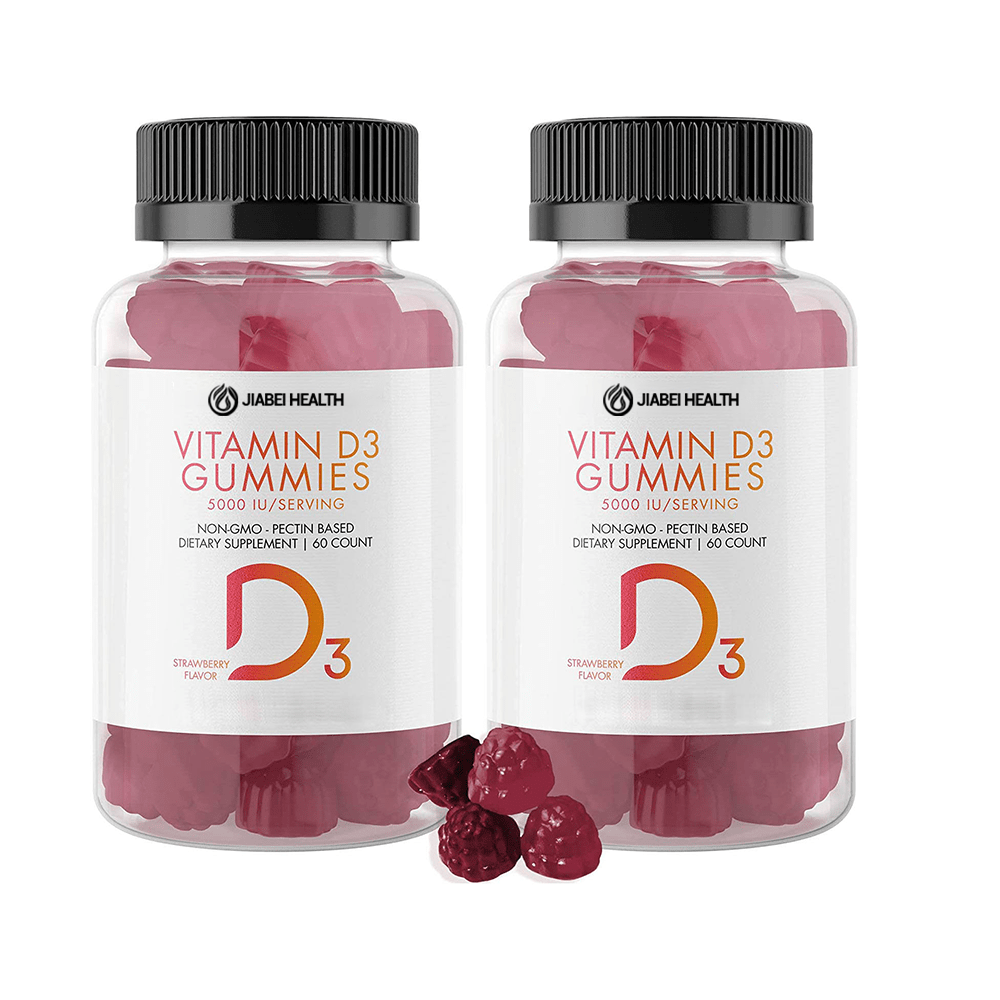
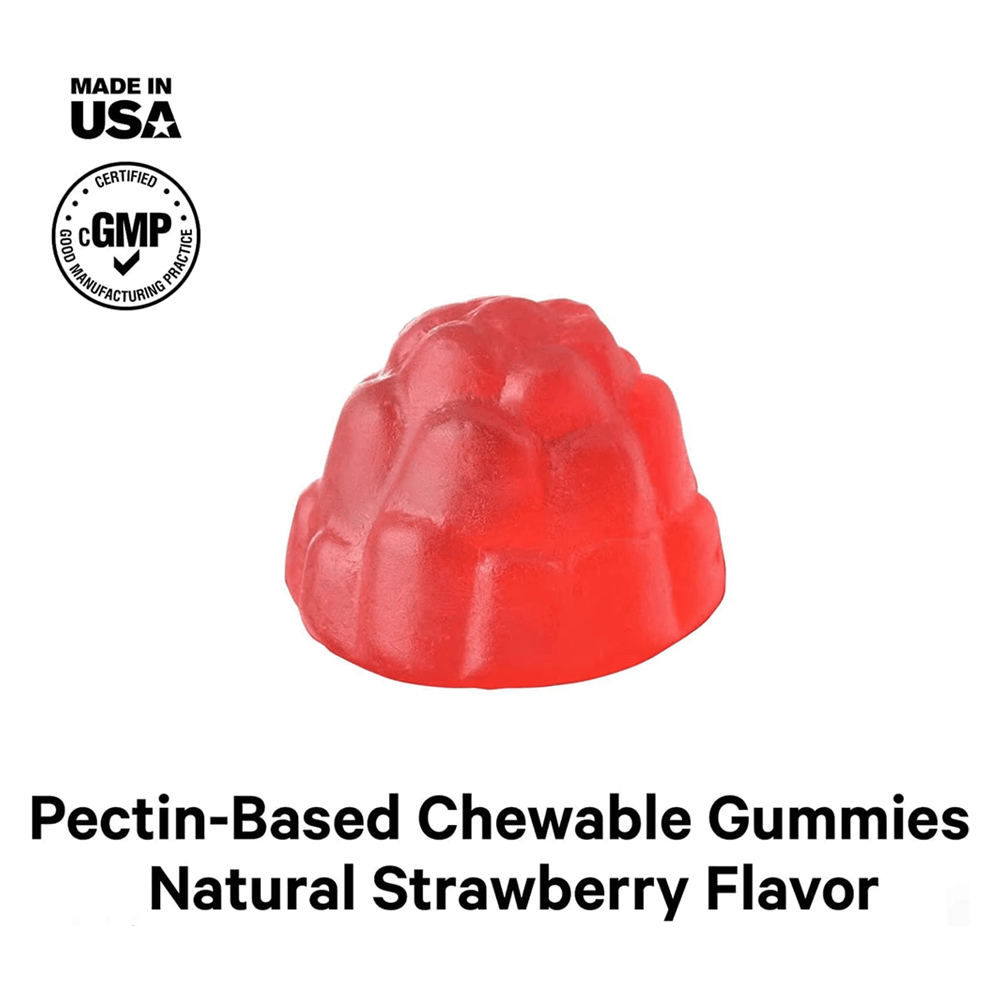
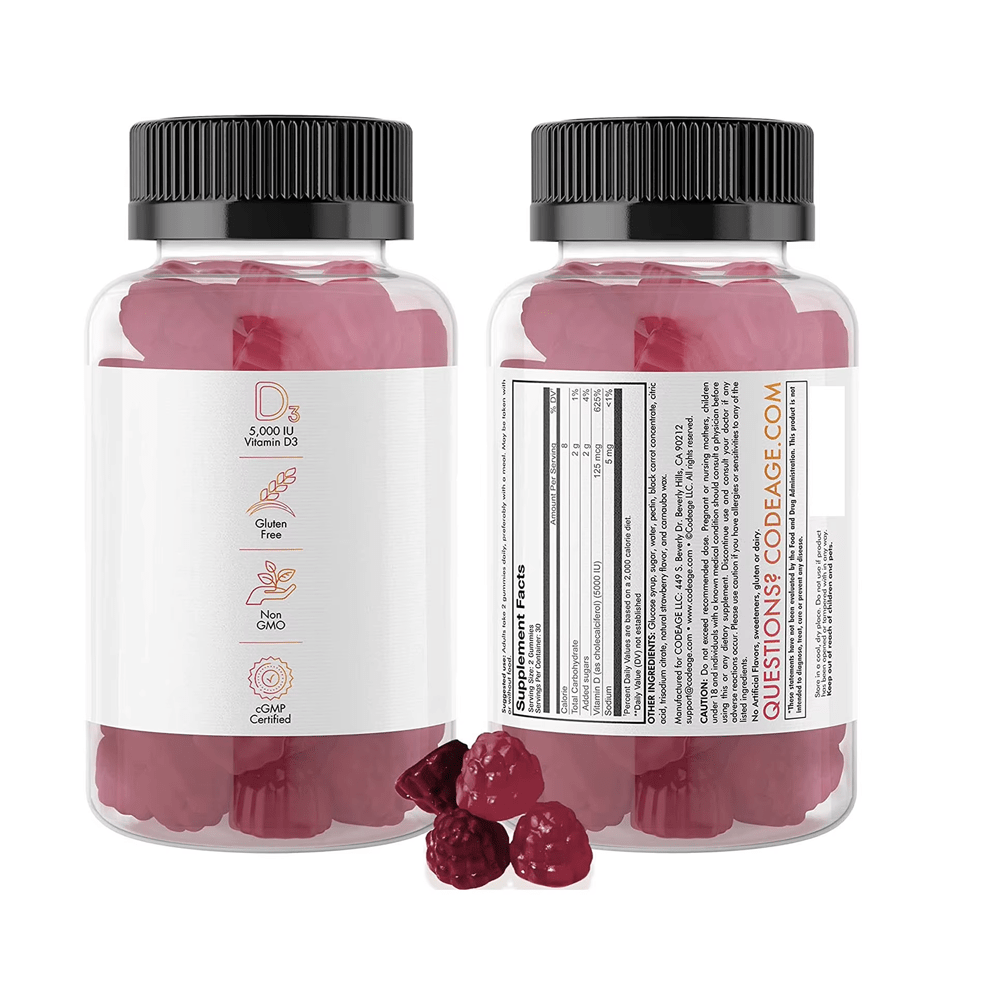
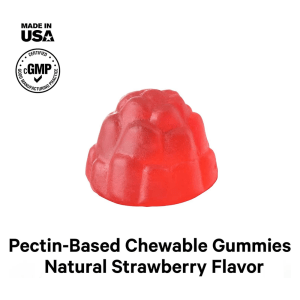
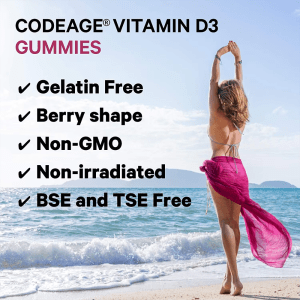
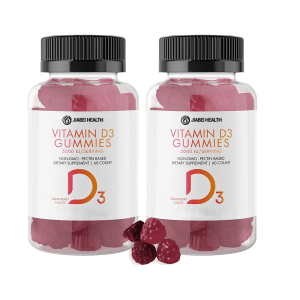
This is a pectin-based, strawberry-flavored Vitamin D3 gummy that delivers 5000 IU per piece. We don’t treat it as a stock product sitting on a shelf waiting for a label. We built it as a starting point — a stable, well-tested base formula that can be adjusted around a brand’s specific positioning.
The default setup works for supplement brands, distributors, and e-commerce sellers who want to move fast. But every part of it is negotiable: dosage, flavor, shape, color, bottle count, label copy, outer packaging. You tell us which market you’re targeting and what your line looks like, we adapt the formula and packaging accordingly.
What you’re getting here isn’t just a gummy with 5000 IU of D3 on the label. You’re getting a formulation that we’ve already put through real-world stability runs — multiple batches, different climate conditions, different packaging setups. The numbers on the COA tell the same story at month 0 and month 12. That’s the part that actually matters.
Why Brands Choose 5000 IU Vitamin D3 Gummies
We talk to a lot of brand owners, and the conversation around 5000 IU usually starts the same way. They’ve already seen the low-dose segment turn into a pricing game — 400 IU, 800 IU, 1000 IU, everyone’s fighting for the same shelf. A 5000 IU product naturally separates itself from that crowd.
From a product development perspective, the appeal isn’t just potency. It’s positioning. This format lets a brand say something clear: one gummy, one meaningful dose. Consumers who want higher-strength D3 aren’t usually looking to take four or five pieces a day. They want simplicity, and a 5000 IU gummy answers that without forcing them to swallow a capsule.
We’ve seen this product work in several line strategies:
-
A bone health product placed alongside a calcium or magnesium SKU
-
A daily wellness item for adult consumers who track their intake
-
A seasonal supplement aimed at the autumn and winter months
-
A private label series where D3 is offered in two strengths — say, 1000 IU and 5000 IU — so the brand covers both casual and committed users
The gummy format itself does a lot of the heavy lifting. Compliance drops when consumers have to psych themselves up to swallow a pill every day. A gummy doesn’t trigger that hesitation. It sounds trivial, but over a 60- or 90-day bottle, that difference shows up in repurchase rates.
One thing worth pointing out: if a brand comes to us with a formula request that pushes medical or disease-treatment language, we pull back. We’ve seen too many labels get flagged at the border because someone tried to write like a pharmacy when they should have been writing like a supplement brand. We keep the language focused on bone health, calcium absorption support, daily wellness, and immune support — structure/function territory. It’s safer, and it still sells.
Manufacturing Notes for 5000 IU Vitamin D3 Gummies
If you’ve never manufactured a high-potency gummy before, the number “5000 IU” sounds like the headline challenge. It’s not. Getting 5000 IU into a gummy is just arithmetic. The real problem is making sure every single gummy actually carries that amount, and that it still carries it six months later in a humid port city.
Uniformity comes first. Vitamin D3 is a fat-soluble vitamin. You’re adding a tiny amount of an oil-based active into a water-based gummy mass that contains pectin, sugars or sugar alcohols, flavor, acid, and color. If you don’t handle the pre-blend correctly, what happens is predictable: some gummies run hot, some run cold. We pre-disperse D3 into a compatible carrier and blend it thoroughly before it ever touches the main gummy slurry. This isn’t a shortcut you can skip. We’ve tested batches where skipping this step produced active variation of over 20% across a single depositing run.
Heat is the next enemy. Gummy manufacturing involves cooking. D3 doesn’t like prolonged high temperatures. We set strict temperature ceilings and hold-time limits on the cooking and holding tanks. The team tracks both of these on the batch record — not as a suggestion, but as a release parameter. If the mass sits too long at the wrong temperature, potency drops. We don’t guess; we assay.
Moisture is the quiet destroyer of gummy quality. Too much moisture and you get microbiological risk and sticky, deformed pieces. Too little and the gummy turns tough and chewy, and the consumer experience falls apart. We control moisture through the entire line: brix targets during cooking, drying conditions after depositing, and final water activity measurements before packing. There’s no single magic number — the target shifts slightly depending on the recipe, the shape, and the destination climate. The important thing is that we measure it, record it, and adjust accordingly.
Stability is where many private label projects run into trouble. A formula can look perfect at release and then fail at the 6-month mark. We run accelerated stability as part of the development cycle, not as an afterthought. By the time a brand receives a sample, the base formula has already been through enough testing that the 12-month numbers are not a surprise. Packaging selection ties directly into this. We match the packaging barrier properties — moisture, light, oxygen — to the route the product will travel and the climate at destination.
Before we commit to a full production run, we lock down five things with the client:
-
Raw material specification
-
Master formula
-
In-process control limits
-
Packaging specification
-
Finished product testing plan
Once those are agreed, the production batch should look a lot like the pilot batch. No surprises.
Pectin Base, Strawberry Flavor, and Texture Control
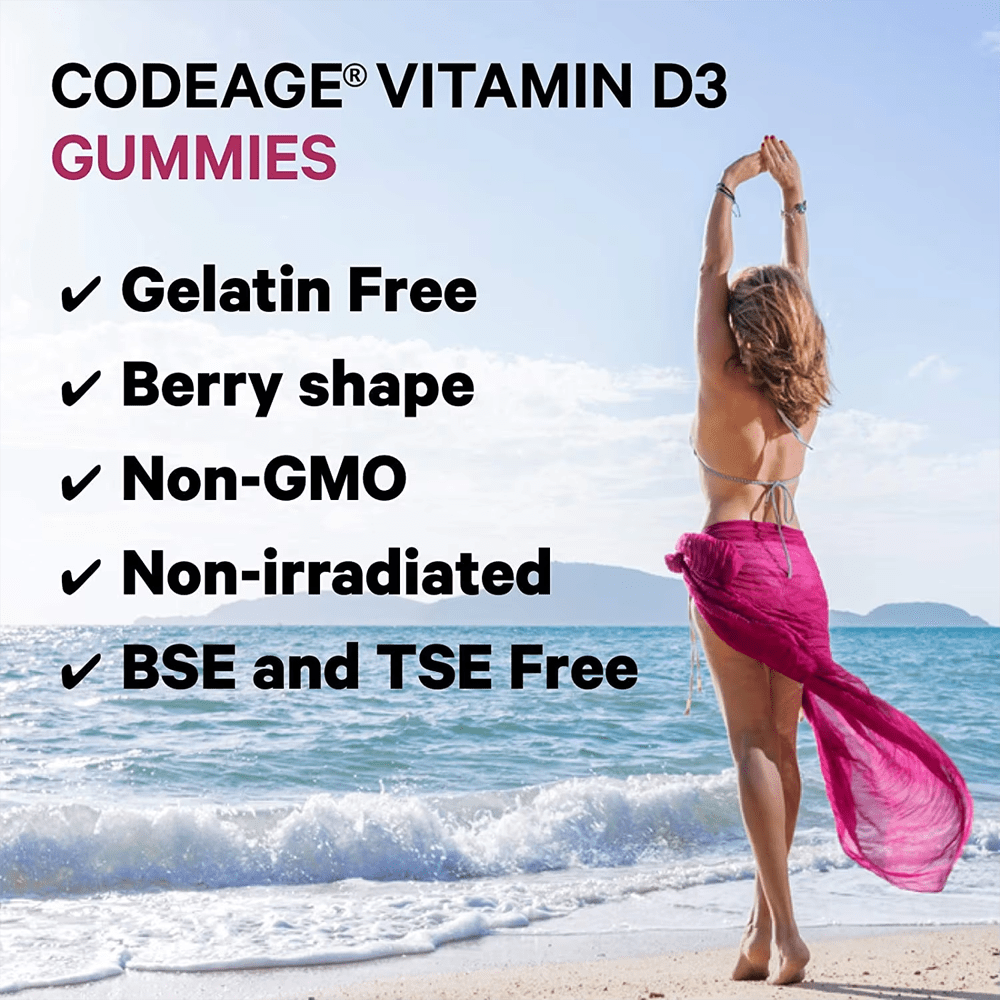
We standardize this product on a pectin base. The practical reason is straightforward: a lot of markets now expect gelatin-free, and pectin is the most reliable way to deliver that without making the texture someone else’s problem. Pectin gives a clean bite, it works for vegetarian positioning, and it holds up during transport better than some of the starch-based systems — if you manage the formula right.
Strawberry is our default flavor not because it’s exciting, but because it works. It masks the slight fatty note of D3 effectively. It’s widely accepted across age groups and regions. And it’s stable through the thermal process.
We’ve run enough flavor trials to know that replacing strawberry with a delicate profile like melon or papaya requires a lot more work on the masking system, and sometimes the result isn’t worth the novelty. For brands that want differentiation, we usually suggest starting with proven profiles — berry, orange, peach, tropical fruit — and then tweaking from there. Mixed fruit is another option if the brand wants something less single-note.
Texture is where we spend a disproportionate amount of development time. A gummy that looks good in the lab but deforms in a container after two weeks in a hot warehouse is a failed product.
We’ve learned that the texture equation includes at least six variables:
-
Pectin type and dosage
-
pH
-
Brix
-
Depositing temperature
-
Drying conditions
-
Curing time
Adjust one, and the others shift. For example, pushing the brix higher makes the gummy firmer, but it also makes depositing trickier and can change the flavor release. There’s no universal recipe. It’s a balance we dial in for each formulation based on the shape, the coating (if any), and the expected transport conditions.
We also run texture checks after simulated transport. You’d be surprised how many gummies that pass a factory QA check fail after 72 hours in a hot container simulation. We include that in our stability protocol. If the gummy arrives looking like it just left the line, the brand doesn’t have to manage returns and complaints. That’s the outcome we’re optimizing for.
Custom Formula and Packaging Options
We give brands room to move on formula. You can adjust the D3 dosage up or down from the 5000 IU baseline. You can change the flavor, color, and shape — we keep a library of available molds and also support custom mold development if the volume justifies it. The base stays pectin; we don’t compromise on that because switching to a gelatin or starch system mid-stream creates stability risks we’d rather not inherit.
Sugar-free and reduced-sugar versions are possible, but we’re honest about the trade-offs. Removing sugar changes the bulking matrix, which affects texture, moisture migration, and sometimes aftertaste. We can do it, and we have working formulas, but we walk clients through what changes so the decision is informed, not aspirational.
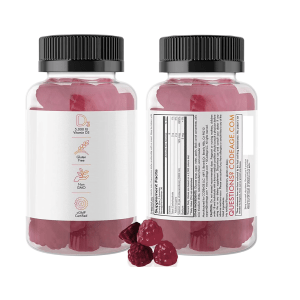
On the packaging side, the conversation usually starts with bottle count: 30, 60, or 90 gummies per bottle. From there we look at format — bottle, jar, pouch, carton, display box — and we match the material specs to the product’s needs. Moisture barrier, light barrier, and seal integrity drive those choices. Label design support is part of the package, and we can coordinate custom outer packaging as well.
Service models follow what you need:
-
OEM if you bring your own formula
-
ODM if you want us to develop it from a concept
-
Private label if you want to take our existing formula and brand it
Most D3 gummy projects end up somewhere between ODM and private label: clients take our base and tweak a few parameters. That works smoothly because the foundation is already stable.
For broader gummy capabilities, we cover more detail here:
Custom gummy supplement manufacturing
Quality Control, COA, and Batch Testing
We don’t treat quality control as a final checkpoint that rubber-stamps a finished pallet. It runs from the moment raw materials arrive until the shipment leaves.
On every batch of this D3 gummy, the testing panel covers:
-
Active ingredient assay — HPLC, not a proxy method, so the D3 number matches what’s in the gummy
-
Microbiology — total plate count, yeast and mold, E. coli, Salmonella, Staphylococcus aureus
-
Heavy metals — lead, arsenic, cadmium, mercury
-
Moisture content and water activity
-
Appearance and texture against the approved reference sample
-
Net weight verification
-
Packaging seal integrity and visual inspection
Batch traceability is something we’ve built into the workflow, not bolted on afterward. Every lot number connects to the raw material receiving records, the in-process batch sheets, the finished product COA, and the packaging logs. If a question ever comes up — from a client, a regulator, or a consumer — we can trace backward and forward without reconstructing history from memory.
We provide COA as standard. For clients who need third-party testing from an ISO 17025 lab, we coordinate that as part of the project scope.
The factory itself operates under GMP and holds FSSC 22000, BRCGS, HACCP, and where applicable by product and site, Halal and Kosher certification. We don’t display these as badges and leave it at that. They represent audit cycles and documentation we maintain year-round. When a brand asks for a quality dossier, we can pull together the relevant certificates, test reports, and audit summaries without scrambling.
Labeling and Claim Review
We spend time on labeling because we’ve learned that a well-made product can still get stuck at customs if the label language is wrong. We’re not a regulatory consultancy, so we don’t give legal advice, but we do review label drafts with a manufacturing and compliance lens.
For Vitamin D3, most brands position around:
-
Bone health
-
Calcium absorption
-
Immune support
-
Daily wellness
These fall under structure/function claims in the US market. When we see a label draft that drifts into disease language — treating, preventing, curing — we flag it. This isn’t about being conservative; it’s about keeping the product off a regulator’s desk. The FDA disclaimer statement needs to be there for structure/function claims, and the wording matters.
For a 5000 IU product, the label also needs to get serving size and directions right. We’ve seen labels where the serving size implied a daily intake that pushed against a country’s upper limit guidance. That’s a preventable problem. Warning statements, where required, should be clear and placed where the consumer actually reads them.
Two resources we point clients to:
These aren’t a substitute for a regulatory review, but they ground the conversation in official guidance rather than marketing assumptions.
Related Formula Options
If the 5000 IU D3 gummy is part of a broader line you’re building, these formats sit alongside it naturally:
-
Vitamin D3 + K2 supplement formulation guide — combining D3 and K2 in one delivery format
-
Calcium and Vitamin D3 gummies — pairing calcium with D3 in a gummy system
-
Vitamin D3 liquid drops manufacturing — liquid drops for consumers who prefer a non-gummy option
These aren’t just cross-sells. From a manufacturing standpoint, D3 + K2 and Calcium + D3 are logical next steps once the base D3 gummy is stable. The process knowledge transfers, which means the development cycle moves faster.
OEM / ODM Support from Jiabei Health
When a brand comes to us with a D3 gummy project, we don’t jump straight to a quotation. We start with a conversation about what you’re trying to do — your market, your positioning, your timeline — and then we work backward into the formula and packaging.
The typical sequence looks like this:
-
Formula discussion and target product profile
-
Sample development and iterative adjustment
-
Flavor and texture fine-tuning based on feedback
-
Packaging selection matched to product and market
-
Label content support and review
-
Pilot batch and confirmation
-
Full batch production with QC release
-
COA, export documents, and logistics coordination
We’ve handled enough global projects that the logistics piece is not an afterthought. DDP support is available where applicable, and we coordinate the documentation — COA, certificate of origin, composition sheets, free sale certificates — so the shipment clears without delays that eat into your launch timeline.
Contact Jiabei Health when you’re ready to discuss your private label Vitamin D3 gummy project. We’ll start with the formula conversation, and take it from there.
FAQ
Can Vitamin D3 gummies be made with 5000 IU per serving?
Yes. We manufacture them at this potency regularly, and we assay every batch to confirm the active content matches the label claim. The uniformity data backs it up.
Are these Vitamin D3 gummies gelatin-free?
Yes. The base is pectin, so they’re gelatin-free by default. If your market requires a specific vegetarian or plant-based statement, we can advise on wording that aligns with the formulation.
Can the flavor and shape be customized?
Yes. Flavor, color, and shape are all adjustable. We keep a mold library and also support custom mold development for clients with sufficient volume and a clear design direction.
Can Vitamin D3 gummies be combined with K2?
Yes. We’ve worked on D3 + K2 combination formulas before. The manufacturing considerations shift slightly — K2 is even more sensitive to light and oxidation — but it’s a well-established combination we can handle. Our D3 + K2 guide covers more detail.
What documents can be provided for private label buyers?
As standard: COA for the finished batch. We can also provide raw material COAs, specification sheets, stability summaries, and third-party testing reports when arranged in advance. The document package is tailored to what your destination market requires.
Are these gummies suitable for global OEM projects?
Yes. We export regularly to multiple regions, and we adapt packaging, labeling, and documentation to the destination country’s requirements. DDP terms are available for many routes, which simplifies the process for brands without their own import infrastructure.