“FDA registered supplement manufacturer” — if you’re searching that, you’re already on the right track for the U.S. market. But registration is just step one. I’ve worked in supplement formulation and quality for over a decade, and I’ll tell you straight: the gap between a registration number and a production line that won’t get you in trouble is bigger than it seems.
That number tells you the facility exists. It doesn’t tell you if your gummies will survive shipping, if your capsules will pass a heavy metal check, or if your label will clear an Amazon review. I’ve seen all three go wrong.
So this isn’t a guide. It’s a checklist — things I’d verify myself before signing anything, based on actual problems I’ve watched play out on the floor.
What “FDA Registered Supplement Manufacturer” Actually Means
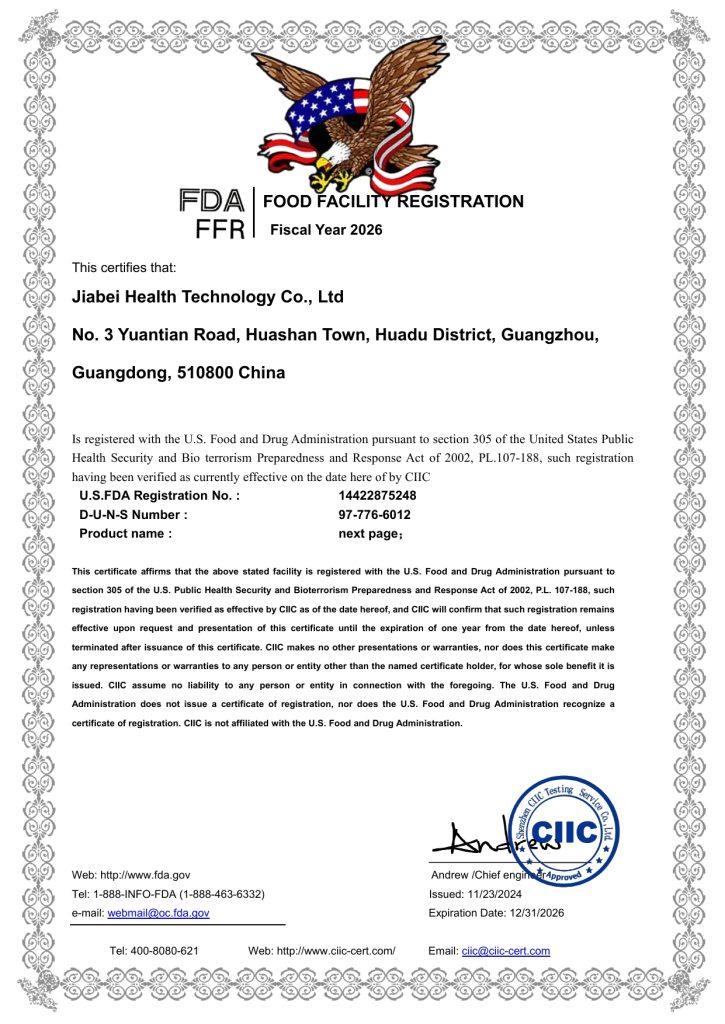
When a factory says “FDA registered,” they’re referring to a facility registration with the FDA. This is mandatory for any establishment that manufactures, processes, packs, or holds dietary supplements for the U.S. market. It is not a product review, not a safety endorsement, and not a shield against enforcement if your product is adulterated or misbranded.
I’ve had brand owners hand me a registration certificate and assume the entire product line was covered. It isn’t. Quality lives in batch records, testing data, and SOPs — not in that registration number. If a supplier leans too heavily on “FDA registered” as their main selling point, dig deeper.
Here’s a quick reference:
- FDA Registered Facility – The facility has registered with FDA. This does not mean the product is approved or the facility is compliant at all times.
- FDA Approved – Generally applies to drugs and medical devices, not standard dietary supplements. Be skeptical if a supplement manufacturer uses this phrase loosely.
- cGMP Compliance – Manufacturing follows applicable quality practices. Verify it through documentation and process observation, not just a certificate.
- COA – Certificate of Analysis; a batch-level testing document. It must match your approved finished product specification.
The most trustworthy manufacturers will give you their FDA Establishment Identifier (FEI) number and invite you to verify it yourself. When a supplier is confident enough to be verified, you’re probably talking to the right partner.
FDA Registered vs. FDA Approved vs. FDA Certified
New supplement brands often mix up “registered” with “approved” or “certified.” Dietary supplements do not go through pre-market FDA approval the way drugs do. FDA explains how dietary supplements are regulated — the key point is that manufacturers and brand owners are responsible for safety and proper labeling before a product reaches the consumer. If a factory calls itself an “FDA approved supplement manufacturer,” that’s either a translation mistake or a deliberate stretch. Neither helps your brand.
“FDA certified” is just as misleading. The FDA doesn’t run a certification program for supplement facilities. What exists is the expectation that facilities operate under cGMP. If a manufacturer says they’re “FDA certified,” ask them to clarify exactly what they mean. The precise, defensible language respected U.S. buyers look for includes “FDA registered facility,” “FDA compliant manufacturing,” and “cGMP supplement manufacturer.”
What Compliance Looks Like in a U.S.-Bound Supplement Factory
Compliance isn’t a binder on a shelf. The dietary supplement cGMP requirements under 21 CFR Part 111 show up in how raw materials are received, how batches are controlled, and what happens in the lab before shipment.
Raw Material Review Before Production
Every incoming ingredient needs a specification sheet checked against the master formula. I’ve rejected botanicals with particle sizes that would have destroyed powder blend flowability. A solid manufacturer quarantines materials, samples them, and only releases them once identity, purity, and potency are confirmed. Ask your partner how they handle a failed incoming material. No clear answer, no working system.
Batch Control During Manufacturing
On the floor, cGMP means real-time documentation. Weights are verified. Blend times are logged. In-process samples are pulled for uniformity. For gummies, you monitor temperature and depositing consistency; for softgels, fill weight and shell seal integrity. A proper manufacturer has a master manufacturing record and a batch production record that proves every step was followed. If your supplier can’t explain what happens when an in-process check fails, your brand is one deviation away from a recalled lot.
Finished Product Testing Before Shipment
Testing should be defined before the first sample is made — active content, heavy metals, microbiology, and stability-sensitive parameters. I’ve watched brands skip heavy metal testing to save money, only to have Amazon request it retroactively. By then, the product was already warehoused. A manufacturer that understands the U.S. market builds these testing protocols into the quote, not as a surprise add-on.
Label and Claim Review
A responsible manufacturer reviews the Supplement Facts panel against the confirmed formula, checks serving sizes, and flags any structure/function claim that creeps toward disease language. Facilities that consistently maintain certifications like those in our quality certifications overview treat label accuracy with the same seriousness as microbial testing.
Documents to Request Before Placing an OEM Order
This is the section I wish every new brand owner would read before wiring a deposit. A true OEM partnership runs on documentation, not trust alone. But here’s a nuance from the floor: not every document exists at the quoting stage. Some are generated only after formula confirmation, sample approval, and pilot production. Demanding a finished product COA before the formula is finalized signals inexperience. Instead, ask for a document timeline.
Your checklist:
- FDA facility registration proof (quoting stage)
- Ingredient specification sheets (during sourcing)
- Formula confirmation sheet (after R&D)
- Allergen statement (with formula review)
- cGMP-related quality documents (for qualified facilities)
- Finished product COA (post-production)
- Heavy metal testing report (tied to COA or separate panel)
- Microbiological testing report (batch-specific, post-production)
- Batch production record (after run completion)
- Supplement Facts label support (after formula lock)
- Certificate of Origin (when needed for export)
- Free Sale Certificate (on request)
- MSDS (for raw materials or finished product, when shipping requires)
A manufacturer who can walk you through this timeline without getting defensive has real operational depth.
Why COA and Batch Testing Matter More Than a Registration Claim
Registration gets you into the system. A COA tells you what’s actually in the bottle. I pay more attention to how a manufacturer handles COA and batch testing than to any framed certificate. The COA should be batch-specific, tied to your approved specification, and cover the parameters that matter for your dosage form.
Gummies need active content testing that accounts for deposition — you need to know the active isn’t degrading or unevenly distributed. Capsules and powders emphasize blend uniformity and microbial limits. Softgels bring fill-weight and disintegration challenges. Our approach to supplement manufacturing with COA support treats the COA as a fingerprint of a specific batch, not a generic document.
At minimum, your testing package should include heavy metals, microbiological safety, and active content. I’ve seen a perfectly good batch held at customs because the heavy metal report was missing from the documentation packet. These are avoidable problems that eat into your margin and timeline.
Labeling and Claims: The Biggest Risk for U.S. Supplement Brands
If there’s one area where brands shoot themselves in the foot, it’s labeling and claims. The FDA’s guidance on structure/function claims draws a sharp line. Cross it unintentionally, and your dietary supplement can be viewed as an unapproved new drug.
A manufacturer serving the U.S. market should verify that the Supplement Facts panel format is correct, ingredient names are standardized, serving size matches the formula, and that the mandatory disclaimer is present: “These statements have not been evaluated by the Food and Drug Administration. This product is not intended to diagnose, treat, cure, or prevent any disease.” I’ve seen a brand omit this disclaimer thinking it was optional. The entire run had to be relabeled, costing weeks.
From the factory side, our job is to ensure label information syncs with batch records and the approved formula. If you claim a specific amount of an active per serving, the COA must back it up. A solid manufacturer will flag risky phrasing and tell you, “This might trigger a review; have your regulatory advisor look at it before print.” That’s the kind of partner you want.
What Happens When Compliance Is Checked Too Late
I’ve received too many panicked emails from brands that cut corners and hit a wall. Compliance problems are cheap to fix on paper and brutally expensive to fix after production.
- Designing the label and ordering packaging before the Supplement Facts panel is finalized. The formula shifts slightly during scale-up, the declared active content no longer matches, and you’re stuck with unusable packaging and a misbranded product.
- Sourcing an ingredient that sounds natural but isn’t permitted in U.S. dietary supplements, or is a new dietary ingredient without the required notification. The product gets detained at the port. You pay storage, destruction, and lose a sales season.
- The Amazon scenario: a listing is live, then a documentation request comes. They want a COA with heavy metals and microbiology. Your manufacturer never ran those tests, or the lab isn’t credible. The listing gets suspended.
- A distributor rejects an entire pallet because the allergen statement wasn’t explicit enough for their legal team.
Each failure traces back to the same root: compliance checks were treated as a final formality instead of being embedded from formula design through shipment.
How to Choose an FDA Registered Supplement Manufacturer for Private Label
After a decade in this industry, my evaluation boils down to a few questions that reveal more than any sales deck:
- Can the manufacturer explain what “FDA registered” means without slipping into “FDA approved” language?
- Can they walk you through their cGMP system with concrete examples, not just policy statements?
- Will they provide batch-level COA and testing documentation without hesitation?
- Do they insist on formula review before quoting a firm price?
- Can they support Supplement Facts label information and explain how they verify it?
- Do they have proven experience with your dosage form? A great softgel facility may not be the right fit for gummies. If your project involves gummies, look for a dedicated gummy supplement manufacturing line that understands the precision depositing and stability challenges of that format.
- Can they reliably support export documentation like Certificates of Origin and Free Sale Certificates?
A manufacturer who answers these directly — sometimes with factory-floor bluntness — is far more valuable than one who only promises “full service” and sends a generic price sheet.
How Jiabei Health Supports U.S.-Bound Supplement Manufacturing Projects
Jiabei Health built its production workflow around these exact checks, because the U.S. market demands it. We start every project with a formula review — ingredient compatibility, dosage form feasibility, U.S. regulatory alignment — before discussing MOQs. Our sampling covers gummies, capsules, softgels, powders, and drops, with process attention specific to each format.
Once the formula locks, we generate the documentation you actually need: COA, heavy metal and microbiological testing, ingredient specs, batch records, and label support that ties the Supplement Facts panel back to the production batch. Our quality systems are backed by GMP, HACCP, FSSC 22000, BRCGS, Halal, and Kosher certifications — and we keep them current because we know buyers check. You can see the details on our quality certifications page.
For export-ready support, we handle Certificates of Origin, Free Sale Certificates, and shipping documentation that prevents clearance delays. We help brands build a compliance file that withstands scrutiny from distributors, platforms, and regulators.
Buyer Checklist Before Starting Production
Before you confirm your order, verify these points:
- Is the facility FDA registered, and can they provide the FEI number for verification?
- Can they clearly explain what FDA registration does and does not mean?
- Are cGMP procedures in place and demonstrated, not just claimed?
- Will they provide a batch-level COA after production?
- Are heavy metal and microbiological tests included in the standard quality package?
- Is a formula review conducted before sampling begins?
- Will the Supplement Facts panel be checked against the final formula?
- Are packaging and label files reviewed for accuracy before printing?
- Can export documents be provided when needed?
- Does the manufacturer genuinely understand private label supplement projects for the U.S. market?
These aren’t hypotheticals. I’ve watched brands skip several of these and pay for it later. A couple of hours of verification upfront is the cheapest insurance policy you’ll ever buy in this industry.
FAQs About FDA Registered Supplement Manufacturers
Does FDA approve dietary supplements before sale?
Generally, no. Manufacturers and brand owners are responsible for product safety and labeling. FDA explains how dietary supplements are regulated, and pre-market approval is not the standard pathway.
Is an FDA registered manufacturer the same as an FDA approved manufacturer?
No. A registered facility has completed a registration requirement. That does not mean its products are approved, certified, or endorsed by FDA.
What documents should I request from a supplement manufacturer?
At minimum: FDA registration proof, cGMP documentation, ingredient specs, formula confirmation, finished product COA, heavy metal and microbiological testing reports, allergen statement, Supplement Facts label support, batch records, and relevant export certificates. Not all are available at the quoting stage.
Do foreign supplement manufacturers need to follow U.S. cGMP requirements?
Yes. If the product enters the U.S. market, manufacturing, packaging, labeling, and holding operations are generally expected to comply with dietary supplement cGMP requirements under 21 CFR Part 111. FDA guidance covers foreign facilities in this context.
Can a manufacturer help with the Supplement Facts label?
A knowledgeable manufacturer can provide a draft based on the confirmed formula, serving size, and ingredient quantities. Final market claim review should involve your own compliance advisor. The manufacturer’s job is to ensure the label data matches the batch record.
Is a COA required for every supplement order?
For B2B purchasing, a batch-level COA is critical. Specific testing items depend on product type, dosage form, and market requirements. A consistent COA program signals manufacturing maturity.
How often must an FDA facility registration be renewed?
Food facility registrations must be renewed every even-numbered year between October 1 and December 31. Confirm your manufacturer’s registration is current, especially if your production run spans a renewal period.
What should I do if a manufacturer says they are “FDA certified”?
Ask them to clarify exactly what certification they’re referring to. FDA does not operate a certification program for dietary supplement manufacturers. The claim often signals a misunderstanding or an attempt to overstate a registration. Proceed with careful documentation review.