Introduction
Cannabidiol (CBD), a non-psychoactive phytocannabinoid extracted from Cannabis sativa, has gained widespread attention for its therapeutic potential in anxiety reduction, pain management, neuroprotection, and sleep regulation. Despite promising biological activity, the commercialization of CBD in functional foods and pharmaceuticals faces one critical obstacle: poor water solubility.
CBD is lipophilic, with low aqueous solubility and high susceptibility to first-pass metabolism, leading to an oral bioavailability of only 6–19% in conventional oil-based formulations (Millar et al., 2018, Frontiers in Pharmacology). This challenge has prompted the development of water-soluble delivery systems, aiming to improve dissolution, absorption, and stability in diverse formulations. Among these, nanoemulsion technology and cyclodextrin inclusion complexes have emerged as the most studied and commercially relevant approaches.
This article reviews the scientific basis, technological advances, and future implications of these two breakthroughs.
The Challenge of Hydrophobic CBD
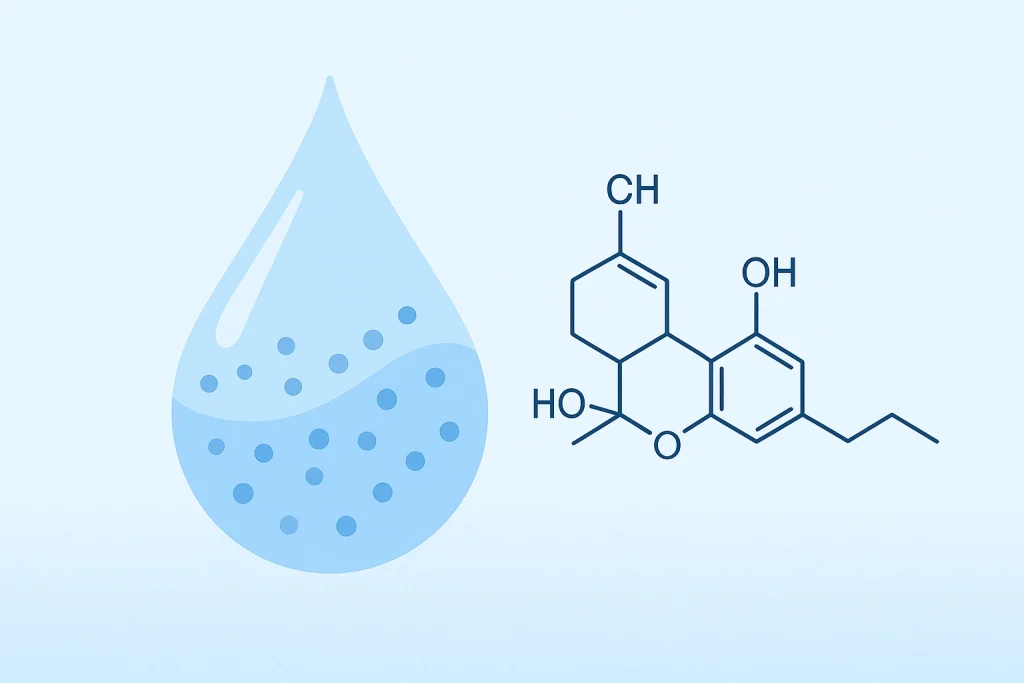
CBD belongs to the class of Biopharmaceutics Classification System (BCS) class II drugs: poorly soluble but highly permeable. Key limitations include:
- Hydrophobicity: CBD is insoluble in water (<1 μg/mL), restricting formulation in aqueous beverages.
- Variable absorption: Poor dissolution leads to inconsistent plasma levels and reduced therapeutic predictability.
- Chemical instability: CBD degrades under light, oxygen, and acidic gastric conditions.
Therefore, technologies that increase aqueous solubility, protect molecular integrity, and enhance absorption are fundamental for pharmaceutical and nutraceutical innovation.
Nanoemulsion Technology: Engineering at the Nanoscale
Principles
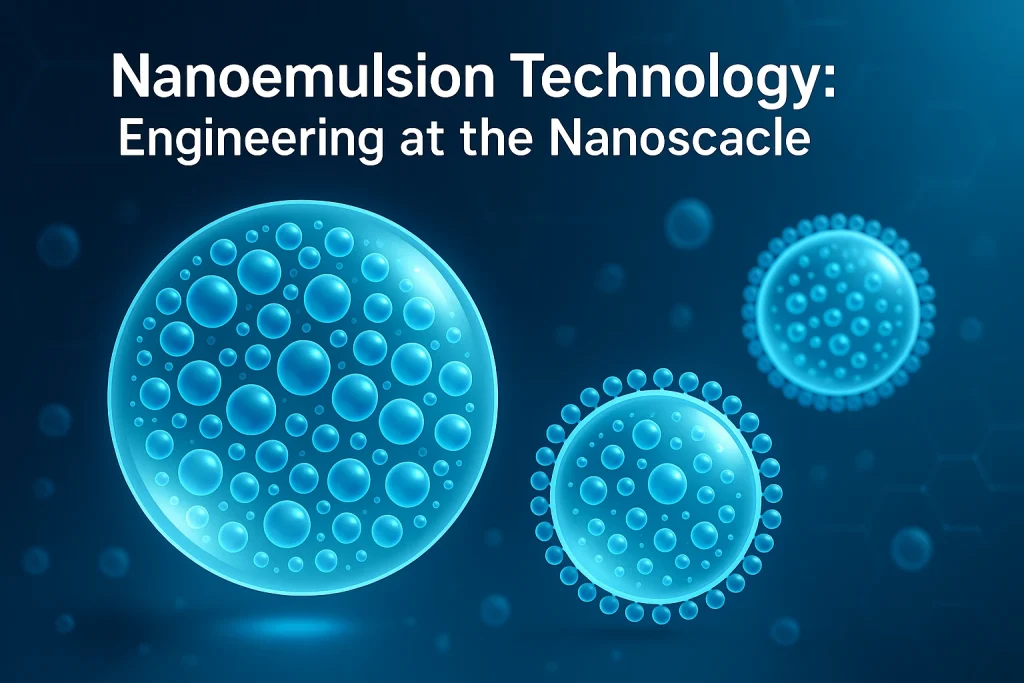
Nanoemulsions are kinetically stable dispersions of oil and water stabilized by surfactants, with droplet sizes typically ranging from 20 to 200 nm. In CBD formulations, nanoemulsification breaks down oil droplets containing CBD into nanosized particles, significantly improving dispersion in water.
Advantages
- Enhanced Bioavailability
Smaller droplet size increases surface area for enzymatic digestion, accelerating absorption through the gastrointestinal tract. Clinical trials report 2–4x higher CBD plasma concentrations using nanoemulsions compared with traditional oils (Lazarjani et al., 2020, Journal of Cannabis Research). - Optical Clarity in Beverages
At sub-50 nm scales, nanoemulsions become nearly transparent, suitable for clear beverages without phase separation. - Rapid Onset
Because absorption bypasses part of the lipid digestion pathway, effects can manifest within 15–30 minutes, advantageous for functional drinks. - Shelf-Life Stability
Properly optimized emulsifiers prevent coalescence and creaming, extending product stability.
Technical Challenges
- Requires high-energy equipment (ultrasonication, high-pressure homogenization).
- Sensitive to pH and ionic strength.
- Regulatory scrutiny over surfactants and emulsifiers in nutraceuticals.
Cyclodextrin Inclusion Complexes: Molecular Encapsulation
Principles
Cyclodextrins (CDs) are cyclic oligosaccharides with a hydrophilic exterior and hydrophobic cavity. CBD molecules can be “trapped” within this cavity through host–guest interactions, forming inclusion complexes.
Advantages
- Molecular-Level Solubilization
Encapsulation masks CBD’s hydrophobicity, enhancing apparent solubility in aqueous systems. - Taste Masking
CBD’s bitter, earthy flavor is reduced, improving palatability of gummies, powders, and tablets. - Stabilization
Cyclodextrins shield CBD from light and oxidative degradation, extending shelf life. - Versatile Formats
Complexes can be processed into powders, effervescent tablets, or dry blends.
Technical Challenges
- Solubility improvement depends on the type of cyclodextrin (β-CD vs. HP-β-CD vs. γ-CD).
- High CD concentration may cause gastrointestinal discomfort.
- Complexation efficiency is formulation-dependent and requires careful optimization.
Comparative Analysis: Nanoemulsion vs. Cyclodextrin
| Attribute | Nanoemulsion CBD | Cyclodextrin CBD Inclusion |
|---|---|---|
| Particle/Molecular Size | 20–200 nm droplets | Host–guest molecular complex |
| Bioavailability | Very high, rapid onset | High, but slower release |
| Sensory Impact | Minimal effect on taste | Strong taste masking |
| Stability in Liquids | Excellent in beverages | Moderate, depends on CD type |
| Application Formats | Clear beverages, shots, tinctures | Powders, gummies, tablets |
| Manufacturing Complexity | High (specialized equipment required) | Moderate (easier to scale) |
Applications in Nutraceuticals and Pharmaceuticals
- Functional Beverages
Nanoemulsions dominate in sparkling water, teas, and energy drinks due to optical transparency and fast onset. - Powdered Nutraceuticals
Cyclodextrin complexes allow CBD to be incorporated into effervescent powders, protein blends, and instant drink mixes. - Pharmaceutical Delivery
Both technologies are explored in oral capsules, fast-dissolving strips, and controlled-release tablets. Early trials suggest improved therapeutic predictability over oils. - Hybrid Systems
Recent studies explore combining nanoemulsions with CDs to achieve dual advantages: enhanced stability and improved palatability.
Regulatory Considerations
Both technologies must address:
- GRAS status of excipients: Many cyclodextrins (HP-β-CD) are FDA-approved, while surfactant use in nanoemulsions requires safety validation.
- Labeling compliance: Manufacturers must disclose carriers and encapsulation methods.
- Pharmacokinetic studies: Increasingly required to substantiate efficacy claims in pharmaceutical-grade CBD.
Future Outlook
The next decade will likely see:
- Hybrid Delivery Systems – Combining nanoemulsion and cyclodextrin inclusion for multifunctional stability.
- Solid-State Nanocarriers – Lipid nanoparticles and nanocrystals to improve scalability.
- Precision Nutrition Applications – Integration into personalized health platforms.
- Regulatory Harmonization – Global standards on solubility enhancement methods for cannabinoids.
As research matures, water-soluble CBD may shift from niche innovation to mainstream pharmaceutical and nutraceutical ingredient, unlocking new therapeutic and commercial potential.
Conclusion
Water-soluble CBD represents a pivotal frontier in cannabinoid science. Nanoemulsion technology enables rapid, bioavailable, and stable liquid formulations, while cyclodextrin inclusion complexes offer molecular encapsulation, taste masking, and powder compatibility. Both approaches address critical challenges in CBD delivery, with complementary advantages depending on application format.
For the scientific community, these technologies open avenues for pharmacokinetic optimization and formulation innovation. For industry, they redefine the possibilities of CBD integration across functional beverages, nutraceuticals, and therapeutic products. As hybrid approaches and regulatory clarity emerge, water-soluble CBD will likely become the cornerstone of next-generation cannabinoid products.
FAQ
Q1: Why is water-soluble CBD technology important for pharmaceutical and nutraceutical applications?
Water-soluble CBD technology addresses the fundamental issue of poor bioavailability. Conventional oil-based CBD has limited absorption in the gastrointestinal tract. By using nanoemulsion or cyclodextrin inclusion complexes, CBD can be dispersed in aqueous media, leading to higher dissolution rates, faster onset, and more predictable pharmacokinetics.
Q2: How does nanoemulsion CBD improve bioavailability compared to traditional CBD oils?
Nanoemulsions reduce CBD oil droplets to the nanometer scale (20–200 nm). This dramatically increases surface area, allowing digestive enzymes and bile salts to act more efficiently. Clinical studies report that nanoemulsion CBD can achieve 2–4 times higher plasma concentrations than standard CBD oil.
Q3: What are the advantages of cyclodextrin inclusion complexes in CBD formulations?
Cyclodextrins encapsulate CBD at the molecular level, improving aqueous solubility and masking its bitter taste. They also protect CBD against degradation from light and oxidation. This makes cyclodextrin inclusion complexes highly suitable for powders, tablets, and dry blends where liquid emulsions are less practical.
Q4: Can nanoemulsion and cyclodextrin technologies be combined?
Yes. Recent research suggests that hybrid systems—where nanoemulsified CBD is further stabilized with cyclodextrins—may offer dual advantages. These include improved stability, enhanced taste masking, and higher bioavailability. Such systems are still in early development but represent a promising direction for future CBD formulations.
Q5: Are water-soluble CBD technologies safe and compliant with regulations?
Both nanoemulsion and cyclodextrin inclusion technologies can be safe when formulated with GRAS (Generally Recognized as Safe) excipients. However, compliance depends on regional regulations. For example, HP-β-cyclodextrin is FDA-approved, but surfactants used in nanoemulsions may require additional safety evaluations depending on dosage form.
Q6: Which technology is better for CBD beverages: nanoemulsion or cyclodextrin inclusion?
Nanoemulsion is generally preferred for beverages, especially clear liquids, because of its optical transparency and rapid absorption. Cyclodextrin complexes are more advantageous in dry, powdered applications such as instant drink mixes or effervescent tablets. The choice depends on the target product format and consumer experience.
Q7: What future directions are expected in water-soluble CBD research?
Emerging areas include hybrid systems combining multiple solubilization strategies, solid lipid nanoparticles, and novel encapsulation materials beyond cyclodextrins. Additionally, more clinical pharmacokinetic studies will be required to validate efficacy and support regulatory approval in both nutraceutical and pharmaceutical markets.