Introduction
Lipo gummies have become an attractive format for brands entering the weight management category, but many projects encounter unexpected difficulties during development. Compared with capsules or powders, gummy supplements introduce structural constraints that significantly increase formulation complexity.
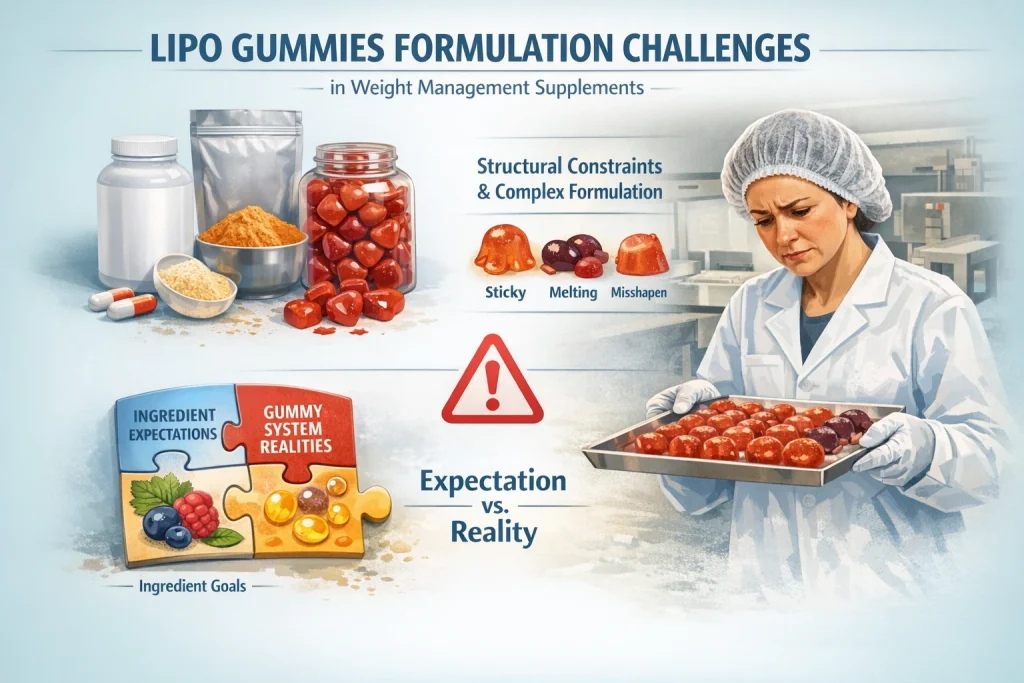
For private label buyers, understanding lipo gummies formulation challenges is critical before finalizing ingredient lists or committing to large-scale production. Many formulation failures are not caused by poor ingredients, but by a mismatch between ingredient expectations and gummy system realities within lipo gummies private label manufacturing.
Why Gummies Are Structurally Different From Capsules
Capsules are dry systems. Gummies are not.
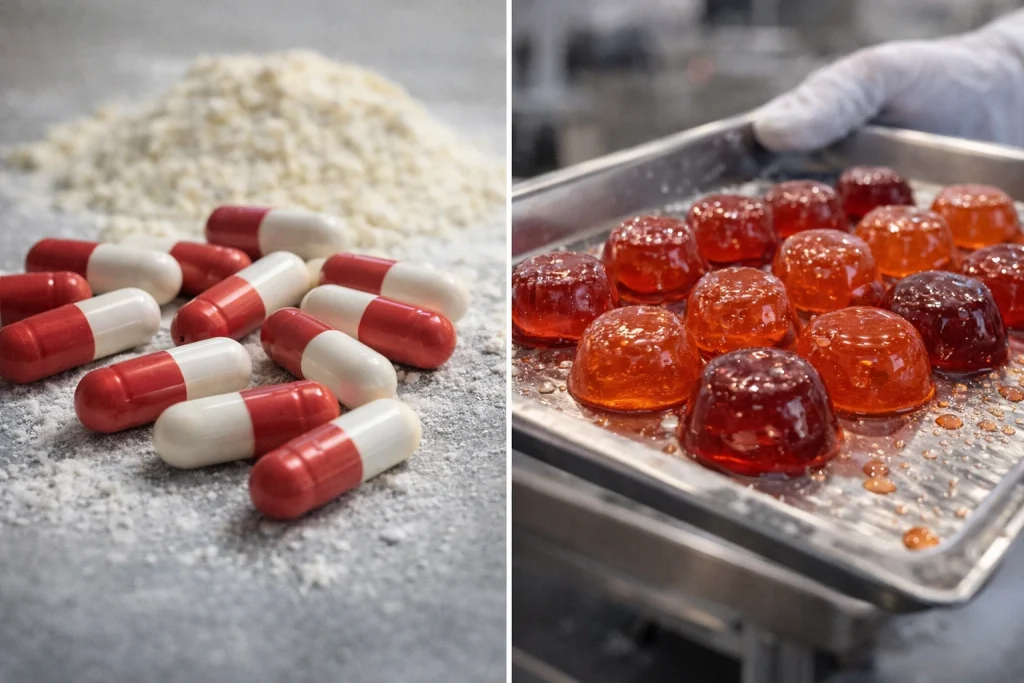
This fundamental difference explains why formulation approaches that work well in capsules often fail in gummies. Capsules allow high ingredient loading, minimal heat exposure, and limited interaction between actives. Gummies, by contrast, rely on a hydrated gel matrix that must remain stable, chewable, and visually consistent.
From an OEM perspective, gummies function as both a delivery system and a food product. This dual nature places additional constraints on ingredient compatibility, processing parameters, and sensory performance, all of which directly influence the selection of lipo gummies ingredients.
Heat, Moisture, and Texture: Core Gummy Constraints
One of the most underestimated lipo gummies formulation challenges is thermal exposure. Gummy production requires controlled heating to dissolve gelling agents and ensure uniform mixing. Ingredients sensitive to heat may degrade or lose functional integrity during this process.
Moisture content further complicates formulation. Excess water weakens gel structure, while insufficient hydration leads to brittle or uneven textures. Ingredients that absorb water unpredictably can destabilize the entire matrix.
Texture is not cosmetic. Chewability, elasticity, and recovery after compression are all indicators of formulation success. Achieving these properties while maintaining ingredient stability requires precise formulation control.
Dosage Compression in Gummy Systems
Unlike capsules, gummies impose strict limits on active ingredient dosage per unit. Attempting to compress capsule-level doses into a gummy format frequently results in compromised texture, unpleasant taste, or instability.
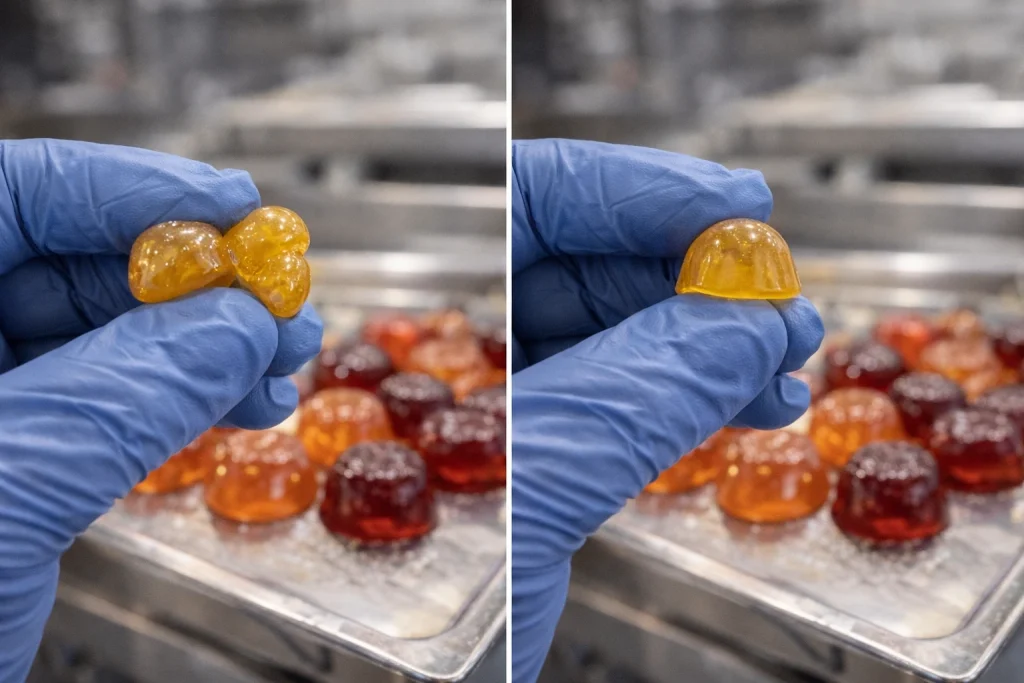
This dosage compression forces brands to rethink formulation priorities. Instead of maximizing ingredient counts, successful gummy formulations focus on feasible inclusion levels that align with consumer experience and production consistency. This issue is closely tied to the evaluation of ingredients that often fail in gummy applications, particularly when dosage expectations are unrealistic.
This reality is often the turning point for private label buyers transitioning from capsule-based concepts to gummies.
Flavor Masking vs Functional Load
Many lipo gummies formulation challenges arise from flavor conflicts. Numerous functional ingredients introduce bitterness, metallic notes, or lingering aftertastes that are difficult to mask within a gummy system.
Flavor masking is not simply a matter of adding sweeteners. Excessive masking agents can weaken gel strength, increase hygroscopicity, and shorten shelf life. Effective formulation requires balancing functional load against flavor system capacity, a step often underestimated in early-stage lipo gummies private label manufacturing projects.
Manufacturers with gummy-specific expertise evaluate flavor compatibility early to avoid late-stage reformulation.
Stability Across Shelf Life
Shelf stability is a non-negotiable requirement for commercial production. Gummies are particularly sensitive to environmental factors such as temperature fluctuations and humidity during storage and transport.
Ingredient interactions can accelerate degradation, discoloration, or texture changes over time. These risks increase when formulations include unstable actives or poorly controlled raw materials, reinforcing the importance of selecting compatible lipo gummies ingredients during the formulation stage.
From a B2B perspective, stability testing is not optional. It determines whether a formulation can support repeat orders and consistent branding.
Why Many Lipo Gummies Projects Fail at Scale
Small pilot batches often perform well, masking deeper formulation weaknesses. Problems typically emerge during scale-up, when processing conditions intensify and batch-to-batch variation becomes more apparent.
Common failure points include ingredient incompatibility under sustained heat, flavor systems that break down over time, inconsistent raw material quality, and unstable gel structure during transport. These failures explain why many lipo gummies private label programs struggle to move from pilot success to reliable commercial production.
Common failure points include:
- Ingredient incompatibility under sustained heat
- Flavor systems that break down over time
- Inconsistent raw material quality
- Unstable gel structure during transport
These issues highlight why lipo gummies formulation challenges must be addressed during development—not after market launch.
How Manufacturers Approach Gummy Formulation Challenges
Experienced manufacturers evaluate gummy formulations holistically. Rather than focusing on individual ingredients in isolation, they assess how each component behaves within the full system.
This includes processing simulations, ingredient interaction testing, texture and recovery analysis, and stability projections. These evaluations help identify ingredients that often fail in gummy applications before they create costly downstream issues.
This includes:
- Processing simulations
- Ingredient interaction testing
- Texture and recovery analysis
- Stability projections
Such evaluations reduce development risk and improve long-term scalability.
Conclusion
Lipo gummies formulation challenges stem from the unique structural demands of gummy systems. Heat exposure, moisture control, dosage limitations, and flavor balance all influence whether a formulation succeeds or fails at scale.
Private label brands that understand these challenges early can make informed decisions, reduce reformulation cycles, and build more reliable lipo gummies private label manufacturing strategies for long-term growth.
FAQ
What are the main formulation challenges when developing lipo gummies?
Formulating lipo gummies involves balancing ingredient stability under heat and moisture, managing texture and chewability, and ensuring flavor masking without compromising the structural integrity of the gel matrix. These constraints make gummy formulation more technically demanding than capsules or powders, and require iterative testing before scale-up.
Why do some ingredients commonly used in capsules or tablets fail in gummy applications?
Many ingredients suitable for hard capsules or tablets are not compatible with gummy systems because they may be heat sensitive, have strong off-notes that are hard to mask, or exceed the feasible dosage that a gummy can physically hold without weakening texture. Manufacturers often reject such ingredients or require reformulation strategies to make them viable in gummies.
How do private label gummy manufacturers ensure consistent texture and stability?
Experienced manufacturers evaluate formulation through controlled mixing and heating processes, pH balance, and ingredient interaction tests, often using specialized gelling agents like gelatin or pectin. They also conduct shelf-life stability testing under different environmental conditions to confirm the product maintains texture and quality over time.
Can I request custom ingredient combinations for my lipo gummies even with known formulation challenges?
Yes. Private label manufacturers typically offer semi-custom to fully custom formulation services, allowing brands to modify ingredients, flavors, and functional add-ins. However, customization is always governed by formulation feasibility and gummy compatibility rather than just marketing preference.
What quality standards and compliance measures do manufacturers follow for lipo gummy products?
Private label gummy makers must adhere to recognized manufacturing quality standards such as Good Manufacturing Practices (GMP) and regulatory guidelines in target markets. These controls cover ingredient identity, processing validation, and finished product safety checks to ensure the gummies meet required compliance benchmarks before shipment.