Similar quotes create a false sense of equivalence
When brands compare multiple supplement manufacturers, similar quotations often suggest comparable capability. Ingredient lists align, dosage specifications match, and unit pricing falls within a narrow range. On paper, the options appear interchangeable.

In reality, quotations capture only a fraction of manufacturing reality. They summarize inputs and outputs, but rarely reflect how production systems handle variability, scale, or unexpected disruption. Treating similar quotes as equivalent decisions is one of the most common sources of long-term manufacturing issues.
Quotes describe costs, not operational behavior
A quotation outlines materials, packaging assumptions, and baseline production parameters. What it does not describe is how a manufacturer behaves when conditions change.
Operational behavior includes how deviations are handled, how internal approvals are escalated, and how capacity is prioritized across customers. These factors determine whether a supplier can deliver consistently over time, even though they never appear in a formal quote.

This gap between documented cost and real-world execution explains why outcomes diverge despite similar pricing.These operational differences often stem from fundamental OEM and ODM manufacturing differences, which rarely surface during quotation comparisons but significantly influence long-term performance.
Raw material control rarely appears in pricing discussions
Two manufacturers may source the same ingredients, yet manage them very differently. Raw material lot control, supplier qualification depth, and inventory buffering strategies directly affect batch consistency and production continuity.

Some factories optimize aggressively for cost, sourcing reactively based on short-term availability. Others maintain tighter lot management and longer-term supplier relationships to reduce variability. These choices influence stability far more than marginal price differences, but are almost never reflected in quotations.
Quality control systems are structured, not improvised
Quality control is often assumed to be a checklist function. In practice, it is a structured system embedded throughout production.
Differences emerge in how frequently in-process checks are conducted, how deviations are documented, and how corrective actions are implemented. Manufacturers with mature QC systems identify issues early, often before finished goods are affected. Others rely heavily on end-point testing, which may detect problems only after value has already been lost.
These structural differences explain why two suppliers with similar quotes can produce very different outcomes under pressure.
Production scheduling determines reliability at scale
Initial orders rarely expose scheduling limitations. Challenges surface when volumes increase or timelines tighten.
Production scheduling reflects how a facility allocates capacity, manages changeovers, and prioritizes long-term customers. Some manufacturers design schedules for stability, accepting fewer customers to protect predictability. Others maximize throughput, increasing risk when demand fluctuates.
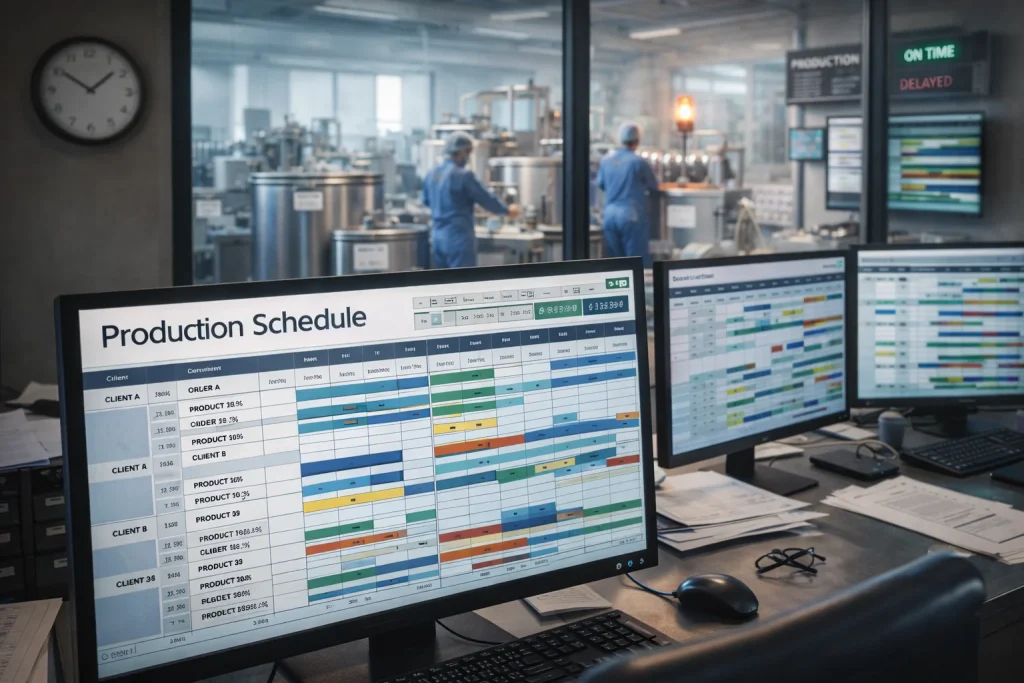
Because scheduling architecture is internal, it is invisible during quotation comparisons, yet decisive for long-term reliability.
Documentation depth separates compliant delivery from delayed shipments
Documentation requirements are often discussed abstractly during supplier evaluation. In reality, documentation depth varies widely.
Manufacturers differ in how they manage batch records, traceability, and revision control. When documentation gaps appear, they tend to surface late—during audits, distributor reviews, or customs clearance—where delays are most costly.
These risks are rarely priced into quotations, but they strongly influence market access and operational continuity.
Why price-focused comparisons increase switching risk
Brands that switch suppliers based primarily on price alignment often assume that operational performance will remain unchanged. This assumption underestimates how tightly manufacturing outcomes are linked to internal systems rather than quoted inputs.
As discussed in our analysis of switching supplement manufacturers, many transitions fail not because alternatives are incapable, but because differences were never fully understood before decisions were made.
What experienced buyers evaluate beyond the quote
Experienced buyers learn to look past surface-level alignment. They assess how manufacturers manage repeatability, documentation continuity, and internal accountability.
Rather than asking whether a supplier can meet a specification once, they evaluate whether the same outcome can be delivered reliably over time, under changing conditions. This perspective shifts decision-making from transactional comparison to operational alignment.
Interpreting quotes as indicators, not answers
Quotations remain useful tools, but only when interpreted correctly. They indicate feasibility, not certainty. Similar quotes suggest comparable starting points, not equivalent manufacturing systems.
Understanding this distinction allows brands and distributors to make supplier decisions with clearer expectations and lower long-term risk.
FAQ
Why do similar supplement manufacturing quotes lead to different outcomes?
Because quotes summarize costs, not operational systems. Differences in raw material control, quality management, scheduling, and documentation processes determine real-world performance but are rarely visible in pricing discussions.
Should brands choose the lowest quote when switching manufacturers?
Not necessarily. Selecting a supplier based solely on price often increases long-term risk. Evaluating operational stability and documentation readiness is more important for sustained performance.
Can manufacturers with similar certifications still perform differently?
Yes. Certifications indicate compliance frameworks, but they do not reflect how systems are implemented daily. Execution depth varies significantly between factories.
How can distributors assess reliability beyond quoted pricing?
Distributors should focus on repeat-order consistency, documentation continuity, and a manufacturer’s ability to manage volume changes without disruption.