At first glance, lamb’s ear and mullein can look surprisingly similar. Both have soft, fuzzy leaves that feel almost velvety to the touch, which is exactly why they’re often mistaken for one another—especially by people new to herbal plants.
But once you move past appearance, the differences become obvious.
They belong to completely different plant families. They’re used in very different ways. And most importantly, only one of them has a consistent role in respiratory support and modern herbal formulations.

If you’re trying to figure out which one actually matters for lung health—or whether they can be used interchangeably—this guide breaks it down in a practical, no-nonsense way.
Quick Comparison: Lamb’s Ear vs Mullein
| Aspect | Lamb’s Ear | Mullein |
|---|---|---|
| Botanical Name | Stachys byzantina | Verbascum thapsus |
| Plant Family | Lamiaceae | Scrophulariaceae |
| Native Region | Mediterranean, Middle East | Europe, Asia (now widespread) |
| Traditional Use | Skin care, wound support | Respiratory support |
| Key Compounds | Tannins, mild antimicrobial compounds | Saponins, flavonoids, mucilage |
| Use for Lungs | Rarely used | Widely used |
| Common Forms | Rare in supplements | Drops, tea, capsules |
If you only remember one thing from this article, it’s this:
Lamb’s ear is mostly a topical herb. Mullein is a respiratory herb.
Botanical Origin: Not Even Closely Related
Let’s start with the basics, because this is where the confusion often begins.
Lamb’s ear (Stachys byzantina) belongs to the mint family (Lamiaceae). It’s commonly grown as an ornamental plant in gardens due to its soft, silvery leaves. In many regions, it’s not even considered a medicinal herb in the modern supplement sense.
Mullein (Verbascum thapsus), on the other hand, comes from a completely different family (Scrophulariaceae). It grows tall—often over 1–2 meters—and produces distinctive yellow flower spikes. Historically, it has been used across Europe and Asia as a respiratory herb.
In practice, once you look at how these plants are actually used—not just how they look—the overlap disappears.
Visual Differences: Why People Get Confused
The confusion comes from one thing: texture.
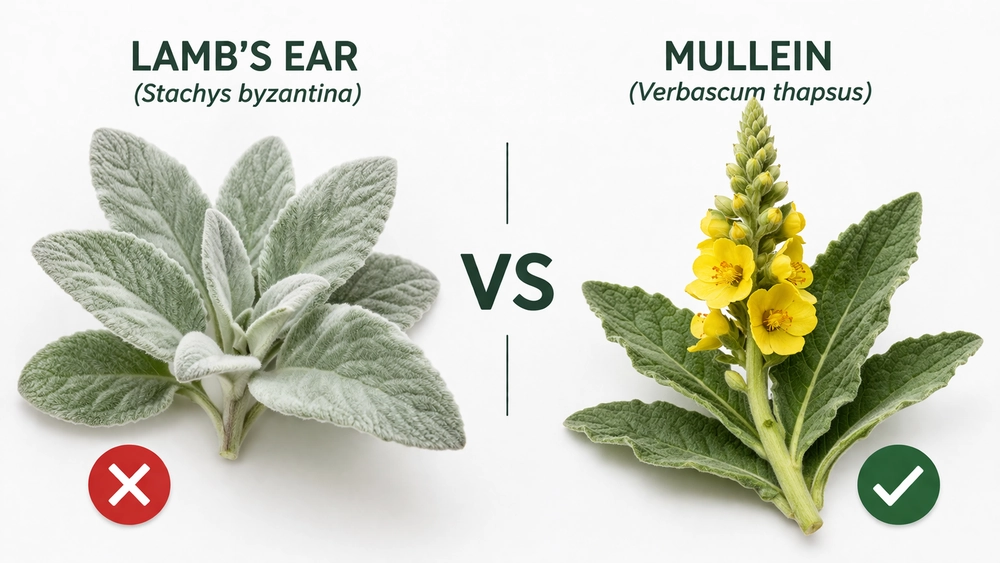
Both plants have fuzzy leaves, which creates that “soft” look. But structurally, they are very different:
- Lamb’s ear grows low and spreads like ground cover
- Mullein grows tall with a central stalk
- Mullein produces yellow flowers; lamb’s ear typically does not stand out in the same way
If you’re identifying them in the wild or sourcing raw material, this distinction matters more than people realize.
Sourcing and Cultivation: Where Quality Starts to Diverge
From a commercial and formulation perspective, sourcing tells a much bigger story than appearance.
Lamb’s ear is primarily cultivated as a garden plant. It’s not widely harvested, standardized, or processed at scale for supplement use.
Mullein is different.
It can be:
- Wildcrafted (harvested from natural environments)
- Cultivated under controlled conditions
- Processed into dried leaves or extracts
And more importantly:
Harvest timing, drying conditions, and handling directly affect its active compounds.
In real production environments, consistency in raw material sourcing is what determines whether an extract performs as expected—or not.
Chemical Composition: This Is Where the Real Difference Shows
This is the point where the two plants stop being comparable.
Mullein contains:
- Saponins – associated with expectorant effects (helping clear mucus)
- Flavonoids – linked to anti-inflammatory activity
- Mucilage – known for its soothing properties on mucous membranes

Lamb’s ear contains:
- Tannins – often associated with astringent effects
- Mild antimicrobial compounds
That’s the key distinction.
Mullein contains compounds like saponins and mucilage that are associated with mucus clearance and soothing irritated airways, which have been discussed in broader herbal and biomedical research.
How Mullein Works for Respiratory Support
Rather than listing “benefits,” it’s more useful to understand how mullein actually functions.
Mullein is commonly described as a natural expectorant. In practical terms, that means:
- It helps loosen and thin mucus
- It supports the body’s natural clearance of mucus
- It provides a soothing effect on irritated airways
This combination—clearing + soothing—is why mullein shows up repeatedly in respiratory formulations.
You’ll almost never see lamb’s ear used this way. And there’s a reason for that.
Who Should Consider Mullein?
This is where things become more practical.
Mullein is typically used by people dealing with:
Smokers or former smokers
- Increased mucus buildup
- Ongoing airway irritation

People exposed to polluted environments
- Urban air pollution
- Dust-heavy workplaces
Individuals with mucus-related discomfort
- Thick mucus
- Occasional coughing
Post-flu or recovery phase
- Lingering chest discomfort
- Airway sensitivity
If your goal is simply general herbal use, lamb’s ear might still have a place (mainly external use). But if you’re thinking in terms of lung support, the direction is fairly clear.
How Mullein Is Used in Practice (Forms & Formats)
Not all herbal formats are equal—and this matters more than most people think.
1. Liquid Extracts (Drops)
This is the most commonly used format in modern formulations.
Why?
- Faster absorption
- Flexible dosing
- Easy to combine with other herbs
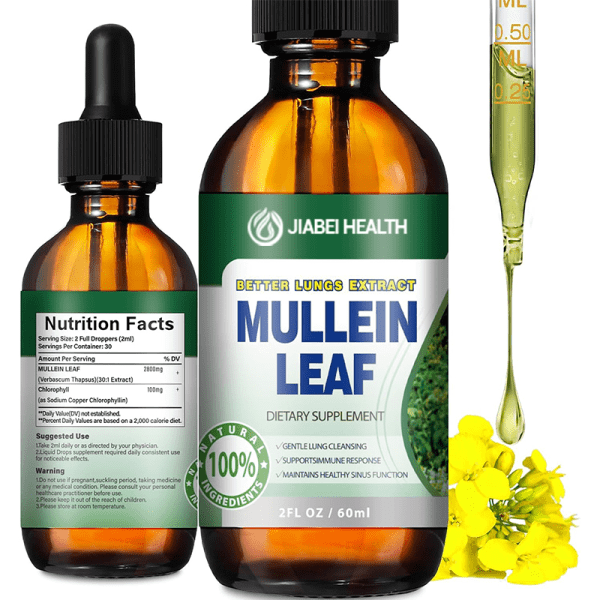
In practice, mullein is very often used in liquid extract form for respiratory-focused products.
In practice, mullein is very often used in liquid extract form for respiratory-focused products, which is why formats like mullein extract drops are commonly seen in this category.
2. Herbal Tea
A more traditional approach.
- Mild
- Slower onset
- Requires preparation
Still widely used, but less common in commercial products.
3. Capsules
- Standardized dosage
- Convenient
- Shelf-stable
Capsules offer a convenient, standardized way to take mullein, especially for users who prefer a fixed daily routine.
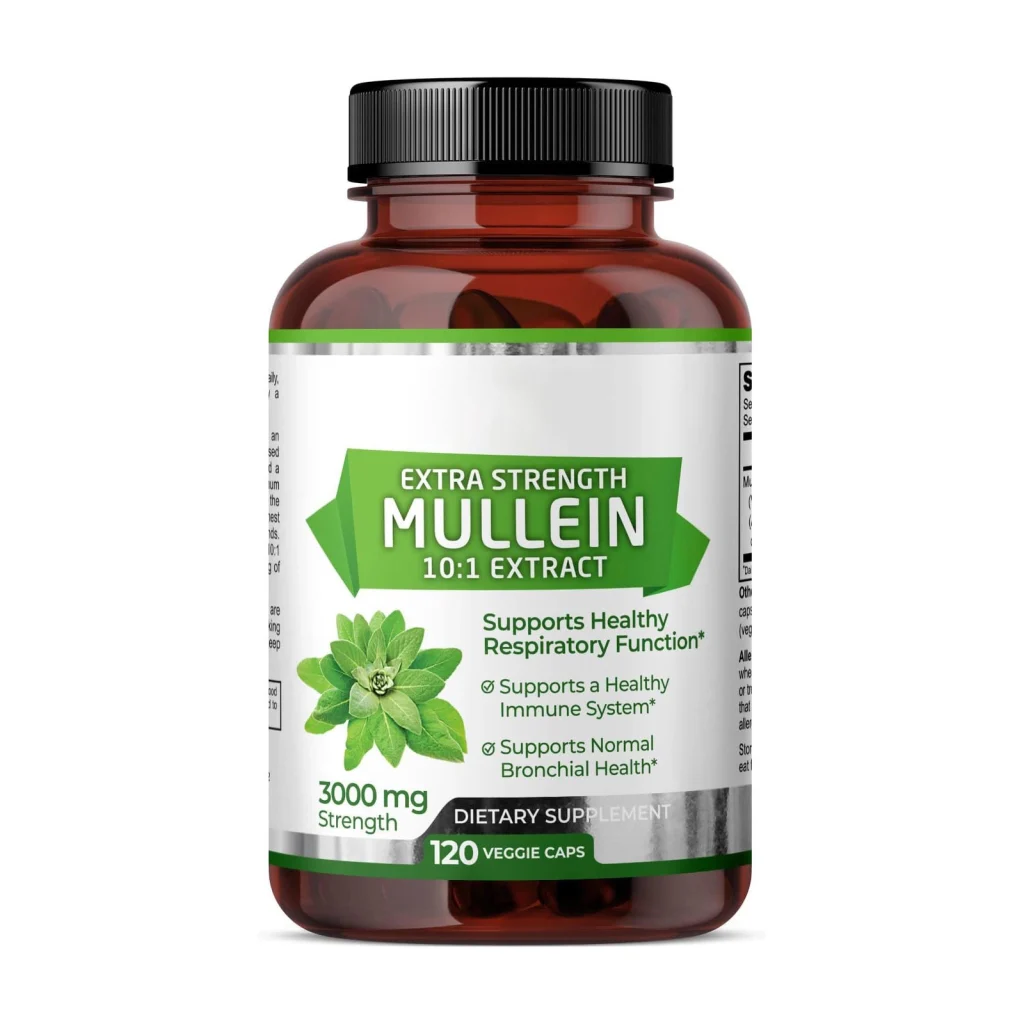
In some formulations, mullein capsules are used when consistency is the priority, although they generally provide less flexibility compared to liquid extracts.
Daily Use and Safety: What Actually Matters
Mullein is generally considered a mild herb in traditional use, but how it’s processed matters.
Instead of repeating generic safety advice, here’s what actually makes a difference:
- Raw material purity
- Heavy metal control
- Microbial limits
- Extraction process
In regulated manufacturing environments, certifications like:
- GMP
- HACCP
- FSSC 22000
are what ensure consistency and safety—not just the herb itself.
In regulated manufacturing environments, certifications like GMP, HACCP, and FSSC 22000 are what ensure consistency and safety—not just the herb itself.
For those using mullein extracts regularly, understanding how different formats are used in daily routines can help maintain consistency in both dosage and overall intake. You can also explore how to use mullein extract drops or how much mullein capsules to take depending on the preferred format.
Commercial Applications: Why Mullein Shows Up in Formulations
From an industry perspective, mullein isn’t just a traditional herb—it’s a functional ingredient.
It is commonly used in:
- Respiratory support blends
- Liquid herbal extracts
- Combination formulas with thyme, licorice, or ivy
And in B2B contexts, brands typically look for:
- Stable supply
- Consistent extract ratios
- Compliance-ready production
That’s why mullein is far more relevant in supplement manufacturing than lamb’s ear.
Final Thoughts: Not All “Similar Plants” Are Interchangeable
It’s easy to assume that two plants with similar textures might serve similar purposes.
But in this case, that assumption doesn’t hold.
- Lamb’s ear is mostly used externally or as a mild traditional herb
- Mullein is consistently used in respiratory support
If your focus is lung-related applications, the choice is fairly straightforward.
Mullein is the one that actually shows up where it matters—in real formulations, not just plant comparisons.
FAQ
Is lamb’s ear the same as mullein?
No, they’re different plants. They may look similar because of their fuzzy leaves, but they belong to different plant families and are used for completely different purposes.
Can lamb’s ear be used for lung support?
Not typically. Lamb’s ear is more often associated with topical or traditional uses, while mullein is the herb commonly used in respiratory formulations.
Why is mullein used for respiratory support?
Mullein contains compounds like saponins and mucilage that are associated with mucus clearance and soothing irritated airways, which is why it’s widely used in lung support products.
Which is better for clearing mucus, lamb’s ear or mullein?
Mullein is the better choice. It’s specifically known for supporting mucus clearance, while lamb’s ear is not commonly used for this purpose.
Can I use lamb’s ear instead of mullein?
In most cases, no. They are not interchangeable, especially when it comes to respiratory support. Mullein is the herb typically used in that context.
Who should consider using mullein?
Mullein is often used by people dealing with mucus buildup, occasional coughing, or those exposed to smoke or air pollution who want additional respiratory support.
What is the best way to take mullein?
Mullein is commonly used as a liquid extract, tea, or capsules. Liquid extracts are often preferred for flexibility and ease of use.
Can mullein be taken daily?
Mullein is often used as part of a regular herbal routine, depending on the formulation and dosage. It’s best to follow product-specific guidelines.