Curcumin gummy manufacturing challenges are often underestimated at the concept stage, especially when gummy and chewable formats are selected for this ingredient.Its market awareness is high, and demand often comes with the assumption that it can be formulated into almost any delivery format. In practice, however, gummy and chewable formats consistently present structural challenges that are often underestimated at the concept stage.
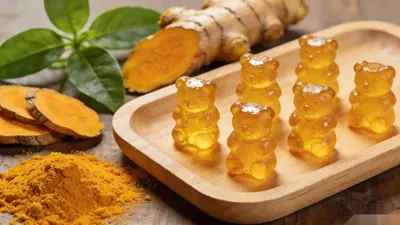
The issue is not whether curcumin is effective as an ingredient, but whether its physical and chemical behavior is compatible with the expectations placed on gummy and chewable supplements during manufacturing, storage, and distribution.
Curcumin as an Ingredient: Why Format Compatibility Matters
From a manufacturing perspective, format selection determines whether an ingredient can be processed consistently at scale. Gummies and chewables are fundamentally water-based systems designed for homogeneous dispersion, stable appearance, and predictable sensory performance.
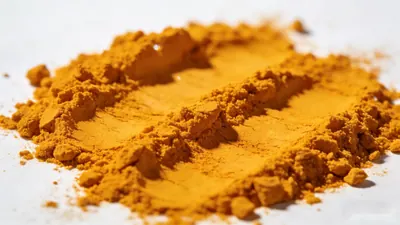
Curcumin does not naturally align with these requirements. Many formulation failures occur not because the ingredient is unsuitable in general, but because the selected format amplifies its inherent limitations.
The Conflict Between Lipophilic Actives and Water-Based Systems
Curcumin’s Poor Dispersion in Gummy Matrices
Curcumin is lipophilic by nature, while gummy and chewable bases rely on aqueous matrices. This mismatch creates immediate dispersion challenges during mixing and deposition. Even when emulsification systems are introduced, dispersion tends to remain sensitive to processing conditions such as shear force, temperature gradients, and holding time.
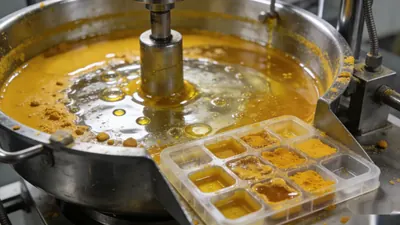
At lab or pilot scale, short production runs may appear uniform. During full-scale production, however, extended mixing cycles and larger batch volumes often lead to gradual separation, localized concentration differences, or uneven visual appearance across units.
Long-Term Migration and Visual Instability
One of the most common failure modes associated with curcumin gummies is post-production instability rather than immediate processing defects. Over time, curcumin may migrate within the matrix, resulting in color gradients, shadowing, or surface discoloration.
These issues typically emerge during shelf-life testing or after shipment, when temperature fluctuations and storage duration exacerbate mobility within the gummy structure. Once packaging has been finalized, corrective options are limited and costly.
Taste Masking Limits in Chewable and Gummy Formats
Intrinsic Bitterness and Flavor Saturation
Curcumin has an inherently strong and persistent bitter profile. In chewable and gummy formats, taste masking relies on sweeteners, acids, and flavor systems that already operate near sensory saturation limits.
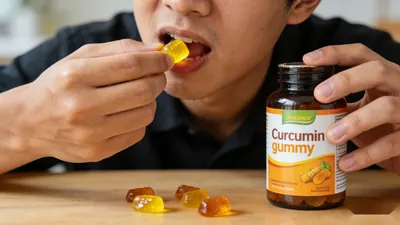
Unlike capsules, where bitterness can be isolated, gummies and chewables require prolonged oral contact. This exposes the formulation to flavor breakthrough, particularly as active load increases.
Why Higher Dosage Makes Palatability Worse, Not Better
Increasing curcumin dosage does not linearly increase bitterness; instead, it often triggers a disproportionate decline in palatability. At higher inclusion levels, additional flavor masking becomes ineffective or introduces secondary issues such as excessive sweetness, acid imbalance, or lingering aftertaste.
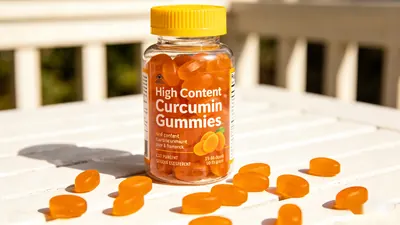
From a manufacturing standpoint, this creates a narrow formulation window that is difficult to maintain consistently across batches.
Processing and Scale-Up Risks Often Ignored at Concept Stage
Why Lab-Scale Success Does Not Translate to Mass Production
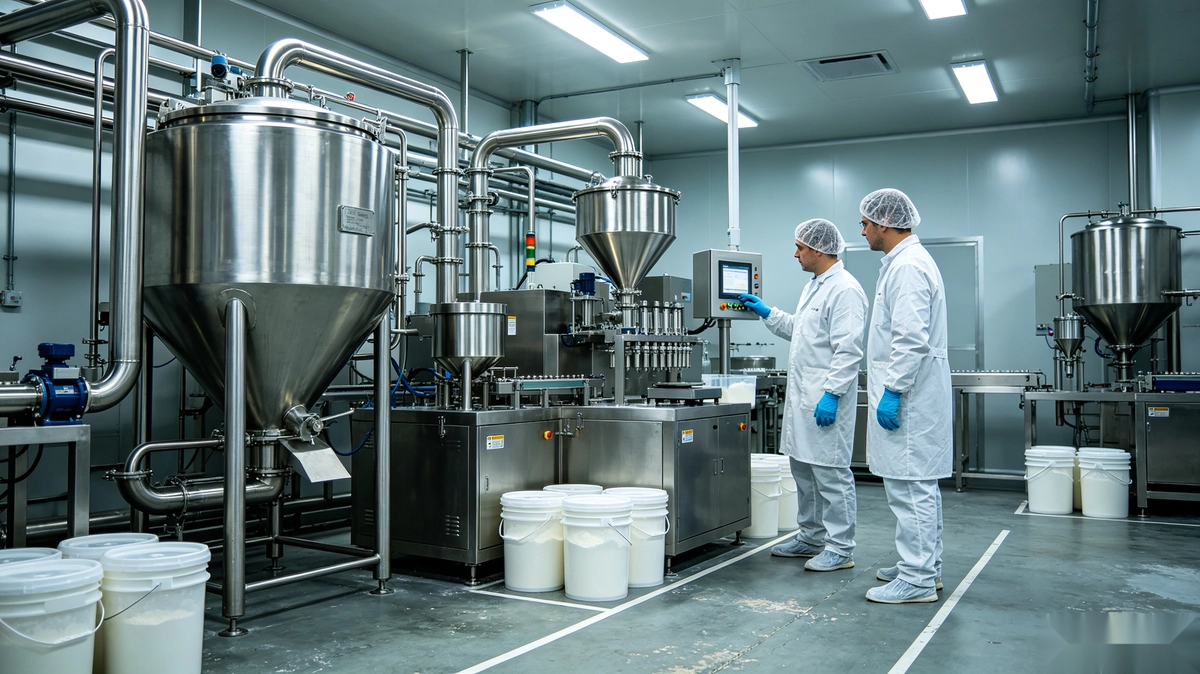
Small-batch success frequently leads to premature confidence in gummy or chewable feasibility. Scale-up introduces variables that are absent at lab scale, including extended residence time, larger thermal gradients, and increased sensitivity to raw material variation.
Curcumin formulations that appear stable during short trials may exhibit separation or sensory degradation when exposed to continuous production environments.
Shelf-Life Instability as the Primary Failure Mode
In many cases, curcumin gummy projects do not fail during manufacturing but during stability testing. Visual changes, flavor deterioration, or texture inconsistency often appear after weeks or months rather than days.
By this stage, development costs have already been incurred, and reformulation may require repeating validation, testing, and regulatory documentation.
Why Gummies and Chewables Are Often the Wrong Choice for Curcumin
The core challenge is not curcumin itself, but the mismatch between ingredient behavior and format expectations. Gummies and chewables prioritize visual uniformity, flavor stability, and long-term structural integrity, all of which are difficult to guarantee when working with lipophilic, strongly colored, and bitter actives.
For these reasons, gummy and chewable formats frequently represent the highest-risk delivery systems for curcumin in OEM projects.
Conclusion: Format Selection Comes Before Ingredient Popularity
Ingredient popularity does not reduce manufacturing risk. Curcumin illustrates how a well-known active can become problematic when paired with an incompatible format. These challenges are not unique to curcumin, but reflect broader manufacturability constraints in supplement production.
FAQ
Can curcumin be manufactured in gummy supplements?
Curcumin can be formulated into gummies at low inclusion levels, but it presents significant manufacturing challenges related to dispersion, stability, and sensory performance, especially at scale.
Why do curcumin gummy projects often fail after sampling?
Sampling success does not guarantee mass production feasibility. Many curcumin gummy manufacturing challenges only appear during extended production runs or shelf-life testing.
Are gummies the best format for curcumin supplements?
Gummies are often the highest-risk format for curcumin due to incompatibility between lipophilic actives and water-based systems. Format selection should be evaluated based on manufacturability rather than popularity.