A formula can fit neatly on a Supplement Facts panel and still be a poor candidate for commercial tableting.
The active dose may leave too little room for a workable excipient system. The powder may feed unevenly into the tablet press. A trial tablet may reach the expected hardness but disintegrate too slowly. A blend that runs well for ten minutes may begin sticking to the tooling during a longer production run.
These problems are rarely visible in the original ingredient list.
They appear when the formula meets the equipment.
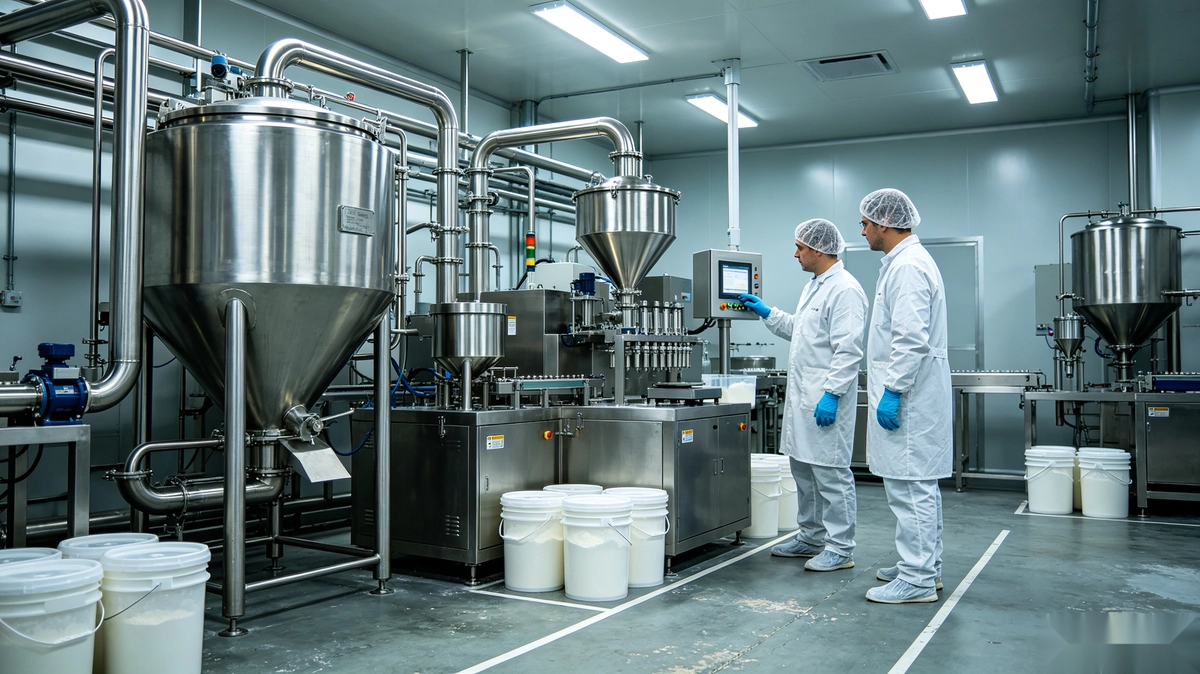
Supplement tableting contract manufacturing is an outsourced production arrangement in which a manufacturer converts an approved or newly developed supplement formula into commercial tablets. The scope may include formula review, blending, granulation, compression, coating, testing, packaging, and batch documentation.
For a brand, however, the first question is not whether a factory owns a tablet press.
It is whether the proposed formula can become a practical, repeatable product.
Can the Formula Become a Practical Tablet?
A product brief usually begins with ingredients, dosage, serving size, and target claims. A manufacturing review has to go further.
The factory must consider how much material will fit into each tablet, how the blend behaves during feeding and compression, whether the tablet can survive coating and packaging, and whether the finished size is reasonable for the intended consumer.
A tablet may be technically possible and still be commercially unsuitable.
The Dose Has to Fit More Than the Label
The active ingredients are only part of the finished tablet.
Most formulas also require some combination of fillers, binders, disintegrants, lubricants, and flow aids. Chewable tablets may need flavors, sweeteners, and taste-masking ingredients. Coated tablets require additional material after compression.
These ingredients are functional. They help the blend move through the equipment, form a stable tablet, release from the tooling, and break down as specified.
The difficulty becomes obvious in high-dose formulas.
A mineral blend, botanical powder formula, amino acid product, or multi-ingredient tablet may already contain a substantial active load. Once the necessary excipients are added, the proposed one-tablet serving may become too large or too thick for comfortable use.
Calcium and magnesium formulas make this tradeoff easy to see: two products can target similar elemental amounts yet require very different raw-material weights depending on the mineral forms used.
At that point, the development team has several choices:
- Divide the serving into two or more tablets
- Reduce the dose
- Use a more concentrated raw material
- Remove lower-priority ingredients
- Change the dosage form
This decision belongs at the beginning of development.
Trying to preserve an unrealistic one-tablet serving often leads to repeated formula adjustments without solving the underlying size problem.
Powder Behavior Determines Production Stability
A tablet press depends on consistent die filling.
When the blend does not move evenly through the feed system, the amount entering each die can change. That variation may later appear as inconsistent tablet weight, thickness, hardness, or active content.
Poor feeding can be caused by fine or irregular particles, large density differences, electrostatic behavior, moisture uptake, cohesive extracts, or segregation within the blend.
The powder must also form a stable compact under pressure.
A difficult formula may produce tablets that are soft, brittle, capped, laminated, rough, or marked by material sticking to the punch face. Increasing compression force does not automatically solve these problems. It may improve hardness while slowing disintegration or creating more stress during ejection.
This is why the complete blend must be evaluated. The name of the main active ingredient does not tell the factory how the formula will run.
Research into direct-compaction tablet manufacturing likewise identifies powder flow during blending, material transfer, die filling, and compression as a central part of process performance.
Moisture, Heat, and Taste Can Change the Manufacturing Route
A blend that cannot be directly compressed may need granulation. That introduces a different set of risks.
Wet granulation adds liquid and is followed by drying. This may be unsuitable for ingredients that are sensitive to moisture or heat.
Dry granulation avoids adding liquid, but it still changes the physical structure of the material. The resulting granules may have different density, flow, and compression characteristics from the original powder.
Hygroscopic ingredients require particular attention. Moisture absorbed during manufacturing or storage can affect feeding, tablet hardness, surface appearance, coating performance, and shelf stability. The product may need environmental controls during production and more protective packaging afterward.
Taste is another practical limitation.
A swallow tablet can hide some unpleasant flavors, especially when coated. A chewable tablet cannot. Botanical extracts and minerals may contribute bitterness, metallic notes, astringency, or a lingering aftertaste. Adding more flavor and sweetener increases the total tablet weight and may also change compression behavior.
The product has to work on the press and for the consumer.
Direct Compression or Granulation?
Direct compression is often the simplest route, but it is not a default choice.
The process should be selected after reviewing the raw materials and testing the blend.
| Production route | Typically considered when | Main trade-off |
|---|---|---|
| Direct compression | The blend already feeds and compresses consistently | Fewer steps, but highly dependent on raw-material and excipient properties |
| Dry granulation | Flow needs improvement and the formula should avoid liquid processing | Adds mechanical processing and can change compaction behavior |
| Wet granulation | The blend segregates, feeds poorly, or does not form a stable tablet | Can improve processing consistency but adds moisture, drying, and more controls |
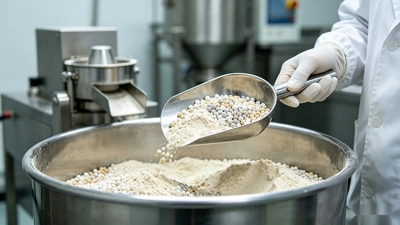
Two formulas with the same label claim may require different routes.
Particle size, extract carrier, ingredient supplier, bulk density, moisture level, and excipient grade can all change production behavior. Replacing one botanical extract with another source may alter the way the entire blend feeds and compresses, even when the declared dosage remains unchanged.
The manufacturer should be able to explain why it recommends direct compression, dry granulation, or wet granulation.
A process decision made from the ingredient list alone is not a meaningful feasibility assessment.
What Trial Tableting Should Prove
Trial tableting should do more than produce a handful of visually acceptable samples.
Its purpose is to determine whether the formula can be controlled.
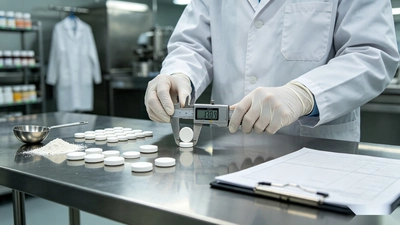
The team should observe whether the blend feeds consistently, whether tablet weight remains stable, whether the tablets release cleanly from the tooling, and whether hardness can be achieved without creating unacceptable friability or disintegration.
The trial should also expose visible press problems such as sticking, picking, capping, lamination, edge damage, or surface defects.
Results may lead to changes in the lubricant level, binder system, granulation route, tablet diameter, compression setting, coating plan, or serving count.
Those changes should be documented before commercial production. A trial sample approved only by appearance is not a finished technical specification.
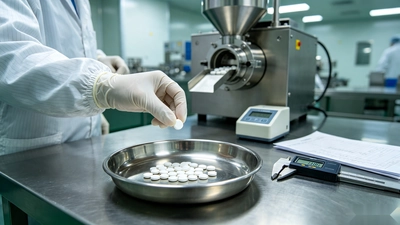
A Short Trial Is Not the Same as Scale-Up
Some problems appear only after the press has been running for a longer period.
Material may gradually build up on the tooling. Powder flow can change as the hopper level falls. Tablet weight may begin to drift. A larger blending cycle may not behave exactly like the development batch.
Production speed matters as well.
A formula that runs acceptably only at a very low press speed may be technically feasible but commercially inefficient. That can affect lead time, cost, and consistency over the full batch.
The trial therefore needs to answer two different questions:
- Can this blend form an acceptable tablet?
- Can the process remain stable under realistic commercial conditions?
The second question is usually the more important one.
Agree on Quality Responsibilities Before Production
Contract manufacturing divides work between the brand and the factory, but it should not leave quality responsibilities unclear.
Before raw materials are purchased or commercial production begins, both sides should be working from the same approved technical information.
| Item to confirm | What should be agreed |
|---|---|
| Formula version | Ingredients, dosage, excipient system, serving size, and approved revision |
| Raw-material requirements | Supplier, grade, extract ratio, carrier, particle characteristics, or other critical attributes |
| Product specification | Test items, methods, limits, physical requirements, and packaging configuration |
| Changes | Which formula, supplier, process, or packaging changes require brand approval |
| Deviations and failed results | Investigation, material hold, communication, and disposition responsibilities |
| Label and artwork | Approved text, Supplement Facts, lot coding, expiry coding, and packaging version |
| Batch release | Required records, COA format, review responsibilities, and final release authority |
| Post-market support | Reserve samples, complaints, returns, traceability, and recall communication |
A signed purchase order does not replace an approved formula and product specification.
The formula should be identified by version. The packaging should be identified by an approved artwork revision. Test methods and acceptance limits should be understood before results are generated.
Supplier changes deserve particular attention.
Two materials may share the same ingredient name while differing in extract ratio, carrier, particle size, density, moisture, or processing behavior. A substitution that appears minor to purchasing may affect both tablet production and finished-product specifications.
The contract or quality agreement should define which changes the factory may manage internally and which require written approval from the brand.
For early-stage projects that still need formulation, sampling, packaging coordination, and production planning, the responsibilities may be handled through a broader OEM and ODM supplement manufacturing process.
In-Process Control and Finished-Batch Release
Quality control begins before the laboratory tests the finished tablets.
The commercial batch should start from an approved specification that defines the formula, tablet description, relevant physical requirements, chemical and microbiological limits, packaging configuration, and release responsibilities.
Production then has to remain within that approved framework.
Monitoring the Compression Run
In-process controls help the operator detect changes while the batch is still running.
Depending on the product and approved procedure, these controls may include tablet weight, thickness, hardness, appearance, press performance, disintegration checks, and foreign-material controls where applicable.
The numbers are useful only when there is a defined response to an abnormal result.
When a result moves outside the approved range, the affected material should be identified and controlled. The issue may require an equipment adjustment, material hold, documented investigation, additional sampling, or quality review.
Operators should not simply change the process until the number returns to normal without recording what happened.
Finished-Product Verification
Finished-product verification depends on the formula, market, specification, and agreed quality plan.
It may involve identity, assay or potency, composition, microbiological limits, heavy metals, other relevant contaminants, tablet properties, and packaging verification.
The verification strategy does not have to be identical for every tablet product. It should be appropriate for the specific formula and supported by scientifically valid methods, component controls, process controls, and finished-product testing as applicable.
For dietary supplements manufactured for the United States, FDA’s dietary supplement CGMP guidance addresses specifications for components, in-process production, packaging and labels, finished batches, production records, and quality-control review.
Completion of manufacturing does not constitute batch release.
Final disposition should be documented and performed by authorized quality personnel after the required records, results, deviations, packaging information, and label controls have been reviewed.
The COA Is Part of the Evidence, Not the Entire System
A buyer-facing COA should identify the correct product and batch, show the approved specification and actual result, and remain traceable to the applicable test method and quality release record.
It should not be treated as a substitute for batch records, deviation handling, supplier controls, or quality review.
Buyers who are reviewing their documentation requirements can refer to this guide on what a supplement COA should include.
The factory and buyer should also agree in advance on which documents will be provided with the shipment. Internal manufacturing and investigation records may remain within the factory’s controlled quality system, while the customer receives an agreed release package.
That distinction should be clear before production, not discussed after the batch is finished.
How to Evaluate a Tablet Contract Manufacturer
A long equipment list does not show how a factory manages a difficult batch.
The most useful supplier questions focus on decisions, changes, and problems.
| Question | What a useful answer should show |
|---|---|
| How do you decide whether a formula is suitable for tableting? | The factory reviews dose, tablet size, raw-material behavior, and process risk |
| What happens when an in-process result is outside range? | Affected material is controlled and the issue is documented and reviewed |
| How are formula or process changes approved? | Changes are traceable and approval responsibilities are defined |
| How are raw-material supplier changes handled? | Critical changes are assessed rather than treated as purchasing substitutions |
| Who releases the finished batch? | Release is an authorized quality decision |
| What happens when scale-up differs from the trial? | The factory has a defined investigation and adjustment process |
| How are cleaning and line clearance controlled? | The facility addresses mix-up and cross-contact risks |
| Which records will the brand receive? | Documentation expectations are agreed before production |
A credible manufacturer may not confirm every request during the first discussion.
It may need the proposed dose, raw-material details, tablet size, target market, and packaging requirements before deciding whether the project is practical.
That is usually a better sign than an immediate promise that any formula can be made exactly as proposed.
Certificates still matter, but they should be reviewed by scope, issuing body, validity, and relevance to the project. They do not replace a discussion about specifications, deviations, supplier changes, traceability, and batch release.
What to Send for a Feasibility Review
A manufacturer cannot prepare a meaningful proposal from a product name alone.
The initial brief should include:
- Target ingredients and dosage
- Proposed serving size
- Tablet format
- Target sales market
- Preferred packaging
- Expected initial quantity
The brand should also state whether it has a finished formula, a reference product, or only an ingredient concept.
These details help the factory judge tablet size, likely production route, development requirements, testing scope, and commercial feasibility.
MOQ should be discussed in the context of the complete project. Raw materials, manufacturing batches, tooling, coating, bottles, labels, cartons, and printed packaging may have different minimums. Creating another dosage, bottle count, or label version may create a separate SKU rather than a small variation of the original order.
The guide to supplement MOQ requirements explains why a quoted bottle minimum does not always represent the full project minimum.
When a Tablet May Not Be the Right Format
Some formulas should not be forced into tablets.
A high-dose powder may require a tablet that is too large for the intended consumer. A blend with poor compression behavior may need so much excipient that the serving becomes impractical. A formula containing a large proportion of oil-based ingredients is usually better suited to another dosage form.
Chewable tablets can also fail at the consumer stage. Adding more flavor and sweetener will not always overcome the bitterness or metallic taste of the active ingredients.
Effervescent tablets require a separate development approach. Moisture control, dissolution performance, flavor, packaging protection, and tube compatibility need to be considered from the beginning.
Changing the dosage form is not a compromise when the alternative produces a more stable, usable product.
Final Thoughts
Supplement tableting contract manufacturing begins long before the commercial batch reaches the press.
The formula must fit into a practical tablet. The powder must feed and compress consistently. Trial work must show more than a good-looking sample. Specifications, change controls, documentation, and release responsibilities must be agreed before production.
A reliable contract manufacturer should be willing to question an impractical serving size, explain why granulation may be necessary, identify the limits of a short trial, and define what evidence is required before the finished batch can be released.
Brands preparing a tablet project should send the ingredient list, dosage, serving size, target market, tablet format, packaging requirements, and expected quantity for review.
Jiabei Health’s tablet supplement manufacturing services cover formula assessment, trial planning, compression, coating, packaging, quality documentation, and commercial production.
A useful quotation should begin with a feasibility review—not only a requested price per bottle.